
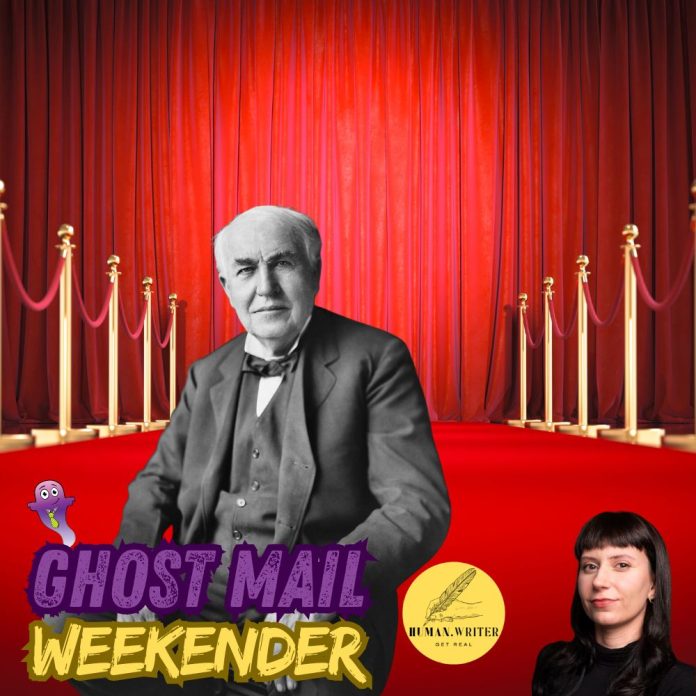
Thomas Edison wanted to own American film. Instead, through essentially operating a cartel, he drove it 5,000 kilometres west and gave the world Hollywood.
In 1886, a devout couple from Kansas bought 49 hectares of farmland northwest of Los Angeles and named it Hollywood. Their dream was to grow figs and build a sober, God-fearing community of like-minded Christians. It is one of history’s better jokes that this particular patch of earth would instead become the global byword for vice, glamour, and manufactured dreams… and that the man most responsible for its transformation never wanted it to happen.
That man was Thomas Edison. And to understand how the inventor of the light bulb accidentally founded the movie capital of the world, we have to start with a running horse.
A racehorse, a shutter, and the birth of an industry
In 1872, photographer Eadweard Muybridge (yes, that’s the right spelling) was determined to help the governor of California, Leland Stanford, with an irritating problem. Stanford owned a racehorse and wanted it photographed in motion, but was frustrated that every picture taken of the horse failed to capture its speed clearly. The primitive cameras of that age could only translate a galloping horse’s legs into motion blur. Muybridge experimented with faster mechanical shutters for his camera, and eventually set up a row of 12 cameras next to the racetrack. The result was not just one clear image of a running horse, but a sequence of 12.
Inspired by his results, Muybridge loaded the images into a device he called a zoopraxiscope (essentially a hand-cranked round projector) and with the turn of a handle, shattered the wall between still and moving images.
Muybridge’s trick of stitching stillness into motion sent inventors everywhere scrambling to build devices that could do the same thing better.

Thomas Edison, characteristically, was among the first to get there. But here it’s worth pausing on who Edison actually was, because the popular image we have of the man – kindly genius, friend to mankind, the man who lit up the world – is really only half the story.
The other half
Thomas Alva Edison was a titan of invention, and that’s not an overstatement. The phonograph, the motion picture camera and the electric light bulb all came out of his laboratories and reshaped the industrialised world. He more or less invented the modern research lab itself, gathering teams of researchers under one roof in Menlo Park, New Jersey. By the end of his life he held 1,093 US patents.
All that success was not won by being a pushover. Edison was shrewd, fiercely competitive and, by most accounts, not someone you wanted as an enemy.
Some of the texture of his character showed up early. At the age of 15, he saved a child from being struck by a runaway train. The child’s father was so grateful that he trained Edison as a telegraph operator. Edison began working as a telegrapher in a local general store before moving to Stratford Junction, Ontario, where he worked as a night telegrapher for the Grand Trunk Railway.
As a night telegrapher, he was supposed to be awake and alert. Instead, he would tire himself out by running chemistry experiments on the job and then sleeping through his shifts. After causing a near-collision of two trains, he decided it was time to put the telegraph behind him and set his sights on something bigger. The boy who cut corners on the night shift would grow into a man with a very particular attitude toward rules.
The camera and the prize behind it
Decades of invention and reinvention passed. By 1888, Edison had established himself as a household name and made a fortune in the process. While running an experimental mining operation, his mind turned to moving pictures. He set his employee William Kennedy Laurie Dickson (a miner who happened to be a gifted photographer) to work on a machine that would “do for the eye what the phonograph does for the ear”.
Edison handled the electromechanical side, while Dickson did the hard optical and film work. By 1891 they had a working prototype (publicly demonstrated that May) and eventually a patent for the motion picture camera Edison called the Kinetograph. Edison’s name went on it, but most of the actual credit (historians agree) belonged to Dickson. This is a pattern that would repeat multiple times over the course of Edison’s life.
But the camera wasn’t even the prize Edison wanted. His real obsession was synchronised sound. He dreamed of a machine that would record picture and audio together and play them back in unison. Dickson shot the first sound film, starring himself, in the spring of 1890. But keeping picture and sound aligned proved maddeningly difficult, and Edison, ever the businessman, shelved the concept.
Instead he built the Kinetoscope, a peephole viewer that let one person at a time watch a short, silent film for a penny, and installed the machines in arcades.
By this point he had invented the camera and the “screen”, but what about the content? Well, naturally Edison had an answer for that too. In 1893, he built America’s first film studio in New Jersey – a cramped, tar-papered black box that the staff nicknamed “Black Maria”. Out of it came nearly 1,200 short films featuring acrobats, parades, a fire crew answering a call, a man sneezing (Fred Ott’s Sneeze, 1894), a couple kissing (The Kiss, 1896), and eventually the first-ever Frankenstein film in 1910.
Edison had not just helped invent the movie camera. He had built the first factory for making movies. He was, for a brief moment, the entire American film industry.
And he intended to keep it that way.
The Trust and the men with the lead pipes
In 1908, Edison gathered the major patent holders in the budding film industry into a single conglomerate: the Motion Picture Patents Company, known to everyone as the Edison Trust.
On paper it was nine studios pooling their patents. In practice it was a cartel with a chokehold on every essential piece of the filmmaking process, from cameras to raw film stock. If you wanted to make a movie in America, you went through Edison, or you got buried in lawsuits. Universal Studios alone fielded 289 separate legal complaints.
Where the courts weren’t enough, the Trust got creative. The MPPC was not above hiring mobsters to pay visits to filmmakers working outside its blessing, intimidating them and destroying their cameras. The courts of the eastern United States, meanwhile, seemed perfectly content to enforce the monopoly. Edison had become the king of the movies, and he ruled the way kings often do: with lawyers in the front and muscle in the back.
How to escape a king
If you were an independent filmmaker around 1910, working with equipment you technically had no right to use, New York was hostile territory. It sat right next to Edison’s headquarters and crawled with his agents, who had a habit of showing up to seize or destroy cameras mid-shoot.
Los Angeles, by contrast, had everything a fugitive industry could want. The weather allowed year-round filming. The landscape offered deserts, mountains, ocean, and ranchland within a day’s drive, so a studio could fake almost any setting on Earth. Land was cheap, labour was mostly non-union, and locals threw incentives at anyone willing to set up shop. As an added bonus, Californian courts seemed less enthusiastic about Edison’s filmmaking monopoly and less likely to blindly sway in his favour.
The pioneers trickled in and then poured. William Selig opened a studio in Echo Park in 1909. In 1911, a New Jersey producer named David Horsley founded the first studio inside the little farming hamlet that the fig-farming Wilcoxes had named Hollywood. Others stampeded after him, clustering together into what they called a “movie colony”. A rural community of 5,000 souls in 1910 swelled to 35,000 by 1920. By 1915, three out of every five American films were being made in Hollywood.
The king dethroned
The monopoly didn’t last either. In 1913, William Fox joined the owners of Paramount and Universal in bringing a complaint to the US government, arguing that the Edison Trust violated the Sherman Anti-Trust Act. The government agreed. In 1915 the court found that the MPPC was an illegal conspiracy in restraint of trade, and in 1917 the Supreme Court ordered it disbanded entirely. The cartel was broken, but by then the damage, from Edison’s point of view, was permanent. The filmmakers he had hounded out of New York had built something almost 5,000 kilometres away that no patent could touch.
That’s the story of how Thomas Edison – genius inventor, but also patent bully, monopolist, and employer of hired thugs – was probably the single biggest individual influence on the existence of Hollywood as we know it. Had he been a more generous man, a fairer competitor, or simply content to share the industry he helped create, there’s a good chance the film capital of the world would today be a stretch of West Orange, New Jersey, and Hollywood would be just another sleepy suburb of Los Angeles, perhaps still growing figs.
About the author: Dominique Olivier


Dominique Olivier uses her love of storytelling and ideation to help brands solve problems.
Her first book, Lessons from Loss, has been published by Penguin Random House.
She is a weekly columnist in Ghost Mail and collaborates with The Finance Ghost on Ghost Mail Weekender, a Sunday publication designed to help you be more interesting.
You can learn more about her work at dominiqueolivier.com and she can be reached on LinkedIn here.


Thanks. Well told and interesting story. I sometimes skip ghost mail, but Never on a Sunday.
Very interesting Domique and well told as always.