
In this edition of Ghost Bites:
- Adcorp is ready for its growth phase – in theory, at least
- Lewis is one of South Africa’s best businesses
- Life Healthcare is growing, but it’s no thrill ride
- Sappi probably needs a miracle
- Sirius Real Estate is buying another German property
- Trematon shows how hard it is to make money from schools
Adcorp is ready for its growth phase – in theory, at least (JSE: ADR)
But with revenue declining, will they get it right?
Adcorp has released results for the year ended 28 February 2026. Despite a 5.9% decrease in revenue, the group managed to increase HEPS by 13.0%!
They say that they’ve moved from a strategy of recovery and stabilisation to a strategy of growth. We will hopefully see that in the revenue story moving forwards, as there’s zero evidence here of top-line growth.
The result was saved through a combination of slightly higher gross margin (from 9.8% to 9.9%) and a significant reduction of 7.3% in operating expenses. This helped operating profit increase by 3.3% (despite the revenue issues). This clearly isn’t a sustainable way to grow, but it does put a Band-Aid on the underlying wound.
Cash generated from operations went the wrong way thanks to working capital pressures. They still have a solid cash balance, but will need to be careful here. To their credit, the final dividend is 6.2% lower than the prior year, so they aren’t stubbornly pushing a higher dividend while the balance sheet has taken a knock.

Ghost Bite: Declaring a growth phase is brave, particularly after reporting a decline in revenue. The share price has been flat over 12 months, with a juicy dividend yield paying investors to wait around for a turnaround. The total return over three years is a solid 78%, showing just how important the dividend can be.
Lewis is one of South Africa’s best businesses (JSE: LEW)
They really have figured things out in this market
Lewis has reminded the market that they are running one of the best businesses in South Africa. I’m hesitant to refer to them as purely a retailer, as the lending component is integral to the business model. Lewis is more like a lending business that uses furniture as a reason to transact with customers.
It works, as demonstrated by the results for the year ended March 2026. Merchandise sales increased 7.3% to R5.5 billion and other revenue was up 15.7% to R4.9 billion. See what I mean about the hybrid business model?
Blended revenue was up 11.1% and gross profit margin improved by 30 basis points to 43.7%. This boosted operating profit by 12.8%, and HEPS by a delicious 18.3%. Very impressive stuff!
Return on equity is up from 15.4% to 16.2%, so Lewis is giving local banks a run for their money on this key metric.
Having just executed the highest number of new store openings in a single year (58 net new stores), Lewis is on a charge. With comparable store sales growth of 4.8%, I doubt investors will complain about the store rollout strategy. A further 40 stores are planned for the 2027 financial year.
Net borrowings have increased at the group due to the need to fund the debtors book and store expansion. Again, with solid return on capital, that’s not an issue provided the overall gearing ratios remain in a healthy range.
The total dividend was up by 12.1% for the year to 891 cents per share. They are paying out 55% of HEPS as a dividend, with the other 45% being retained for growth.
This puts Lewis on a dividend yield of over 10%, while the underlying business is casually growing at a high-teens rate. That’s pretty hard to beat.
Ghost Bite: This is another perfect example of a company focusing on a core strategy and executing it to a high standard. It’s funny how Lewis doesn’t feel the need to run off and do deals in Europe, accompanied by flashy PowerPoint presentations and advisors in nice suits.
Life Healthcare is growing, but it’s no thrill ride (JSE: LHC)
The revenue growth outlook is of concern
Life Healthcare isn’t quite the growth story that we are seeing at sector rival Netcare (JSE: NTC). For the six months to March 2026, Life Healthcare only managed revenue growth of 2.4% and a modest increase in normalised EBITDA margin.
The earnings per share numbers were severely impacted by the fair value adjustment on the Piramal liability related to the disposal of Life Molecular Imaging. I’m happy to go with management’s suggestion to use normalised EPS from continuing operations, which increased by 8.4% in this period.
This isn’t a bad number in isolation. After all, it’s a growth rate that is well ahead of inflation, with Life managing to achieve this growth with a defensive business model.
The outlook is a worry though, as the 12 months to September 2026 are only expected to see growth of around 2%. With inflation and now higher interest rates to worry about as well, that doesn’t sound encouraging for earnings growth.
Ghost Bite: This isn’t a sector that I’m usually keen to invest in. Interest rates in South Africa are high enough that I don’t need to take equity risk on defensive stocks that offer low growth. If I want risk, I can find it elsewhere. If I want a defensive profile, I can find that elsewhere as well. This is a personal choice, of course.
Sappi probably needs a miracle (JSE: SAP)
But in the meantime, they have a deal in Europe
Sappi is desperately in need of some positive news to address the extraordinary slide in the share price. Just look at this chart and pay particular attention to the timeline on the x-axis:
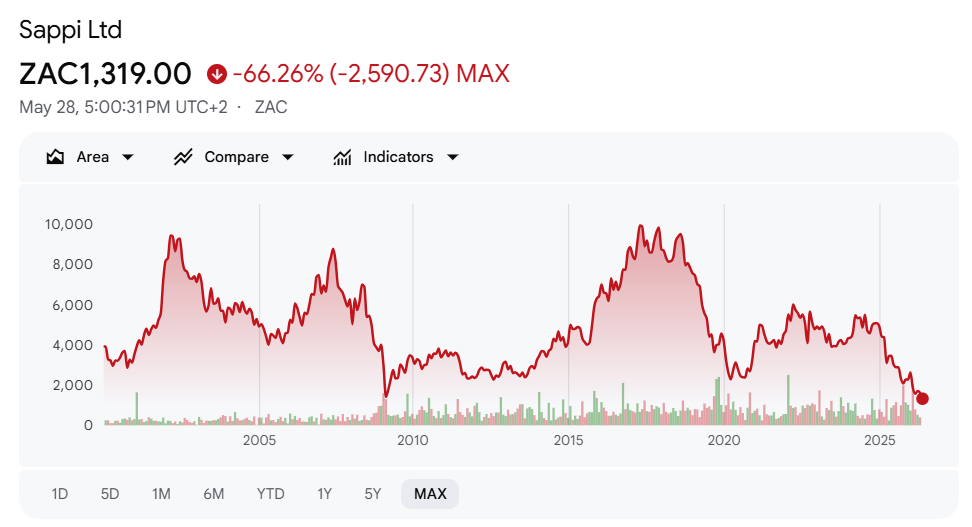
Yes, the share price is at the same levels we saw in the Global Financial Crisis (GFC) in 2008/2009! This is what a cyclical stock can look like.
The problem for Sappi is that the world is a lot more digital than it was during the GFC, so the argument of “this time, it’s different” might be appropriate here. If so, there’s no guessing where the bottom might be.
To respond to a changing world, Sappi is putting in place various steps including a joint venture with UPM-Kymmene Oyj. We knew about the deal already, but now we have a detailed terms announcement to consider.
This deal combines Sappi’s European graphic paper business with UPM’s communication papers business in Europe, the UK and the US. They will own this corporate equivalent of polony on a 50-50 basis.
Sappi acknowledges in the announcement that the graphic paper industry has been in “structural decline” for “decades” thanks to digitalisation. Capacity in the sector has been reduced, but there’s still too much of it.
By combining with UPM’s businesses, they believe that the joint venture can unlock synergies of at least €100 per annum – a suspiciously round number if ever I’ve seen one.
The pressure on the graphic paper business is clear in the valuations. Sappi’s business has an enterprise value of €320 million, while the UPM businesses are much higher at €1.1 billion. To balance everything out and create a 50-50 joint venture, the newly formed venture will raise external debt and pay Sappi and UPM €90 million and €475 million respectively.
From an accounting perspective, this means that they will move from consolidating this business to equity accounting it. That will help group margins, but thanks to accounting techniques rather than major operating improvements.
It also means that dividends won’t be paid by the joint venture until shareholder loans have been settled. They will need to put a lot of effort into creating a sustainable balance sheet.
They still have some regulatory hoops to jump through (this is Europe, after all). The European Commission is busy with a Phase II investigation and has until 26 October to make a decision. They aren’t exactly famous for applying a rational economic lens to anything they do in that neck of the woods, so any outcome is possible.
Sappi shareholders will also need to vote on the deal. A circular is expected to be released by the end of June.
Ghost Bite: The share price may have closed 4.6% higher on the day, but it’s down 46% year-to-date. These are desperate times at Sappi and it will take a lot more than just this deal to rescue the share price.
Sirius Real Estate is buying another German property (JSE: SRE)
It won’t come as a surprise to you that it’s in the defence sector
The podcast that I recorded with the leadership team at Sirius Real Estate at the end of 2025 is as relevant as ever. They walked me through their acquisition strategy in Germany and the UK. Listen to it below or check out the transcript here.
This is important context to the latest transaction: the acquisition of a light industrial business park in Fulda, Germany, for €49.8 million. The anchor tenant is a leading European manufacturer of ballistic protection equipment.
This fully let property has a net initial yield of 7.8%. The anchor tenant is 78% of the rent roll and is looking to take additional space as it becomes available, so this will eventually be closer to a single-tenant building.
This deal isn’t a surprise in terms of the sector of the underlying tenant, but other elements are slightly out of character for Sirius. Unlike most of their deals, this one doesn’t seem to offer much potential upside from active management of the property. The yield is also lower than most of the recently acquired assets, with the blended gross yield on recent deals now sitting at 8.9%.
Ghost Bite: Not every deal needs to be a hero on a standalone basis. This is still a sensible strategic fit for Sirius. They just need to be careful not to dilute their reputation for successful active property management. After all, they’ve worked hard for it!
Trematon shows how hard it is to make money from schools (JSE: TMT)
Will they achieve a price in line with the external valuation?
Trematon Capital’s numbers for the six months to February 2026 look strange due to the classification of discontinued vs. continued operations. The company is following a value unlock strategy to return capital to shareholders.
Club Mykonos Langebaan and Generation Education have both been put into the discontinued operations bucket. The progress on disposing of Club Mykonos is far further down the road than the negotiations on Generation Education.
The intrinsic NAV per share of 151 cents owes more than half of its existence to this proposed value for Generation Education. The share price is taking a more conservative view, trading at 108 cents per share.
The big focus is clearly on whether they will get their price for Generation Education. It’s not an easy business – for the six months to February, it made profit before finance costs of R12 million from revenue of R113 million.
It’s a highly leveraged structure, with finance costs of R11.2 million that take profit down to almost nothing. With an asset base of R393 million, this is a reminder that schools are a capex-intensive business with dicey return on capital metrics.
An independent valuation has put the schools on a value of R191 million. That feels like a very big number. I get the point around existing facilities etc. but assets are only worth the cash flows they can produce. There’s a reason why Curro has now moved into a non-profit structure.
Ghost Bite: I can’t wait to see who the buyer of Generation Education will be. I would be very surprised if it’s an investor with purely a profit motive.
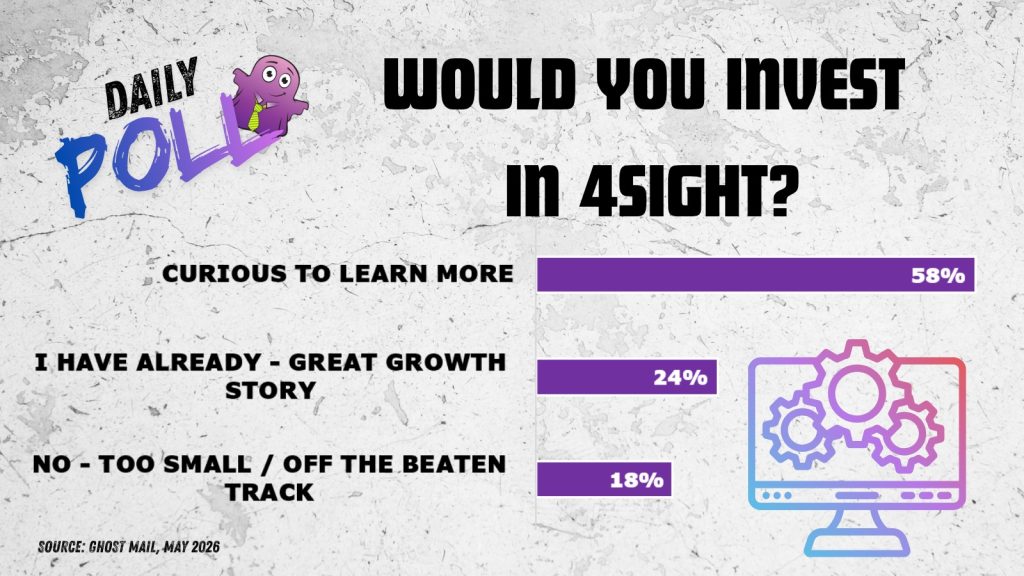
Results of previous poll:
Nibbles:
- Director dealings:
- There’s been significant selling by top executives at Advtech (JSE: ADH). A total of R11 million in shares has been sold by four execs.
- A director of Master Drilling (JSE: MDI) has sold shares worth around R8.6 million.
- Two directors of MAS (JSE: MSP) have sold ordinary shares, but the price will only be determined in future based on the PK Investments preferred shares.
- Jubilee Metals (JSE: JBL) has raised $1.5 million via an unsecured convertible loan note. This cash from an external investor is earmarked for the accelerated development of the greater Molefe region. This will help Jubilee unlock the near-surface opportunities at Molefe, with a potential further investment of $10 million on a staggered basis. Mezzanine structures like these are interesting, as they have elements of both debt and equity. The investor gets downside protection and upside participation, while Jubilee gets access to funding that usually isn’t available through other structures like senior debt. This will require a shareholder vote, so a circular will be released soon. They need a boost at Jubilee, as the share price has been on a nasty downward trajectory.
- Here’s some good news for shareholders in Araxi (JSE: AXX): the acquisition of Pay@ has been concluded as all of the conditions precedent have been fulfilled.
- It didn’t take long for CA&S (JSE: CAA) to close the acquisition of 71.19% in Sunpac, a leading South African route-to-market player that fits in beautifully with the broader group strategy. Having announced the deal in early March, they’ve received all regulatory approvals and concluded the transaction.
- Copper 360 (JSE: CPR) released an updated trading statement for the year ended February 2026. Things are better than before, but they are still firmly in a loss-making position. The expected headline loss per share is 18.49 cents to 20.44 cents per share. That’s an improvement of between 40% and 45% vs. the previous headline loss per share of 33.82 cents. I must note that part of the improvement is that there are far more shares in issue than in the prior year. When you’re making losses, it’s better for shareholders if the loss is spread across more shares!
- Africa Bitcoin Corporation (JSE: BAC) is doing what it now says on the tin. They’ve invested another R628k in bitcoin. I remain concerned that this is being funded by debt, even if the interest rate is below 5% per annum. They’ve now invested a total of R8.5 million in bitcoin at an average price of R1.53 million per BTC. The current price is significantly lower at R1.19 million per BTC.
- Wesizwe Platinum (JSE: WEZ) is trying to get its house in order in terms of financial reporting. The goal is for the suspension of shares to be lifted after the release of the integrated annual report (for the year ended December 2025!) in June 2026. Let’s hope there are no further headaches.


Here we go again – Jubilee issuing shares again. Very poor and unreliable management