

Some mysteries survive not because they’re clever, but because the truth is so simple that nobody wants to believe it.
You’ve heard about artificial intelligence, sure. In fact, by now you’re probably a bit sick of hearing about artificial intelligence. But what about artificial artificial intelligence?
It sounds like a joke, but this is a real thing: people are being paid to do menial jobs that artificial intelligence can’t quite get right yet – things like labelling images, transcribing, and answering survey questions. A business might want their customers to think that these tasks are being performed by an advanced AI agent, while secretly farming the job out to low-paid, human workers, mostly in third-world countries.
Perhaps the most famous example of this is Builder.ai’s “AI agent”, Natasha, who promised to build a fully-functioning app based on only a user description. As it turns out, Natasha was just a front. Investigations revealed that most of the work was actually done by human engineers – about 700 of them, primarily based in India. The “AI” part mainly involved routing tasks to these engineers and occasionally using large language models to generate boilerplate code. As the joke goes, the AI in this instance stands for Actual Indians. In case you’re wondering, the company has since filed for insolvency.
Amazon saw this gap in the market a long time ago and swooped in to monetise. They’ve been offering a service called Mechanical Turk, or MTurk for short, since 2005. Similar in some ways to TaskRabbit, MTurk is essentially a job platform that lets companies farm out little scraps of digital work to a vast crowd of people online. Each is paid a few cents to do a task a computer can’t quite manage on its own. The result is work that looks automated, but is actually being done by a person.
Mechanical Turk is a strange name for a piece of modern software, and it isn’t an accident. To understand where it comes from, we need to talk about a chess-playing robot that fooled Europe for the better part of a century.

Enter the Turk
The late 1700s were the golden age of the automaton – not a typo, but rather an intricate clockwork machine built to mimic living things. Inventors across Europe were producing mechanical ducks that appeared to eat and digest grain, mechanical boys that could dip a pen and write a sentence, and mechanical musicians that played real instruments with eerie little fingers.
Automatons were the must-have spectacles of the age. They drew gasps at royal courts and emptied the purses of the wealthy. In 1769, a Hungarian inventor named Wolfgang von Kempelen watched a magician perform at the court of Empress Maria Theresa and was distinctly unimpressed. He announced he could do better, and promised to return within a year with something that would put the illusionist to shame. This is the kind of confident statement that tends to set people up for failure, but Kempelen delivered.
What he brought back in 1770 was a life-sized model of a man – bearded and dressed in Ottoman robes and a turban – seated behind a large wooden cabinet with a chessboard on top. In its left hand it held a long Ottoman smoking pipe, while its right hand rested near the edge of the board, ready to move.
Kempelen would begin each show by theatrically opening the cabinet’s doors and drawers, revealing a dense thicket of gears and cogs, letting the audience peer right through the machine. Nothing in here but honest machinery, the gesture said. Then he’d announce the Turk was ready to play, and invite a challenger forward.
The Turk would consider the board, lift its wooden arm, and move its pieces. It nodded when it threatened your queen. It shook its head disapprovingly if you tried to cheat; one challenger deliberately made an illegal move with his queen, and the Turk promptly picked the piece up and put it back where it belonged, declining to dignify the attempt. And then, with grim and unfailing regularity, it beat you. Usually within half an hour.
A long and undefeated career
People lost their minds, in the polite eighteenth-century manner. One elderly woman at an early showing was so convinced the machine was possessed by an evil spirit that she hid in a window seat as far from it as she could get. More resourceful minds set themselves to working out the trick, and produced a magnificent body of theories, most of them wrong.
Some thought Kempelen was guiding the arm with a magnet (he cheerfully invited spectators to place their own magnets on the cabinet, which did nothing). Some thought there were wires thinner than a hair controlling the Turk from above, like a puppet. Edgar Allan Poe, who saw the Turk decades after it was introduced, wrote a famous essay concluding that a man must be folded up inside the figure itself – wrong, but beautifully argued.
The marvel could not be beat, and the machine even outlived its inventor. After Kempelen died, it was bought by a showman named Johann Mälzel (the same man who popularised the early metronome), who toured it relentlessly and even gave it a voice box so it could rasp “Échec!” when it put you in check.
Over its long career the Turk beat, among others, Napoleon Bonaparte (who reportedly tried to cheat, had his pieces swept off the board for his trouble, and rather enjoyed it) and played Benjamin Franklin, who remained fascinated by the thing for the rest of his life. For more than eighty years, across two continents, the wooden Turk defeated statesmen, aristocrats and grandmasters while Europe argued about how on earth it could possibly work.
The man in the box
The true answer, of course, was the most boring one available. There was a person inside, just not in the figure (as Poe suggested).
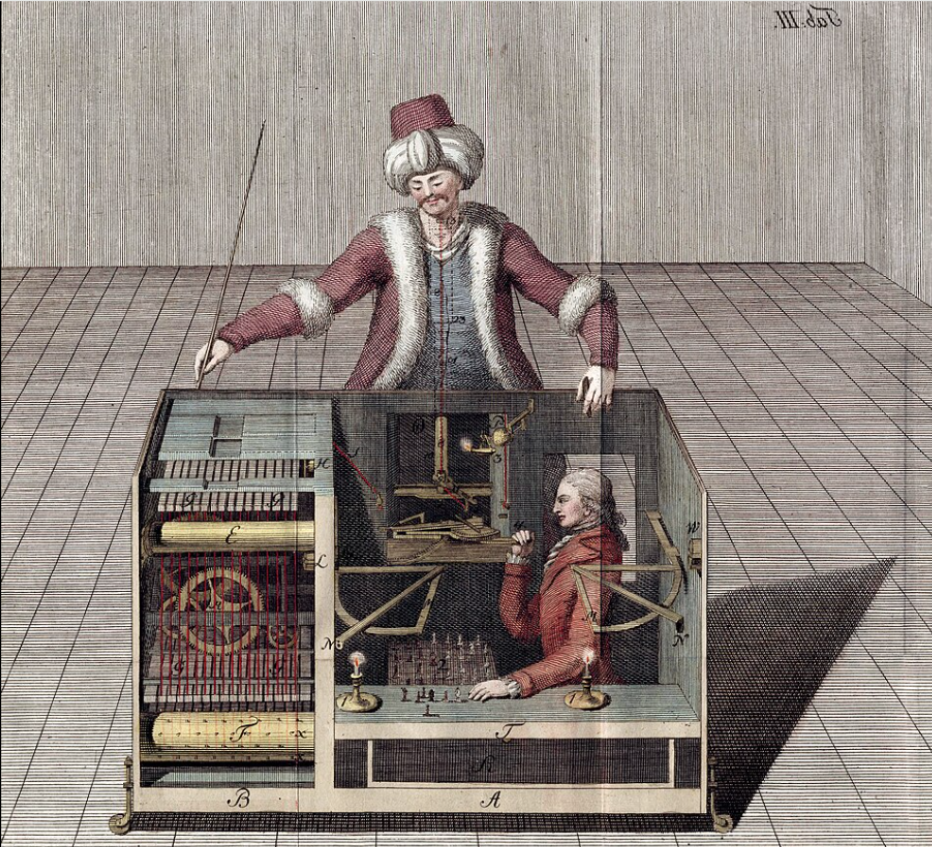
The cabinet that Kempelen so generously opened to the public was a masterpiece not of chess, but of carpentry and misdirection. The clockwork the audience could see only extended part of the way back. Behind it sat a sliding seat that let a hidden operator shift from side to side, staying tucked out of view as each door was opened in turn, while dummy gears slid obligingly into place to fill the space.
Every chess piece had a small magnet in its base, and beneath the board a corresponding magnet on a string would twitch to show the operator exactly which piece had moved where. A system of levers let the operator work the Turk’s arm from inside, by candlelight, with the smoke vented discreetly up through the turban.
The operators were the real secret, and they were excellent – a rotating cast of strong chess players, most of whom history never named, crammed into a hot wooden box for hours to keep the illusion alive. People had guessed this, again and again. They simply didn’t want it to be true.
When two teenagers spotted an operator climbing out of the cabinet in Baltimore in 1827 and the story made the local paper, almost nobody believed it. The world, as one writer put it, had decided the secret was far too deep to be cracked by a couple of boys.
The Turk was eventually destroyed in a fire in 1854, and three years later the son of its final owner finally published the full explanation. By then there was nothing left to protect, and not much of an audience left to surprise.
The razor still cuts
Occam’s razor is a rule of thumb that has served scientists, detectives, and exhausted parents well for the better part of a thousand years. It says that when you’re faced with competing explanations, the simplest one is usually correct.
The trouble is that humans are about as bad at applying it today as we were back in the 1700s. We are drawn to the complicated answer the way moths are drawn to porch lights, and for roughly the same reasons: it’s shiny, it promises something, and we don’t fully understand it. Give a person a choice between “there’s a simple trick here” and “this defies all known laws of nature,” and a surprising number will plant their flag firmly in the second camp and refuse to move.
Which brings us back to Amazon’s MTurk, and to the joke buried in the name.
We are once again surrounded by machines that seem to think – software that writes, draws, answers and decides. And once again, the truth is frequently less magical than the marketing. A great deal of what gets sold as pure artificial intelligence runs on enormous quantities of hidden human labour: the people who label the training data, moderate the worst of the content, and correct the machine when it stumbles. The industry even has a tidy phrase for it – “human-in-the-loop” – which is really just a modern way of saying there’s a man in the box.
Amazon, to its credit, didn’t pretend otherwise. It looked at a system held up by invisible human workers, reached back two hundred and fifty years for the most famous example of exactly that, and named its platform accordingly.
So the next time something seems too clever to possibly be human, it’s worth picking up the old razor and asking the boring question first. Not “How does the magic work?”, but “Who’s in the cabinet?”
About the author: Dominique Olivier


Dominique Olivier uses her love of storytelling and ideation to help brands solve problems.
Her first book, Lessons from Loss, has been published by Penguin Random House.
She is a weekly columnist in Ghost Mail and collaborates with The Finance Ghost on Ghost Mail Weekender, a Sunday publication designed to help you be more interesting.
You can learn more about her work at dominiqueolivier.com and she can be reached on LinkedIn here.