

Ghost Mail is a daily dose of analysis on JSE-listed company news. If you’re craving a proper financial lens on local company performance, view the recent newsletters and sign up here>>>
It’s time to cover a story that has driven a lot of chatter this week: an announcement by MTN (JSE: MTN) that the company is going to have a tilt at Telkom (JSE: TKG).
And I mean all of Telkom.
The market has responded
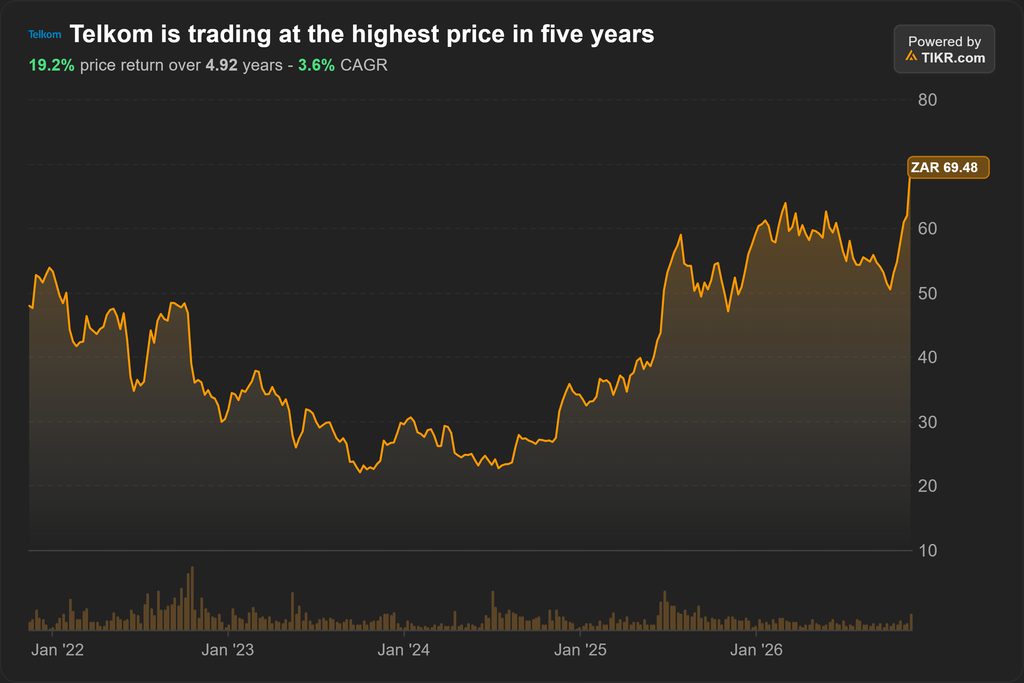
The news of MTN being in in discussions to acquire every Telkom share in issue had a predictably significant impact on the Telkom share price. Whether this deal happens or not, there are speculators piling into Telkom on the assumption that this showcases the underlying value in the Telkom business.
Despite the announcement having the word “cautionary” all over it, speculators aren’t famous for caution.
The release of results by Telkom (to be covered below) also proved to be positive for the share price.

But what about MTN?
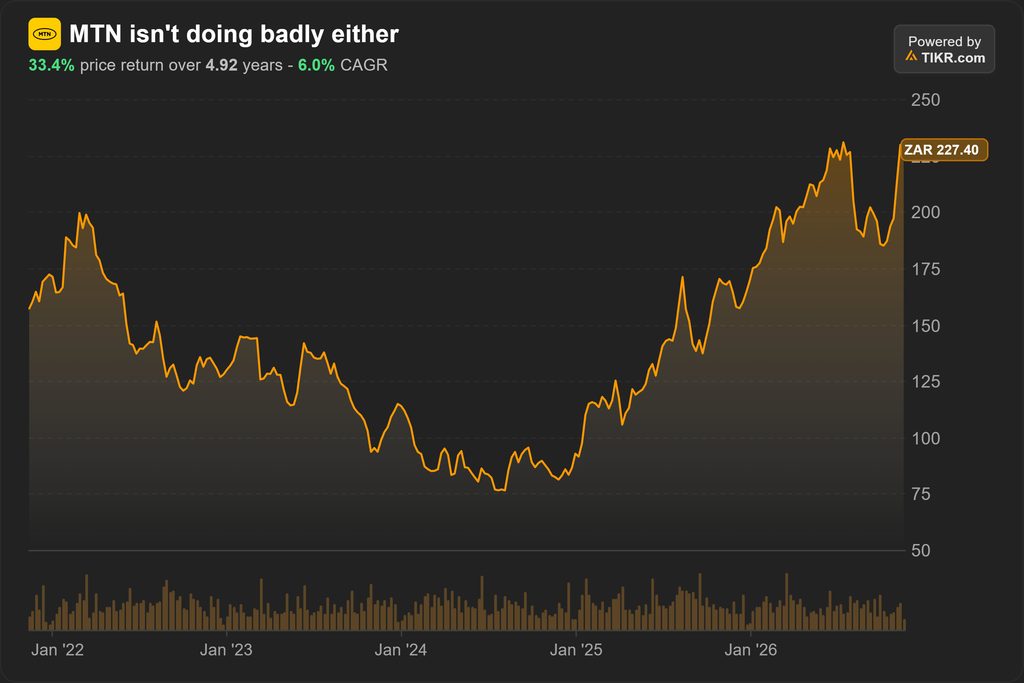
A strong recent rally as well, but much of that was in response to the release of strong earnings by MTN. The African subsidiaries have been doing very well, particularly the West African markets that really move the dial for MTN. The South African business has also enjoyed some recent momentum (particularly in prepaid), with Q3 EBITDA up 7.0% and EBITDA margin up 3.6 percentage points to 38.1%.
Times are good in the sector and MTN’s pockets are deep, with the intention being that the transaction is settled in cash, with an alternative to receive MTN shares.
Telkom has been a strong turnaround story
Telkom released its interim results the day after the cautionary announcement. This gives us a good opportunity to dig into the situation at Telkom.
The company has some new-age stuff (like data and digital infrastructure) that is doing well, but the legacy businesses (e.g. traditional voice etc.) is in structural decline. Telkom has needed to evolve with changing consumer behaviour. In my view, Telkom has done a great job.
Looking at some of the headline numbers, group revenue grew by 2.0% for the period. This shows you that the mix of businesses has been averaging out at only modest growth. But that’s not the end of the world when a company is exhibiting the kind of cost control that we are seeing at Telkom, with expenses down by 1.0%.
This has a positive leverage effect on EBITDA, up by 5.8% at a margin of 28.3%. The leverage continues down the income statement, leading to HEPS growth of 9.3%.
The balance sheet is also in good shape, with net debt to EBITDA of 0.6x.
But it remains a tale of two technological eras
Digging into the segmental split gives us a much better idea of what’s going on at Telkom.
Within Telkom Consumer, prepaid data revenue growth of 12.0% is easily the highlight, driven by a 13.6% increase in mobile data subscribers. This powered prepaid service revenue growth of 6.1% and an expansion in EBITDA margin to 30.8%.
Openserve achieved revenue growth of 4.2%, with broadband revenue as the critical growth engine (up 10.1%). The fibre-to-the-home connectivity rate remains industry leading at 54.8%. EBITDA margin of 33.8% is even better than the Telkom Consumer business!
We then get to the odd one out: BCX. This is where the technology treadmill is set to a steep incline and a fast jog, as the core portfolio at BCX is only 70% of revenue. Put differently, 30% of the thing is arguably in trouble.
Telkom makes it easy to see the revenue growth in the other segments in the summarised SENS announcement, but the opposite is true for BCX. You have to go digging all the way into the segmental report to see that BCX’s revenue fell from R5.3 billion to under R4.9 billion, a decline of 8.1%. This is despite growth drivers like cybersecurity (up 8.7%) and cloud (up 16.2%).
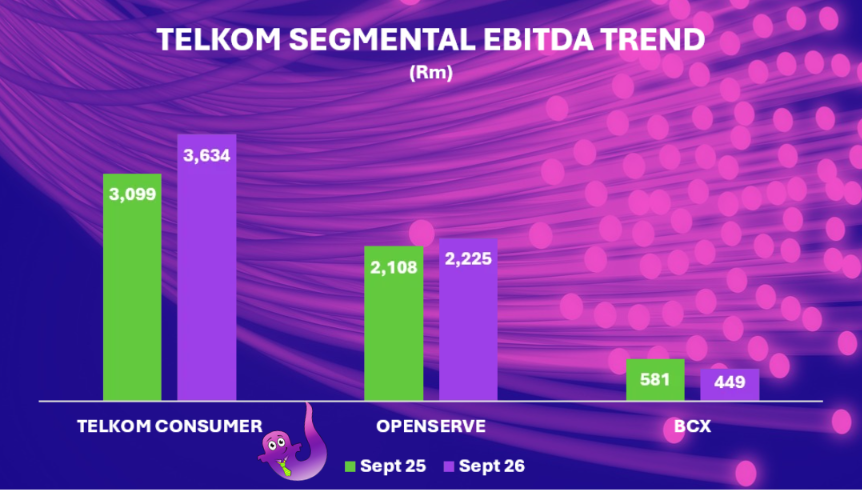
Although costs reduced by 5.0% in BCX, the reality is that EBITDA still fell by 22.7% from R581 million to R449 million.
None of this is helpful without giving you an understanding of how Telkom makes its money. The revenue split is more even in terms of the segments, but the structurally different EBITDA margins take us to a place where BCX is (thankfully) the smallest part of the group:
What does MTN actually want?
This is where we head into the realm of speculation, an understanding of corporate strategy and a bit of common sense.
Firstly, there is constant pressure on listed companies to grow. When the focus is on Africa, as we see at MTN, there are only certain places that most investors would see as investable. MTN is already in many of those markets (certainly not all of them), so it’s not a surprise to see the company looking to deepen exposure in markets it already understands and that the market would be happy with.
Strategically, the fibre business at Telkom is surely one of the biggest motivating factors here. After Vodacom finally got the deal with Maziv across the line, MTN looks exposed in this space in South Africa. Locking in Openserve would certainly plug that gap!
There are a number of factors specific to Telkom’s performance that I believe are also at play. To Telkom management’s credit, the company has done a solid job of turning the business around and carving out a growth path. The balance sheet is also in good shape, so MTN wouldn’t be taking on a high-risk story here. A further point I would raise is that it’s easier to sort out some of the legacy businesses in Telkom in an environment where Telkom simply rolls up into MTN’s reporting as a single segment rather than broken out into BCX and the rest.
There’s also a cheeky point to think about: by acquiring Telkom, MTN would be getting rid of a pesky competitor in areas like prepaid, where there has been serious pressure applied in the local market.
With the clear overlap in services here, the gigantic elephant in the room is the Competition Tribunal. It’s very hard to see a route to approval for this deal, unless there are substantial conditions involved that would require Telkom (or MTN South Africa?) to be broken into pieces along the way.
At this stage, there’s no guarantee that a formal offer will even land on the table. If it does, the regulatory process is likely to be long and tenuous. Even if MTN somehow gets this across the line, I strongly doubt it would happen anytime before 2028.
Everything you read in Ghost Mail is for informational purposes only and is never financial advice. You should always speak to your financial advisory. Where I disclose a position, this is for transparency purposes and should never be seen as an implied recommendation. This article is not an endorsement of the company.
Keen to get JSE-listed company insights in your inbox every morning? Sign up to Ghost Mail here: