
Huge progress was made at Accelerate Property Fund in the past year (JSE: APF)
The question now is around how much the gap to NAV can still close
Accelerate Property Fund has been a fun (and profitable) turnaround story to follow. The macro tailwinds have done wonders for them here, giving us an important example of why turnarounds are a much better idea for investors when the broader economy is playing ball. If you need to run into a headwind, you’d better pick a strong athlete. If the property sector is enjoying gusts of wind from behind, then anyone with working legs has a chance.
Accelerate’s vacancy rate has improved from 21.7% in September 2024 to 15.1% in September 2025, a strong performance over the past 12 months. Much of the good news is obviously at Fourways Mall, with this white elephant slowly becoming a pachyderm of the grey and economically-useful variety.
The disposal of Portside is expected to take place by the end of December 2025. There are a few other property disposals also expected to close in January 2026. In total, these disposals will reduce debt by R719.1 million, with the disposal of Portside having been the ultimate get-out-of-jail card for Accelerate’s balance sheet.
When these disposals are concluded, there will be a further decrease in the vacancy rate to 10.3%. The loan-to-value ratio is expected to be 41.8%, a far more palatable number.
The net asset value per share is R1.86. The share price is currently R0.57, having picked up nicely from the recent rights offer price of R0.40 per share. I’m personally hoping for the stock to get to around 50% of NAV, at which point I’ll probably take profit on this position. So far, so good.

Alexforbes delivers 9% dividend growth (JSE: AFH)
The financials aren’t the simplest to read
It’s always frustrating when a set of numbers is crawling with normalisation adjustments and all kinds of other confusions. Inevitably, the market then skips ahead to the dividend to see what the cash growth was. In this case, Alexforbes reported interim dividend growth of 9% – a far cry from “normalised HEPS” growth of 41%.
Operating income was up 9% with a decent performance across the segments. Expense growth was only 3% if you’re willing to adjust for various distortions related to long-term incentive plans and leases. If you include those items, expenses were up 10%. Normalised profit from operations was up 18%, while profit without the adjustments was actually down 1%. Sigh.
Corporate is still the biggest segment, contributing R958 million of the R2.3 billion in total operating income. With growth of 5% in this period, it was a solid underpin to the numbers that was driven by growth in the retirements business.
The Investments segment is next up at R768 million, with growth of 16% suggesting that it might not be in second place forever. Closing assets under management and administration increased by 23% and blended margins were only slightly lower, so that’s looking good for this business.
The Retail segment grew operating income by 10%, while “Growth Markets” (their name for operations in certain African and other countries) delivered 6%.
There’s plenty of corporate gumph in the narrative and not much in the way of hard targets to hang your hat on. There’s an outside chance that the 5.5% drop in the share price on the day was purely from exhaustion in trying to find useful nuggets of information amongst the flowery language in the report. Absolutely nobody wants to read about “navigating the waters ahead” – just give us an outlook statement that includes some numbers!
Equites brings us the first “unhealthy” REIT capital raise of the cycle (JSE: EQU)
Blank cheque capital raises with no details are signs of trouble
After market close on Monday, Equites Property Fund announced an accelerated bookbuild process. This is a way for companies to raise money quickly from institutional investors.
How much, you ask? No idea.
Why do they need the money? No idea.
It’s just: “Hi everyone! We would like some money. Thanks. Kisses.”
This is proper frothy-market stuff. This approach would get laughed out the door during a weak point in the cycle, but the property market has been on a charge. As I’ve written throughout the cycle, the time to get worried is when the capital raises with a non-existent rationale start happening. This is strike 1.
Earlier in the day, Equites provided a trading update to at least give the bookrunner something to talk about when phoning institutional investors. They are on track for their full-year guidance of 140 cents – 143 cents per share, so that’s encouraging.
In terms of corporate news in the trading update, they highlighted a few local development highlights and leases. They also gave an update on the exit from investments in the UK, where they haven’t managed to sell the assets as quickly as they had hoped.
Do they need money because they have development plans in South Africa that they were hoping to fund with UK exit proceeds that haven’t materialised timeously? In the absence of any other explanation, it sure seems that way.
Fairvest’s B shareholders enjoy double-digit returns (JSE: FTA | JSE: FTB)
And more of the same is expected in 2026
Fairvest has released results for the year ended September 2025. You would be forgiven for getting confused, as the headline for the announcement incorrectly talks about the six months to September instead of a year. Then again, the announcement also talks about the “propsects” for FY26, which is perhaps a new kind of bug. The proofreading was certainly very buggy.
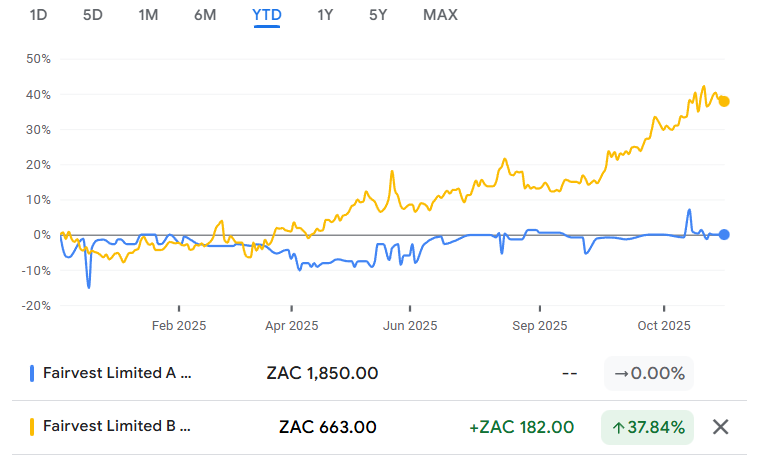
The numbers in the announcement are hopefully correct, with the property fund achieving revenue growth of 7.1% and like-for-like net property income growth of 5.8%. They delivered dividend growth of 3.1% to the risk-averse holders of Fairvest A shares who get the lesser of 5% or a CPI-linked return. This leaves plenty of meat on the bone for the Fairvest B shareholders who get the residual profits, with growth in their dividend of 11.2%.
Looking ahead to 2026, the fund expects the B shareholders to enjoy growth of between 9% and 11%. At the mid-point of guidance, that’s another year of double-digit returns to investors. When times are good in the property sector, you would far rather be holding Fairvest B shares than Fairvest A shares:
Hyprop is on track for FY26 guidance (JSE: HYP)
Growth in total footcount shows that quality malls do well in an omnichannel environment
Hyprop released an operational update for the four months to October. The most important news for shareholders is that the group is on track to achieve the targeted growth in distributable income per share of 10% to 12% for the year ending June 2026.
The fund is well known for owning high quality malls, like Canal Walk in Cape Town. They also aren’t shy to dispose of assets from time to time, as evidenced by the disposal of 50% in Hyde Park Corner (one of the most upmarket malls in Gauteng) for R805 million. They note that they are at advanced stages in concluding another disposal. It will be interesting to see what they are up to.
These malls are proving to be resilient in an omnichannel environment, with the South African portfolio enjoying growth in footfall of 1.9%. With 43% of the portfolio value in Gauteng and 57% in the Western Cape, Hyprop is focused on attracting shoppers in the country’s economic capitals. The strategy is working, with tenants achieving turnover growth of 5.3% and trading density growth of 8.5%. These strong metrics helped drive vacancies down from 4.2% in June 2025 to 3.2% in October 2025. They are also achieving significant positive reversions.
Here’s an incredible statistic on the power of a Checkers FreshX store: since the store opened in Hyde Park, the centre has experienced growth in footcount that included 12% year-on-year growth in October 2024! These tenants aren’t known as “anchor tenants” for nothing.
Hyprop also has exposure to Eastern Europe, with four premier retail centres. They literally have a 0.0% vacancy rate, which is incredible. Tenants enjoyed turnover growth of 2.9% and trading density growth of 3.1%, although footcount is under pressure in that region.
The balance sheet is in good shape – not least of all thanks to the capital raise of R808 million that ended up being used for debt repayments rather than a deal for MAS (JSE: MSP) – with the loan-to-value ratio increasing slightly from 33.6% in June 2025 to 34.3% in October 2025. Borrowings costs are coming down in the current environment.
It all looks good for Hyprop, with the share price up more than 20% year-to-date.
Lighthouse Properties raises guidance (JSE: LTE)
They are also looking ahead to a strong 2026
Lighthouse Properties has delivered a pre-close update dealing with the period ending December 2025. The good news is that distribution guidance for 2025 has been revised upwards from 2.70 EUR cents to 2.75 EUR cents. That might not sound like much, but it’s the difference between 5% growth and 7% growth, with the latter providing a particularly appealing premium above inflation (and thus real growth).
They’ve been busy with acquisitions this year, with net property income for the nine months to September up by a whopping 63.4%. Remember that the distribution on a per-share basis is what really counts, so don’t extrapolate something like growth in total revenue. The pie may be getting bigger, but you need to also consider how many pieces it gets cut into.
On a like-for-like basis, net property income grew by 5.3%. This is a more sensible metric to look at. Footfall was up 2.8%, with France as the surprising highlight at 3.9%.
The focus now is on sweating the assets they already have, which means bedding down the acquisitions and looking for further areas of improvement. Although the vacancy rate has increased from 2.0% to 2.6%, this is because of planned vacancies to accommodate new key tenants. They expect vacancies to drop below 2% in 2026 once leases with incoming tenants are finalised. Speaking of leases, positive reversions are a meaty 4.4% excluding regional indexation (inflation increases), so that’s really strong.
With solid performance across Spain, Portugal and France, Lighthouse expects to deliver a strong 2026. Increasing the guidance for 2025 certainly sends a message!
Can Nutun return to profits going forwards? (JSE: NTU)
2025 was another loss-making year, with the group promising that they now have a foundation for growth
Nutun is the charred remains of what was once a highly successful group: Transaction Capital. With WeBuyCars (JSE: WBC) having been cut loose from that mess and all of the Mobalyz Group (SA Taxi) legacy obligations now sorted out by Nutun, all that is left in Nutun is a business process outsourcing group with local and international operations.
You would be forgiven for hoping that Nutun is therefore a profitable business, safely protected from the braai coals by a tinfoil wrap. Alas, it hasn’t been quite that simple. The group just reported a continuing core loss of R45 million for the year ended September 2025, which is at least only half as bad as the loss of R92 million in the comparable period.
The legacy restructuring costs are all behind them now. They’ve got no more exposure to anything to do with Mobalyz, having now created a single point of funding into the South African business with a common security pool across all funders.
In other words, if 2026 is another loss-making year, then it will be a disaster. Management is bullish about growing off the 2025 foundation. With the share price down 62% year-to-date, I would certainly hope so.
Remgro wants more of Mediclinic’s SA business (JSE: REM)
While MSC, Remgro’s co-shareholders in Mediclinic, want Switerland
You may recall that Remgro partnered with MSC Mediterranean Shipping Company to take Mediclinic private. This was less to do with putting hospitals on cruise ships and more to do with two wealthy families coming together to acquire the Mediclinic group.
As time has gone on, it seems that Remgro’s partners prefer Swiss exposure to South African exposure. The parties are therefore negotiating a deal that would see Remgro take full ownership of Mediclinic Southern Africa, while the partners would then take full ownership of Hirslanden (the Swiss business). The parties would retain their current joint interests in the Middle East and in Spire Healthcare Group.
To keep things simple and thanks to relatively similar net asset values across the two geographies, they are looking at a straight swap. This would be based on EV/EBITDA multiples of 6.3x for Mediclinic Southern Africa and 9.4x for Hirslanden. The Swiss business would always carry a higher multiple because of the structurally different cost of capital across the two regions.
This is only a cautionary announcement, so there’s no guarantee of the deal proceeding on these terms (or on any terms for that matter).
Standard Bank reaffirms full-year guidance (JSE: SBK)
A 10-month update shows consistent performance this year
In an update for the 10 months to 31 October, Standard Bank noted that performance trends are in line with the first 6 months of the year.
Banking revenue is up by mid-to-high single digits despite lower average interest rates putting some pressure on endowment income. This is too complicated a concept to try explain in one sentence, but I’ll try anyway. It refers to the bank lending out its equity with no associated funding cost, so a drop in interest rates means they earn less on their equity. The thing to remember is that when rates fall, banks experience pressure on their pricing and hence they make less money. To make up for it, they need higher volumes of loans and overall activity. This activity came through in book growth, investment banking deal origination and the non-interest revenue line.
Revenue growth was ahead of cost growth, so margins are trending in the right direction.
The credit loss ratio was in the middle of the through-the-cycle range of 70 to 100 basis points. That’s better than we saw at the halfway mark when it was up at 93 basis points.
Finally, the Insurance and Asset Management business enjoyed a strong performance across life and short-term insurance. It really has been a bumper year for the short-term insurance industry in general.
The reaffirmed outlook for the year ending December 2025 is revenue growth of mid-to-high single digits, a flat or better cost-to-income ratio vs. the prior period and group return on equity (ROE) in the target range of 17% to 20%.
In terms of medium-term targets, a capital markets day scheduled for March 2026 will give the market plenty of detail behind the 2028 targets of HEPS growth of 8% to 12% and ROE of between 18% and 22%.
Tharisa’s SARS victory saved the 2025 numbers (JSE: THA)
The core mining metrics, like production, are down
Tharisa released results for the year ended September 2025. They require a more careful read than usual, as there’s a significant adjustment that needs to be dealt with first.
Tharisa has been in a serious fight with SARS around the calculation of royalty payments for the 2018 to 2021 year of assessment. Tharisa won an important victory in the Tax Court and SARS was set to appeal, but then the parties managed to negotiate a deal where Tharisa wouldn’t pursue costs and SARS wouldn’t appeal. Instead, SARS is now accepting the mining royalty calculations submitted by Tharisa.
Why is this so important? Here’s why:

Tharisa has reversed the provision this year, giving a $67.3 million boost to the financials in the cost of sales line. Despite this, EBITDA was only up 5.5% to $187 million. Profit before tax was flat at $117 million. You can quickly see how rough these numbers would’ve been without this adjustment!
The reason for the disappointing overall performance is that revenue dropped by 16.4%. The PGM business wasn’t the problem, with the favourable pricing environment boosting segmental revenue from $154.5 million to $191.9 million despite a 4.7% decrease in production. Chrome was the issue, with revenue dropping sharply from $491.3 million to $393.3 million as chrome prices fell by 11% and production dropped by 8.2%. When your biggest segment takes a knock like that, it’s rather nasty.
Although HEPS is only down by 2.1%, the better reflection of the difficult chrome environment can be found in the 33% drop in the dividend for the year. Whenever you see a significant divergence between HEPS and the dividend, you need to go digging. In this case, it’s because of the reversal of the SARS provision.
Nibbles:
- Director dealings:
- Acting through Titan Premier Investments, Christo Wiese bought R14.9 million worth of shares in Brait (JSE: BAT).
- A non-executive director of Blu Label Unlimited (JSE: BLU) bought shares worth nearly R1.5 million.
- An associate of a director of South Ocean Holdings (JSE: SOH) bought shares worth R265k.
- A director of Finbond (JSE: FGL) bought shares worth R120k and an associate of the same director bought shares worth R100k.
- An associate of a non-executive director of Spear REIT (JSE: SEA) bought shares worth R152k.
- An employee of the designated advisor of website-less Visual International (JSE: VIS) sold shares worth R10k.
- On a day this busy, some of the less liquid stocks simply have to drop into the Nibbles. One such stock is Primeserv (JSE: PMV), where results for the six months to September indicate revenue growth of 5% and a juicy increase in HEPS of 16%. The interim dividend is up 17%. This strong performance despite modest revenue growth was largely thanks to cost control.
- Thungela (JSE: TGA) has announced the disposal of Goedehoop North for a theoretical maximum of R700 million, although the minimum payment is much lower than that. R50 million in cash is payable initially and the remaining R650 million will be structured as quarterly instalments based on various milestones. The minimum total deferred payment is only R60 million though, so it shows you how much variability there is in that number. Mining operations are expected to cease in 2025 and the net loss before tax for the six months to June was R111 million, so the theory behind this deal is that the infrastructure is far more useful to the buyer than it is to Thungela.
- In July 2025, South32 (JSE: S32) announced the sale of Cerro Matoso, a ferronickel operation located in Colombia. The deal was structured as a nominal initial payment and future cash payments of up to $100 million, although achieving that number would require a considerable improvement in the nickel market. The latest announcement is that the transaction has been successfully completed.
- SA Corporate Real Estate (JSE: SAC) announced that the acquisition of the Parks Lifestyle Apartments at Riversands has met all conditions and has a deal closing date of 1 December.
- Hosken Consolidated Investments (JSE: HCI) announced that the JSE has granted the company a dispensation from the 60-day rule to dispatch a circular to shareholders for the transaction with B-BBEE partner SACTWU. It will be distributed to shareholders as soon as the circular has been approved by the JSE, with no further update given around timing.
- There’s a change in the CFO role at Pick n Pay (JSE: PIK). Lerena Olivier will step down in August 2026 after the 2026 AGM, having been in the role since 2019 (and with the group since 2011). She will be moving into a strategic role overseeing priority projects related to the turnaround. Tina Rookledge will take the CFO role after the AGM next year, joining the retailer from her current role as Regional Managing Partner of the EY Western Cape practice.
- Castleview (JSE: CVW), a large property fund with practically zero trade in its stock, released results for the six months to September 2025. The distribution per share increased by 21.8% and the net asset value per share is up 13.4%. The loan-to-value ratio, net of cash, is 45.5%. Much of the recent activity has involved an increase in the stake in SA Corporate Real Estate (JSE: SAC) to 24.93%.
- Africa Bitcoin Corporation (JSE: BAC) continues to add international trading opportunities for its stock. The company is now trading on the Börse Frankfurt Quotation Board. This doesn’t mean that new shares have been issued or that any capital has been raised. It just means that there’s an additional venue for the trading of shares. They are clearly trying to attract a global audience.
- Guess what? There’s yet another delay to the payment of funds by Gathoni Muchai Investments Limited (GMI) to Shuka Minerals (JSE: SKA). I can only imagine what the tone on the deal calls must be like by this stage. A promise made by a toddler about not touching an ice cream is more dependable than anything GMI says about the timing of cash flow, so I wouldn’t put much faith in that latest timing update regarding the balance of the £2 million loan facility being paid by mid-December. Remember, the final payment for the acquisition of Leopard Exploration and Mining is due by the end of December.
- As part of its exit from the JSE, Safari Investments (JSE: SAR) is paying a “clean-out distribution” as described in the circular that was sent out in October. For those who have been wondering what the goodbye kiss will be, the distribution has been calculated as 30.0765 cents per share.
- Insimbi Industrial Holdings (JSE: ISB) announced that its listing will move to the General Segment of the JSE. We’ve seen many small- and mid-caps take this route, as it gives them a more size-appropriate set of listing rules.
- Quite why Globe Trade Centre (JSE: GTC) is listed on the JSE, I cannot tell you. The stock literally never trades. For the nine months to September 2025, the Polish property group suffered a loss after tax and a substantial decrease in funds from operations (FFO). The net loan-to-value has increased from 48.8% to 53.1%, dangerously high for a property company.