

In this edition of Ghost Bites:
- Why I don’t have a position in Truworths
- Rainbow Chicken’s earnings are as volatile as ever
Why I don’t have a position in Truworths (JSE: TRU)
The latest results reveal the growth problem
The Truworths share price is down 3.6% this year. If you haven’t been following the sector closely, it may shock you to learn that this is one of the better outcomes in clothing retail!
It comes down to expectations vs. reality. Truworths has been so weak over the years that the market really hasn’t expected much, so the valuation unwind hasn’t been as severe as we’ve seen at previous darlings like The Foschini Group.
Here’s a view on the sector over 12 months:
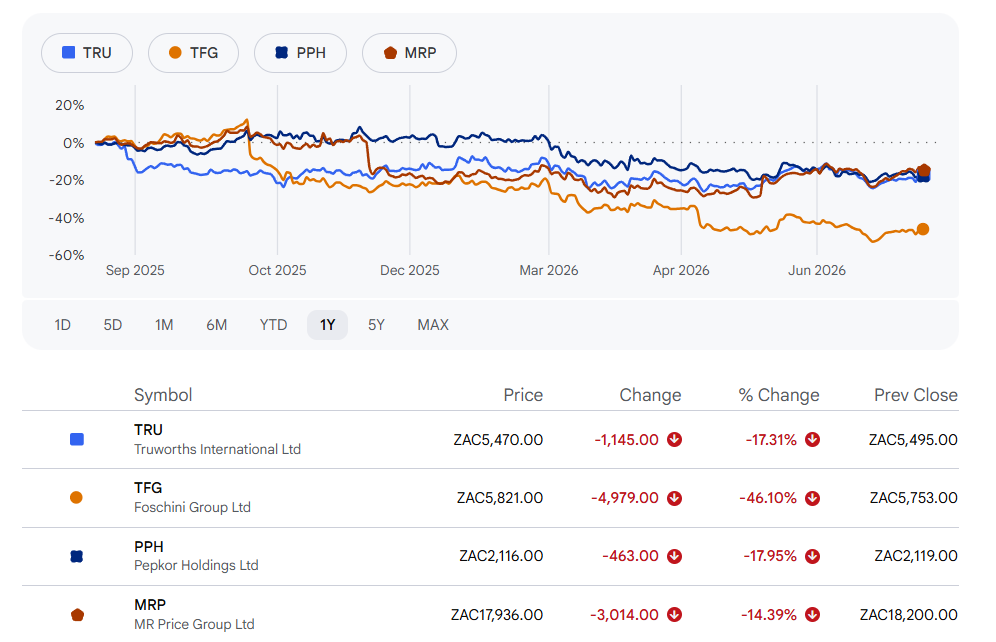
There are absolutely no winners here. Glancing at this chart is like seeing a bunch of SALE signs at the end of the season.
Even a strong dividend yield (a whopping 9% at Truworths) can’t shield investors from this kind of trauma.

What can we learn from the latest numbers?
In the 52 weeks to 28 June 2026, there’s more disappointment for Truworths shareholders. Even without a demanding valuation, nobody wants to see a 0.9% decline in group retail sales for the period. HEPS is expected to be down by between -2% and -4%.
To make it worse, the momentum during the period is particularly poor. The group managed flat sales in the first half of the financial year, while the second half suffered a decline of 2.1%.
That’s because the second half suffered from the same issue that is plaguing the broader retail sector: the impact of the conflict in Iran on consumer affordability. Our money has been redirected from the malls to the petrol pumps.
When we dig into the segments though, you may be surprised by the shape of the geographical split.
South Africans are a tough bunch
Truworths Africa is where you’ll find an unusual outcome. Despite the petrol price making everyone bleed in uncomfortable places, Truworths Africa had a better H2 (-0.1%) than H1 (-3.6%). This equates to a full-year performance of -2.1%.
Cash sales bore the brunt of the pain, down -5.0% for the year. Account sales fell by -0.9%, with approval rates for account sales dipping from 79% to 77%. They talk about having a more “prudent approach to credit granting”. You can refer to my detailed piece on Weaver Fintech for great insights into the state of lending to South African consumers.
Despite all the inflationary pressures out there, Truworths Africa actually experienced deflation of -0.4% for the period (vs. inflation of +1.2% in the prior period). When growth in volumes isn’t coming through during a period of weak pricing, deflation becomes a huge issue for retailers.
At least online sales moved in the right direction, up 21.5% at Truworths Africa and now contributing 8.1% to retail sales (up from 6.5% a year ago).
Despite all the local challenges, Truworths Africa still increased trading space by 0.8% – an acceleration from the 0.5% growth in 2025.
A nasty slowdown in Office UK
Unlike its peer group, Truworths has been doing relatively well offshore vs. the local business. Admittedly, part of this is because Truworths Africa is just so poor.
This leaves Truworths shareholders vulnerable to a slowdown in Office UK. It seems to be happening, with growth of 6.4% in H1 firmly in the rear-view mirror. Growth was just 2.9% in H2. Full-year growth was 4.9%. These rates are all in local currency (i.e. GBP).
If you translate the numbers to rand, then the reported growth was just 1.3% for the full year. Gone are the days of local companies relying on an ever-depreciating rand to boost the value of offshore earnings.
Online shopping adoption is much higher offshore than locally, evidenced by online sales contributing 44.7% of Office UK sales (down from 44.9%).
Despite the growth narrative being weak in the UK, the Office business has gone on quite the expansion drive. Trading space increased by 17.8%, or 8.1% on a weighted average basis.
Overall, Office UK did a good job of outperforming the market. The problem is that the market will extrapolate the slowdown and feel concerned about where the growth will come from.
My view
I don’t invest for the dividend yield. In fact, I actively avoid slow-growth companies that promise great dividends. Inevitably, the dividends don’t withstand the underlying pressure on earnings.
Pepkor is my chosen player in this sector. I love the fintech / banking upside. I’m stuck in Mr Price in the aftermath of the NKD deal unfortunately, but at least they are also finding ways to grow.
I can’t bring myself to feel excited about Truworths. I also can’t get past the risks that The Foschini Group is facing offshore, so that’s off my list as well.
Rainbow Chicken’s earnings are as volatile as ever (JSE: RBO)
There ain’t no business like the chicken business
Rainbow Chicken released a trading statement for the year ended June 2026. As is often the case in this sector, there are some utterly insane percentage movements at play here.
The poultry business is characterised by low net profit margins and volatile gross margins. In practice, a small change to gross margin can drive a substantial change in net margin.
Let’s do an example
To just use hypothetical margins, let’s assume that your gross margin is 20% and your profit before tax margin is 5%. A 200 basis points deterioration in gross margin can easily happen if you have a spike in input costs, pressure on consumer spending or issues with bird flu.
It may not sound like much (we are talking 200 basis points on 20% here, or a 10% deterioration), but that move in gross margin will drop profit before tax margin from 5% to 3% (all else held equal). Assuming constant sales, that’s a 40% drop in profit before tax!
And believe me, gross margin can move by a lot more than 200 basis points.
Earnings have more than doubled
This is why the year ended June 2026 has seen a jump in HEPS of between 118% and 138%. Earnings more than doubled!
A combination of strong demand for poultry products, lower commodity prices and operational efficiencies delivered the goods here.
I prefer to eat the stuff
The poultry sector is far too terrifying for me. I can’t bring myself to be invested in stocks that oscillate between incredible earnings growth and near-death financial experiences.
I’ll stick to eating chickens rather than investing in them.