
Listen to the show using this podcast player:
Or on YouTube:
How do you know whether your investment performance is actually good?
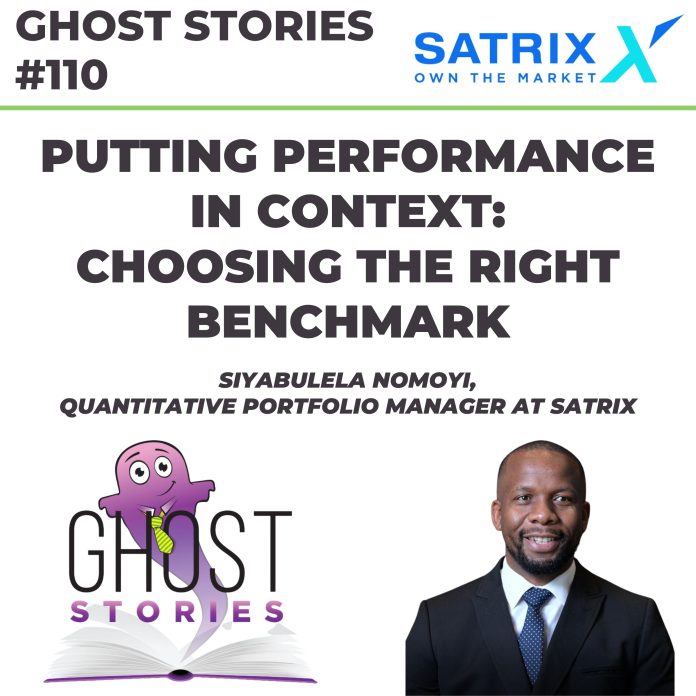
In this episode of Ghost Stories, The Finance Ghost is joined by Siyabulela Nomoyi from Satrix to unpack one of the most important, yet often misunderstood, concepts in investing: benchmarks. From retail portfolios to institutional mandates, we explore why returns only tell half the story and why every investment outcome needs a meaningful point of comparison.
The discussion goes well beyond the basics, covering how benchmarks are selected, the role they play in risk management, the differences between indices and other benchmark types, and why ETFs offer investors an accessible way to measure performance against the market. Siya also shares practical insights into index construction, concentration risk, tracking error and the common mistakes investors make when choosing benchmarks, reminding us that outperforming a benchmark isn’t always as impressive as it sounds.
In this episode:
- Why benchmarks are essential for evaluating investment performance
- How investment mandates, time horizons and risk tolerance influence benchmark selection
- The difference between indices, benchmarks and hedge fund hurdle rates
- Why ETFs are a practical way to access investable benchmarks
- How index construction and weighting methodologies affect risk and returns
- The importance of tracking error, fees and liquidity when assessing ETFs
- Why beating a benchmark can sometimes be misleading
- Common mistakes investors make when choosing and using benchmarks
This podcast was first published here
Transcript:
The Finance Ghost: Welcome to this episode of the Ghost Stories podcast. I’m your host, The Finance Ghost. My guest today is Siyabulela Nomoyi from Satrix. And let me tell you, we have both been having the Monday of all Mondays. We’ve had to move this a couple of times while we deal with some respective tough stuff.

But thank you for nonetheless making time for this, and I’m really glad that we actually got a chance to sit down and do this in the end.
Siyabulela Nomoyi: Yeah, Ghost, thanks for having me. Mondays are like that; it is what it is. That’s the life. Hi to the listeners as well and thank you for inviting me again.
The Finance Ghost: So, Siya, let’s make the most then of the time that we do have, which I am really looking forward to. And we’re going to be talking about benchmarks today. And that’s because you wrote quite a cool piece recently on this entire topic.
I think that people, when they talk about returns on their stocks or their investments, they’re really only giving half the picture, right? They’re basically telling you how they did, but it doesn’t give you the context of how everything else did and things with maybe similar risk profiles and that kind of stuff. And we’ll talk about that on the show.
But I think let’s maybe just cover why it’s important to have a benchmark in the first place. And obviously this is something that as an ETF specialist, you live and breathe, which we’ll also cover in this discussion. But initially, just to kick us off, take us through why it’s important to actually have a benchmark.
Siyabulela Nomoyi: Sure, Ghost, thank you. So, as you mentioned, the other day I wrote an article on this and believe me, my marketing team actually trimmed it to fit media house limits. I had about five pages of writing on it. In other words, I think it’s very, very important and I hope our discussion can actually shed light on the why of that.
I’m hoping both retail and institutional investors can appreciate this. But choosing the right benchmark is one of the most significant decisions in investment management and one of the most underappreciated as well.
So, firstly, let’s just step back a bit, and ask what a benchmark is before we continue. Just in case there’s someone curious about that part (and has not really or exactly appreciated why we would be talking about today).
So very, very loosely, think of a benchmark as a standard way to test or use to measure and compare how well something performs, right? So, in investments you can use it as a baseline to measure how yourself and how your portfolio is doing; or the market, or any other player that’s out there.
Or if you want to look at peers or anything like that, you can actually look at how well you’re doing in relative terms compared to those.
So, there are investors out there who spend their days trying to beat a certain benchmark (the market in this instance), and so they compare themselves to an index that would be the benchmark. Others actually just prefer to be in line with the market, just want the market exposure and don’t bother with outperforming it.
To quote what I had mentioned in the article, is that for a fund manager, a benchmark is often a constraint, the reference point against which performance will be measured and against which any deviation must be actually justified. So, in investment terms, we would talk about tracking error here or an active return.
But now, if you are sitting in an investment committee, it might function more as a goal, where it acts as a proxy for the return of the portfolio that you expect to deliver.
But also, for risk management as well, it does act as a blueprint; a description of what the market exposure of the portfolio is designed to actually replicate or actually approximate.
But look, a well-chosen benchmark serves all those three purposes simultaneously. It sets a realistic performance expectation, defines the risk profile of the investor, whatever that investor has agreed to actually accept in terms of risk. It also creates accountability as well, which is very important, especially in my field. So, giving both the investor and the manager a shared language for evaluating outcomes.
So, you want to sit there and evaluate whether this manager is doing well, you should ask: doing well compared to what or relative to what? I should just mention that choosing a benchmark should never be a tick-of-a-box exercise. A well-chosen benchmark serves all the purposes that I’ve just mentioned.
It sets a realistic performance expectation. It also defines the risk profile of the investor. As I mentioned, the accountability part. If you are telling me, Ghost, that your portfolio is doing well, I need to just ask you: performing well relative to what? Especially in a space where I need to actually evaluate your answer within some investment risk spectrum.
The Finance Ghost: Siya, thank you so much for setting the scene for us there. And in the world of professional money management (and I think most people listening to this will be retail investors, but if we just borrow from the professionals for a moment) then the benchmark essentially is related to their investment mandate, right?
But for retail investors, it’s not necessarily that formal. You can technically pick whatever benchmark you like. You should just pick something that makes sense. You know, if you’re investing in South Africa, then something like the JSE Index would make a lot of sense. You wouldn’t go and choose something random like another emerging markets index. That wouldn’t really make any sense in the context of that portfolio.
So perhaps just dealing with the professional side of things for a moment, how does the investment mandate of a professional asset manager actually inform their choice of benchmark?
Siyabulela Nomoyi: It’s an important question and I think it covers the entire investment world, whether retail or professional management.
And I’m saying that because I think as a retail investor I might sit at home, look at my returns and I think I’m doing very well for what I’m investing for. But there is nothing that I’m actually benchmarking myself to, to actually see that relative return.
And this is where the word mandate comes in. Just moving into the professional management part, but it applies to retail as well. What is the aim here in terms of the money invested? What is it supposed to do and when? And that translates to how someone actually views the risks that their mandate can actually partake in.
Before this recording, Ghost, we were talking about marriage; weddings. And if my mandate is to actually save and invest for a wedding in six months’ time, my mandate is totally different from if I’m investing for my two-year-old’s varsity fees, for instance.
It’s the same in the professional world, where people are investing in these different unit trusts. Whether you’re talking to a pension fund trustee or a fund selector, what they want in the time horizon is very important, which is influenced by the fact that they would have a mandate for the money that they want to invest.
The mandate actually answers three basic questions which then help with how to actually choose the benchmark. Firstly, what is this money for? Secondly, when does it actually need to be available? And what are the risks that are acceptable in the pursuit of these returns, right?
The wedding in six months versus varsity fees in 16 years example comes in here. Although I think if you have a wedding in six months and you start now, you might be late to the party.
Let’s just look at a pension fund, for instance. They would have long-dated liabilities, right? So future benefit payments. Its benchmark must reflect the duration and also the asset class exposure required to actually match those liabilities over time, right?
If they choose a super conservative benchmark, for instance, they would definitely not be able to actually match those payouts in the future, because there’s inflation and it would have eaten into the real returns of that portfolio.
While if there’s too much risk taken while there’s quite a huge beneficial payout coming very soon, and then the market tanks or something happens in the market, they would fall into the same trap in terms of the payouts.
So, retail clients also face the same challenge on a smaller scale. Someone saving for retirement in 30 years has very different needs from someone who’s preserving capital for property purchase or the wedding example that I made.
So, the benchmark should just reflect the time horizon, the liquidity requirement that talks to when the money is needed, and then the tolerance for drawdowns in terms of what you can take, given that you want to chase the returns that you want.
In other words, the dream must always match the returns and risks profile. So, the risk part is very important to understand. It can be expressed in terms of volatility, tracking error, relative the benchmark, and all those things, as it often does.
But I think it’s very, very important that as a client talking to your fund manager, or as a retail client sitting at home trying to manage your own portfolio, it’s very, very important to just understand firstly what the mandate is, and how that translates to, “Okay, this is what I want to measure myself against” and whether that benchmark actually makes sense.
The Finance Ghost: Lots to think about there. And that’s because benchmarks are confusing things for people who haven’t really dealt with them before, and complex things even for people who have.
And it also gets quite complex when you get into areas like hedge funds, right? Because here they have things like hurdle rates and performance hurdles and that kind of thing, which is not quite the same as a benchmark, because that’s typically how a hedge fund would earn its fees.
Whereas in other types of funds, the benchmark will be just how you measure performance, but not necessarily how they earn a fee. And of course, that is a nuance that people need to understand when they’re looking at fact sheets.
Maybe the other thing to just touch on, Sia, for us is whether or not a benchmark is always an index or can it be something else? Just take us through the differences there between hedge funds and long-only funds and how they think about this stuff.
Siyabulela Nomoyi: The short answer to your question is definitely a no. The benchmark is not always an index. In an index you think about as, “Okay, there’s constituents, create weights for those constituents. And this is the index that I want to follow”.
Yes, a lot of people, including myself, always think of a benchmark as an index that’s made up of constituents. For instance, S&P 500 or the ALBI or just the FTSE/JSE Top 40, for instance, as that index. So institutional investors like pension funds do use non-index benchmarks.
So again here, going back to my liability matching example or what I mentioned previously, is that institutional investors who actually use benchmarks like liability matching, which uses future cash flow projections. So in order to actually manage that part and see if you are successful there, the fund needs to actually always be maintained to track those obligations. It’s very important to just keep track of that.
And of course, the other one would be inflation-linked benchmarks, where maybe there’s like a fixed number or a moving target relative to inflation. So, I’m pretty sure anyone who’s actually listening to this, would have seen funds that target inflation, 3% inflation plus 5 and so on.
So those move with inflation and they change. And then that also influences how an investment manager actually changes their asset allocation to their fund to match how they can actually beat that benchmark.
And the other part is probably some sort of industry or peer group average, for instance. So, an investment manager, for example, let’s say they manage a fund on local equity and then they have an average or the median of the ASISA general equity category as the benchmark. So, they measure themselves versus the peers.
That’s where your question about hedge fund or the hurdle rates that comes in, where in order for them to actually get any performance fees, there should be an amount that actually can go over in terms of their performance, which can allow them to charge the investment fee and then on top of that actually charge the performance fee.
There’s quite a lot of other ways of actually having a benchmark, but it just again fits back to I guess the mandate part that I spoke of previously. And that fits in terms of how you understand or which benchmarks you want to choose for your portfolio.
And also very, very important, especially if you’re someone who… again going back to this performance fee part… if you are someone who’s selecting funds or buying into funds which have that, it’s very important for you as the investor to look at the portfolio and then look at the benchmark and be able to actually evaluate whether that benchmark makes sense.
What’s going to happen there sometimes is that what if that fund manager is always beating the benchmark, then there’s always going to be the performance fee, for instance, and why it actually makes sense, that’s the case.
So, you need to just make sure you understand if that benchmark makes sense. That is a measure for that fund. There’s over 1,600 unit trusts out there to choose from, so you don’t have to stick to one player.
So, if there’s information that you’re not understanding in terms of the benchmark, then you need to evaluate the next one, up until you’re actually comfortable enough to say, this is the fund manager that I want to go with. If you are interested, active management or buying into portfolios that outperform the benchmark.
At the same time, when it comes to the benchmarks that I’ve just mentioned, in terms of fluctuations, they’re linked to a target that’s moving. You should ask: does that make sense in terms of your time horizon and the mandate that you have as well?
The Finance Ghost: Siya, I think the big thing we’re learning today is that the benchmark just needs to make sense in the context of your entire investment strategy and everything you’re actually doing. Because if you don’t understand the risk of what you’re doing, then you’re going to do a really bad job (in all likelihood) of picking a suitable benchmark.
And I will say that ETFs are actually a really good way for people to not just bring market returns into their portfolios, but also just to see how something is performing. Investors can explore the Satrix ETF range to see how different ETFs track various benchmarks and indices. So, I actually do that all the time when I look at a particular stock and I think to myself, “Okay, what would make sense? How would I compare this to, for example, the JSE?”
It’s actually quite easy to go and get a traded price for a Satrix ETF, because the point is, that’s an investable benchmark. As opposed to an index which you can’t actually buy. You need to go and buy an ETF that tracks the index. And then there’s a very small layer of fees, which of course is the Satrix brand promise, to do this as cost-effectively as possible.
And once you subtract that, then you actually get an idea of the investable index, and you can then use that as a benchmark.
Now, you are certainly an expert on indices, you live and breathe this stuff, so perhaps you can just walk us through any other characteristics you want to raise of an index that you would look out for when you’re actually choosing a benchmark.
You’ve already mentioned so many. Is there anything else that you think is worth highlighting for the listeners?
Siyabulela Nomoyi: Sure, sure. Now we’re talking Ghost. That liability matching stuff. Definitely not my area, but ETFs and indices, we can sit and talk about those the whole day. It’s very, very important for clients or investors or anyone who’s listening to actually just understand what that entails.
Because ETFs, they generally just track an index or a benchmark. So as an individual, you can attempt to just track how the certain market performs and not worry about performance. You could just go for an ETF that tracks the JSE capped all share, for instance, for the SA local markets, S&P 500 for the US or the MSCI World. If you’re looking to developed capital markets and so on.
You can’t just wake up and select an ETF blindly, right, for your investments. I would hope not. The ETF you buy into will match back to what your mandate is. Investors looking to access ETFs directly can invest through SatrixNOW as part of their broader investment process. And that mandate helps you to just filter through 140-odd ETFs listed on the JSE, which includes actively managed ETFs.
You need to look at that list and just filter through in terms of what you want. So as an investor, you need to actually be able to read through the index that the ETF tracks, and be able to see if it will give you the exposure that you actually want for your overall portfolio’s needs or the mandate that you have.
But there’s a couple of things that you actually need to look out for. The index should represent the market or the segment or the sector; the country, whatever, that it actually claims to cover. That’s very, very important. So, if the index says China, it needs to give you China. If it’s saying Japan, it needs to give you Japan. Property, it needs to give you property.
A quick example would be FTSE/JSE capped all share index again. So, does that index really give you SA local equity exposure? The answer is yes, because if you’re looking at the fact sheet, for instance, the Satrix capped all share ETF, you’ll see that that index has about 119 stocks in it, right?
But it still gives you a broad exposure to companies that are representing 99% of the total market cap of the JSE-listed companies. So that definitely gives you SA local equity.
So, anyone who’s listening, I think you need to be careful at looking at concentration, especially if you look at broad world indices, which tend to actually have a big skew towards one country like the US. The definition is to also speak to what the exposure gives you.
The other part is actually how the weights (which I guess talks to the concentration part) of the constituents are making up that index that’s being tracked. That part is very, very important.
The most common one will be market cap weighting. So, the biggest companies will be at the top and the smallest will be at the bottom. This has got the practical advantage of reflecting the actual investable universe and keeping turnover low as well.
But it also means that an index can become increasingly concentrated in companies that have already risen sharply in prices, which introduce momentum risk and potential overvaluation bias as well. An index can be influenced by one or two names. Think of the Korean index as well, Kospi, where one or two stocks are actually influencing the volatility of that market.
Something to consider here is that, especially if there’s quite a lot of concentration towards single names, is things like equal weighting schemes or fundamental weighting; think value investing. But my point is that as an investor, you need to actually make sure that you understand the weighting methodology of the index that the ETF that you want to buy into actually tracks.
Ghost. I think very important more for fund managers here as well. The benchmark also is useful if a fund can actually track it or replicate it at a reasonable cost. I was speaking to another interviewer the other day and I mentioned that the JSE has this Africa 30 index, excluding South Africa index, right?
It’s a great index but wait until you actually try and track this by buying the actual companies that are in those different countries. Let’s just say as an investment manager myself, I never want to actually see myself in such a situation ever again. So, it’s very important that you see the definition, you see the benchmark, but it’s also able to actually replicate that.
So, liquidity is very important as well. Otherwise just a terrible way to actually just track the funds.
And I did say I might be all day on this point, Ghost, so maybe let me just close my answer by mentioning that the indices that ETFs track are not static. They rebalance frequently to adjust weights. Some constituents can be added, or they can be dropped from that index, so the ETF actually does the same.
So, the methodology is important to understand as the cost of that fund comes from that methodology. So, if an index is rebalancing way too often and has large turnovers, that’s also going to mean that the running costs are also high.
So, investors, please look at the total expense ratio and transaction costs of the fund that you are looking at; and historically, tracking error of any fund against its stated benchmark. Don’t just look at the headline fees. This is extremely important.
The Finance Ghost: Yeah, I know this is a passion point for you, Siya. And I know full well that you can probably take us through a five-hour podcast series by the end of which everyone will understand everything there is to know about ETFs and benchmarks.
It is something I do really enjoy about you. I love the mention of Korea there. That’s actually an index that has suddenly become really important in the world. Whereas a year ago or certainly two years ago, I don’t think anyone was talking about it. So, as you point out, things do change over time, and that’s why you also have to be careful with which benchmarks you’re looking at, to make sure you’re actually doing a good job of reflecting the kind of things you’re investing in and the risk you’re taking along the way.
Something else I want to ask you then is we talk about beating the benchmark, and people generally see that as a good thing, but is it always a good thing?
So, for example, can it be a bad thing because you maybe took on too much risk, or you actually walked away from your investment mandate?
In an extreme example, if your benchmark is, well, the JSE Top 40, and then you compare your gains from crypto or something to that extent, and you say, “Well, look, I smashed the benchmark”. The benchmark didn’t make sense in the first place.
But are there other examples where maybe you’ve just taken on too much risk or you’ve deviated and that “beat” is actually a bad thing?
Siyabulela Nomoyi: Yeah, definitely, Ghost. That’s part of the reason why I mentioned that if anyone is in the game of looking at fund managers that are charging performance fees, it’s very, very important that they look at the benchmark so that they can actually determine whether that makes sense or not.
Because it might be a benchmark that just completely doesn’t match what the fund or category is in. I know a few of those, but definitely not going to mention them here.
But the most fundamental pitfall is choosing a benchmark that does not match the actual objective. As an investor, you have the mandate, but then you choose the wrong benchmark for that.
The wedding and university fees example still applies, but outside that, sometimes investors actually tend to adopt a widely used index out of the convenience rather than the alignment.
And the reason why I’m saying that the wedding and varsity fees example applies is that the wedding is in six months or 12 months versus your child is going to go into varsity in 16 months. Your mandate is totally different for those two, which means you need to just make sure that you benchmark it to the right one.
Otherwise, if you think that you’re beating the benchmark, but it’s really not matching the outcome that you want, then you’re not really investing in the right place that you want to be investing in.
It can be the right thing. But outside that part, sometimes investors actually do tend to adopt widely used indices. And the problem is that it’s just convenient, right? You just look at other people or what’s the most widely used benchmark and you just adapt to that.
So as an investment manager, you might end up performing very, very well against that benchmark, but you might fail to serve the investor’s real needs, which is a big problem.
You can go to a presentation to a client and tell them, “Look, I’ve done really, really good. I’ve done positive returns for the last 10 years and I’ve given you 3% over those 10 years every year”.
But my target was inflation and looking at the inflation numbers, there’s a problem there, right? Having done exactly what I needed you to do in terms of the money that I gave you.
So, it’s same as your retail investor, you might be happy with what you see in terms of returns. Yet in terms of your mandates, something else is actually just brewing and it’s not exactly matching up to what you need.
But there’s also another side to that where if you are an active manager or a stock picker, for instance, you might also be hugging the benchmark on the fear of just blowing out your tracking error. Or maybe previously you were underperforming so you more on the side of not taking more risks. You literally just hug the benchmark in terms of your positioning. So, you take bets close to the index.
Now that would not be fair, right? Because you might as well be just tracking the index. And especially if you’re someone who’s sold themselves as a stock picker or an active manager, that means that you are probably charging more than someone who’s tracking the benchmark.
And if I go to you and you’re giving me exactly the same as the benchmark or quite close to, it while you’re charging two or three times the fee, then it’s definitely not fair. And I went to you because you can pick the winners for me.
The Finance Ghost: So much wisdom, Siya. Thank you very much for sharing it.
As we start to bring this to a close (and you’ve given us so much to think about in terms of good stuff and bad stuff around benchmarks: where it goes wrong, all of that kind of thing, we’ve touched on a lot of that); anything else you want to raise there around where things can actually go wrong in terms of choosing a benchmark? Or do you feel like you’ve landed all the key points?
Siyabulela Nomoyi: I think I’ve covered quite a lot of that.
Also, a well-constructed benchmark should offer meaningful diversification. That part is very important. When it comes to a handful of securities, or even a single company accounting for a disproportionate share of the index weight, then the investor is taking on the concentration in a single name.
It’s very important to just make sure that you understand, and you know that it is well constructed. Once you understand the benchmark, Ghost, you then automatically understand the ETF landscape, especially in South Africa, where you have to dive into a pool of 100 ETFs which track around 60 indices. They’re coming from eight different ETF providers.
You don’t want to be the guy who’s holding four Top 40 ETFs just because you’re just understanding what those indices are. So, benchmarks are quite powerful tools, Ghost. And as a fund manager, I need to make sure that I give you access to the benchmark returns and you get to as close to that as possible.
And also from your side, you need to make sure that we are able to evaluate my performance as well, relative to something. So that’s very important on both sides.
The Finance Ghost: Siya, thank you. I think we can safely leave it there. I think we’ve covered off a really important point here, which is that ETFs give you excellent access to an investable benchmark.
And if you go and understand the ETF universe, and you go and understand the underlying risk and reward characteristics of what you’ll find in each of these benchmarks, each of these indices, then you’ll be so far down the road in understanding the ETFs as well.
And I would obviously encourage listeners to go and check out the Satrix offering, which is incredibly broad. There really is just about something for everyone there, both locally and offshore.
And of course it’s all here on the JSE. So even when it’s an offshore benchmark or offshore index that they are tracking, it’s an investable instrument right here at home on the Johannesburg Stock Exchange.
Siya, thank you so much as always, for your time on what I know has been a particularly challenging day. I look forward to doing the next one with you as always.
Siyabulela Nomoyi: Awesome, Ghost, thank you so much, hey.
Disclaimer
Satrix Managers (RF) (Pty) Ltd is a registered and approved Manager in Collective Investment Schemes in Securities. Collective investment schemes are generally medium- to long-term investments. With Unit Trusts, Exchange Traded Funds (ETFs) and Actively Managed ETFs (AMETFs), the investor essentially owns a “proportionate share” (in proportion to the participatory interest held in the fund) of the underlying investments held by the fund. With Unit Trusts, the investor holds participatory units issued by the fund while in the case of ETFs and AMETFs, the participatory interest, while issued by the fund, comprises a listed security traded on the stock exchange. ETFs and AMETFs are registered as a Collective Investment and can be traded by any stockbroker on the stock exchange, LISP platforms and / or via online trading platforms. ETFs and AMETFs may incur additional costs due to being listed on the JSE. Past performance is not necessarily a guide to future performance, and the value of investments / units may go up or down. A schedule of fees and charges, and maximum commissions is available on the Minimum Disclosure Document or upon request from the Manager. Collective investments are traded at ruling prices and can engage in borrowing and scrip lending. Should the respective portfolio engage in scrip lending, the utility percentage and related counterparties can be viewed on the ETF and AMETF Minimum Disclosure Document. AMETFs are ETFs are actively traded by a Portfolio Manager to adjust the AMETF holdings and asset allocation with the aim to outperform the benchmark. AMETFs differ from ETFs which only track indices. The Manager does not provide any guarantee, either with respect to the capital or the return of a portfolio. The index, the applicable tracking error and the portfolio performance relative to the index can be viewed on the ETF and AMETF Minimum Disclosure Document and/or on https://satrix.co.za/products.