
In Season 2 of this podcast, The Finance Ghost talks to South African entrepreneurs about the ideas, choices and turning points behind building a business from scratch.
Listen to the podcast:
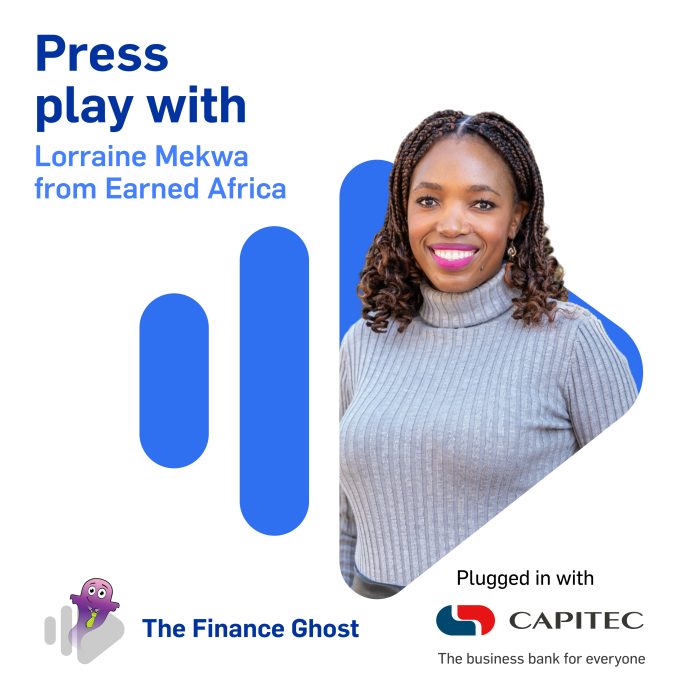
In this episode of The Finance Ghost Plugged in with Capitec, The Finance Ghost sits down with Lorraine Mekwa, founder of Earned Africa, to talk about her leap from corporate executive to entrepreneur.
After two decades in financial services, Lorraine had worked her way up to a divisional executive role at a listed group. She then made the leap into entrepreneurship, driven by a desire to help businesses grow and create broader economic opportunities.
Throughout her career, Lorraine had seen a recurring challenge: businesses needed access to highly skilled professionals, but traditional hiring could be costly and complex. She set out to find a better way.
Lorraine shares the vision behind Earned Africa, a platform designed to connect businesses with independent talent, while using technology to make contracting and consulting simpler. From the challenges of building a two-sided marketplace to the realities of startup life, she offers a candid look at life beyond the corporate world.
This is a story about entrepreneurship, problem-solving and having the courage to bet on yourself.

Episode 6 covers:
- Leaving corporate life for entrepreneurship
- Building a two-sided marketplace
- The future of independent work and the gig economy
- Using technology and AI to improve talent matching
- Early wins and lessons from building a business
- Creating opportunities for professionals and small businesses
The Finance Ghost plugged in with Capitec is made possible by the support of Capitec Business. All the entrepreneurs featured on this podcast are clients of Capitec. Capitec is an authorised Financial Services Provider, FSP number 46669.
Read the transcript:
The Finance Ghost: Welcome to this episode of The Finance Ghost plugged in with Capitec. Really enjoying the season thus far, and another good podcast coming your way today.
I’m here with Lorraine Mekwa and she has a fantastic story.
Lorraine had a really good career in financial services, I must say – Lorraine, I saw you on TV many times doing your thing. She made it all the way up to a divisional exco role at a listed financial services business, and then she did a crazy thing and said, “No, thank you. I’m going to go off and start my own business instead.”
Which is a really fun and brave story (maybe slightly insane, Lorraine, but we’ll talk about that on the show), and certainly very exciting, what you’re doing. So, welcome. Thank you for doing this with me and I can’t wait to learn more about your journey and what you’re building.
Lorraine Mekwa: Thank you for having me, Ghost. I think definitely crazy. But, yeah, I’m enjoying it.
The Finance Ghost: [laughing] Well listen, enjoying it is half the battle won. So, it’s a big call. Let’s just start right there. To walk away from a divisional exco role at one of the most impressive financial services groups (on the continent, I guess) is a big decision.
I think what makes it even more interesting is that you were relatively early on in that journey. It kind of feels like you’d done the hard part, and you were at the point where the rewards were going to really start coming through, and that’s the moment at which you decided you want to do something else with your life – which I would imagine was a very interesting thought process that I really want to tap into.
So, what can you share with us about this decision that you’ve made, this unusual path that you’ve taken?
Lorraine Mekwa: There are a few things that have contributed to it and, for me, they’re all equally important. And I think, importantly, I don’t look at it as “walking away from a career”. It does feel like I’m still achieving some of the bigger objectives that I have for my career, just in a different way.
I don’t see it as “you’re closing one door”, necessarily. I think that the skills that I have are transferable and the skills which I get here will be transferable to something else in the future. So, I don’t necessarily look at it like that.
But I think the most important thing that’s a driver for me (and I found this out recently when we were tested at work for personality types in terms of understanding what drives you) – I am classified as an Enneagram Type One.
That’s a personality classification. I think it’s got nine types, and all the different types are driven by different things. Understanding why I was a One, I think, has made me understand a lot of the decisions that I make.
So, Enneagram Ones, they want to see changes in the world. They’re very much driven about making sure that they’re part of that change, and I think there’s a big part of that which is at play here.
And then also, I’ve been in financial services for 20 years, which is a long time. I think a lot of the problem solving that we’re doing, we’re trying to make people’s lives better by giving them value, by making decisions which give them better returns for their money.
And, more and more, in all the conversations that we’re having, it’s always about, “This is great, but how do we increase this pie?”
That conversation has been happening in this country in some form or another over my whole career. I think I saw an opportunity for me to partake in that conversation and to be part of that problem solving for: “How do we actually grow the pie?”
I got involved with Business 20 (B20) policy work last year as part of my role, and I think that really made me get into a lot of detail around the systemic problems that we have in the country and where the blockages are for that growth. I think that is also part of that reason.
You know when you know so much and you feel like you know what some of the solutions are? Sometimes it’s very difficult not to act on that knowledge. I think that’s sort of where I am right now. I couldn’t move away from acting, and this is what I’m doing.
The Finance Ghost: I love that. Something that definitely comes through there: a career is not a job. Absolutely. You can leave a job, carry on a particular career, of course, by building something wonderful, which is what you are trying to do now.
I was researching Enneagram Type Ones while you were talking there. You come out as a Reformer, which, according to this particular website I found, puts you in good company here. Nelson Mandela, among others. Don’t get too excited though, because Osama bin Laden is on this list as well, Lorraine…
Lorraine Mekwa: [laughing]
The Finance Ghost: …so you’ll have to just manage yourself quite carefully here. It seems as though Reformers can really go in one of two directions [laughing]. I have no doubt that you’re going in the right one, but I guess the point is it’s people who feel strongly about something and want to make change. That’s essentially the personality type, right?
Lorraine Mekwa: Absolutely.
The Finance Ghost: I think that suits an entrepreneur quite well, because that’s what entrepreneurship is, specifically. I think, again, and maybe we need to distinguish here between entrepreneurship in the form of just going and starting a business that already exists – so, you know, going and opening a florist for example, or a hairdresser. Those are just silly examples that come to mind. These are cool businesses, they come with their own challenges for sure, but everyone knows what they are, they exist. Whereas you’re doing something different. You’re in Startup Land. You are trying to create product-market fit. You are trying to build something that doesn’t actually exist in South Africa, certainly not at scale. And that is really, really interesting.
I was going to ask you about some of the shocks from going from corporate into your business, but I think people by this stage must be very curious what you’re doing, so let’s jump to that and we’ll circle back later to the other stuff.
Talk to us about Earned Africa. This is the business that you’ve decided to just throw yourself at now. What does this thing do and why do you feel like it needs to exist? What is the reason you’ve chosen to apply your personality in this direction?
Lorraine Mekwa: So, once Earned Africa is fully formed – let me talk about what it will do because it will grow to that, so let me talk about when it’s fully created.
It will be a marketplace where professionals who want to work independently (so, they want to work and not be in full-time employment, whether it’s consultants, freelancers, even people early in their career that just do not have the capacity to work full-time jobs) will be able to find their employers on this platform.
And businesses of all different sizes will also be able to recruit this talent, find it very easily, and be able to secure their services.
So, you asked me why I think this thing needs to exist. I think for me, I can speak about the different sides.
For employers – in my career, I’ve worked for big businesses (listed companies, mostly) and I’ve worked with some smart people.
When I was on the trading floor, I worked with some of the most numerical people. You work with the lawyers who are helping us put the transactions together. There are all sorts of skills in a room.
And the reason we’re able to achieve all those great outcomes (which you sometimes talk about) is because we have very different skills which are making sure there is value in the work that we’re doing, which are partaking in those discussions. And a lot of listed companies benefit from those skills.
But my assessment here is that as you go down in terms of the sizes of the companies, the ability for those companies to benefit from the top minds in the country becomes lesser and lesser.
By the time you get to small businesses, small business owners are on their own. They need to be all of those things. They need to know how to do marketing. All of the things that they need to do, they are responsible for that until they can get enough money to hire someone.
And for me, that’s a big hindrance to growth for businesses. They need to be able to get access to these top skills just like the rest of the listed companies are getting.
So, for me, from the employer perspective, it’s about making sure that there is access. It’s about democratising that access of skills and saying that if you are at this level and you can’t really afford to hire a Ghost-level of skills, maybe what you need to be doing is hiring just a fraction and being able to grow your company and get those skills in and move quicker in terms of the ladder of where you see this business going.
It’s about making sure that those skills are becoming accessible to the businesses. Because we keep looking to businesses to grow the economy. For me, it’s about making sure that we get them there quicker by giving them the skills that they need.
The Finance Ghost: Lorraine, what I’m hearing is a lot of very gig-economy-type thinking, right? Using technology, allowing professionals to almost carve themselves up into little pieces and actually be available to multiple users and then allowing those users to afford the piece of that skill that they need. Right?
And I guess that’s where this comment probably comes from on your website, which is: “The cost model doesn’t work, the trust infrastructure doesn’t exist. We’re fixing both.”
I think that sends quite a good message about not just how exciting this will be if you get it right, but also the task at hand is no joke, right?
Lorraine Mekwa: Exactly, yeah. That’s why I was saying that it’s such exciting work and I’m having so much fun because I keep thinking about that end product and what it can do for small business owners and I think it will be game changing.
So being able to create the infrastructure so that there’s that trust in the system. That I can work for the smallest business owners, but I trust that I’ll get paid. I trust that I won’t be chasing invoices. So, this platform will take care of all of those things. It’ll take care of the contracting, making sure that you, as a professional who is doing this work, you’re not sitting there worrying about all the other logistics. The platform will take care of that.
And that’s really the value that we will be adding for the professionals. It’s to say that you don’t need to be the biggest business development person to go find your next client, because this platform will bring those clients to you.
It’s about making sure that you are sure that you’re going to get paid for the work that you’re doing. That the scope of the work that you’ve been asked to do is not going to be changing whilst you’re mid-work. That it becomes a dependable way for you to work with these businesses. So, it almost brings the type of structure that we have in big corporates in order for us to be able to work there.
The Finance Ghost: And people underestimate how difficult it is to consult into enterprise-level clients, in particular. Just the onboarding, just the procurement side, waiting to get paid. I mean, anyone who’s consulted into these companies will understand just how much of a headache that can actually be. It is quite remarkable.
It’s also very frustrating because when they want to go faster, when they have to go fast, they can, but most of the time they will take their sweet time to pay you. It’s just the way these big businesses work. So, there are a number of friction points even when it comes to big business.
What I’m hearing is, from an SME perspective and maybe just starting with that side of the marketplace, SMEs struggle to get access to skills and it’s very expensive. And they almost never need a full-time person with 20 years of experience in a particular thing. But if they get that person for just a small amount of time, it can have a huge impact.
It’s very much your “Bomb Squad in the Springboks”-kind of situation. You know, it’s, “Bring on the heavy hitters for a short period of time and see what happens.” And even for enterprises, ironically, that can make a huge difference.
People think that Big Enterprise is this slick machine and it just always works and every team is always exactly what it needs to be – you know, and I know, that that’s not true. All the problems you get in an SME just scale up into an enterprise [laughing]. You go and have a look at individual areas of that business and you think, “Okay, that’s… quite different.”
That was one of my biggest takeouts, I think, of moving into what I would call a blue-chip for a short amount of time – just how many problems there actually still are and how it’s really just a big SME in so many ways. And that’s what you’re trying to allow for here, right? To just help these companies find the exact thing they’re looking for?
Lorraine Mekwa: Absolutely, because there’s lots of friction currently. You rightly pointed out that even big enterprises are struggling with this. I mean, as a divisional head, in my role, I had a lot of problems that I would want to solve, and I can just see that it’s about getting someone in quickly. I don’t necessarily need the headcount forever. I just need someone to come in quickly.
But the frictions, the gatekeepers that are sitting in that whole conversation, it becomes so much more expensive than what it really needs to be. And I would have really appreciated being able to just quickly get someone in to fix a problem and out when we’re done. Being able to have that flexibility even in a big enterprise would have saved me a lot of pain. So, it’s about being able to get that access, even at that level.
And big enterprises, I think, are probably going to be the biggest users of this platform, because they still have the most demand. And I think that the way big enterprises work is that they almost have to hold on to the talent in case they need it.
There’s a lot of fat, of people, in businesses, and obviously this weighs down businesses and they end up with costs that they shouldn’t have. This will allow them to be able to also only use what they need because you’ll be able to see that the talent is there and there’s so much work that they’re doing out there.
Also (and this is an additional benefit that you have with this), because the people are working for so many different organisations, they are learning so much, so their knowledge is always just top of the crop. You’re able to get so much more from them because they’re seeing everything else and not just necessarily stagnating in terms of learning because they’re sitting in one organisation.
The Finance Ghost: Another interesting point here to talk about is that, at enterprise level, it’s actually really hard to add headcount. You have to really justify, especially in this world now with AI and everything else.
You need to go and say, “Well, we need this person,” and it’s expensive now because for a corporate to bring on a professional, the salary tends to be quite high. There are lots of benefits they need to think about. There’s all the other stuff like leave policy, etcetera, etcetera. And it’s often just complete overkill.
Maybe the right analogy is just to imagine you’re going on holiday to Europe and you need to rent a car. All you need to do is rent a car. You don’t need to buy a car that lives in Europe when you’re not there. It makes no sense. You need a car for three days, that’s it. Just rent a car. Don’t buy one.
Lorraine Mekwa: Absolutely.
The Finance Ghost: So yeah, it’s almost that level of thinking. You know, just rent the car you need for the time you need it, pick the car that suits your needs and that’s it. You don’t have to justify additional headcount, long-term stuff, or all the other issues that come with enterprise.
This hits that consulting line item and solves your problem pretty much straight away. Now that, obviously, in and of itself, is not a new concept – nor is the concept of finding an expert. All you’re trying to do is just make that much easier, right?
And I can imagine it’s very hard to build this because a two-sided marketplace is very much a chicken-and-egg problem. If you have too many people who want the skills and not enough people saying, “Hey, pick me,” then you end up with a problem.
Similarly, if you have hundreds of people who have said, “Yes, I’m available to work,” but you’re not finding opportunities for them, that’s also an issue.
So, this is a tough business to build. How are you managing that chicken-and-egg issue in the early stages of the business, now? Because that must obviously be quite a challenge.
Lorraine Mekwa: Yeah, it’s very much the challenge that I’m dealing with every day, currently. Because what we are doing in phase one of the business is, when you build something like this, you need to build it for this market.
It’s great to look at what’s happening in the rest of the world and how they’ve built their platforms, because there are platforms in other parts of the world, even platforms that some South Africans are using.
But here you need to make sure that whatever we build for a South African context is what’s going to really solve our problems. You need to really be able to listen. So, in this first phase, there’s a lot of listening. Sitting with people who have worked as independent consultants for a long time, understanding their pain points, understanding what they deal with when they work with entrepreneurs.
Because what you want is for this platform to be so compelling that consultants don’t want to sit there and work by themselves. You solve their problems for them. So, it’s a lot of listening, which is why the build is not there yet. Because we need to be going through the listening to both sides, what the consultants need and listening to what the entrepreneurs and the bigger businesses need out of this.
So, that is all we’re doing right now. We’re recording all of the interactions – this works; this does not work; this is part of the frustration; if you do this for me, this will be really compelling – really gathering all of that data so that we end up with a platform that is really solving the problems that we have to actually move us to where we want to go.
Because I think one of the problems with building something like this is that for a lot of people it just intuitively makes sense that we need something like this. But if you don’t listen enough to all the different users that one could have in a platform like this, then you run the risk.
The Finance Ghost: So, the early days of a business like this, as you say – lots of listening to people, lots of understanding the problem, which is obviously a very hands-on situation as you develop the product.
I would imagine that the longer-term dream is to then scale this using technology, etcetera, because otherwise what you’re basically acting as, essentially, is a glorified headhunter, right? Which I don’t think is at all the business that you’re looking to actually build.
So maybe if you look a few years ahead, if you think about how technology can scale this, what does the longer-term dream look like once you’ve understood all the problems and you’ve kind of started to solve them?
Because I think what you’re doing is really interesting. I think the biggest challenge is going to be to scale it, right? And to try to turn it into something that can be replicated rather than needing your involvement on each and every little bit of matchmaking.
Lorraine Mekwa: Yeah. Definitely, the goal is not to have this just be a headhunting or recruitment business. It’s about a platform that will use AI and the data about both sides to be able to make sure that the match happens.
What we’re doing right now is trying to capture the logic of what the platform will need to do in the future, but it will not be done by individuals. So, there won’t be a consultant who will be trying to help a company get the perfect candidate. All of that will be using the data that sits in the platform.
So, when we get a professional coming in, we capture their data, and all of the interactions that are happening on the platform will be enhancing the data that we have to make sure that, increasingly, this professional is matched to the right employer.
And similarly for employers, when they engage, we will capture their information when they come in, and increasingly there will be enrichment of that data as professionals also give feedback around what working with that employer is like. So, it’s about making sure that we use that data to make the matches increasingly better in the future.
So, it’s not at all like some of the platforms that currently exist. There are a lot of platforms that do exist currently in the country, but there’s nothing like it at the moment. It’s about almost adopting what some of the platforms which are currently in the country do, but there’s a lot more that will be happening also.
Also, to my knowledge, I don’t think that even the mechanism of the contracting and the payments and all of that, there aren’t platforms that currently do that…
The Finance Ghost: It’s going to be a very interesting journey, that is for sure.
Lorraine Mekwa: …Yeah, it’s an exciting way to solve for a big problem that we have in this country, right? Of getting people used, of getting people who have skills to be more productive. And I think that this is definitely one way to do that.
The Finance Ghost: Yeah, absolutely. So, maybe last question about this early stage in this business in particular, and then I just want to end off with what some of the big surprises have been, moving from corporate into entrepreneurship.
But you must have had some early wins that are just giving you a little bit of wind in your sails right now. I think that’s important for anyone who’s starting a business, to just feel validated early on. And it can be a small win, right? I mean, that’s certainly been my experience, if I think back, what, six years now?
So, has that been the experience for you? Have there been some small wins that have validated your decision? Maybe a big one here or there? What’s getting you up in the morning at the moment? What’s keeping you believing in this very early stage in the journey?
And I specifically ask that question because most of the guests on this podcast are a long way down the road. They’re like 10, 15 years down the road. Not all of them, obviously, but I think no one has been earlier than you in your journey. And so, it’s a very interesting way to just give people context to what this leap is like.
Lorraine Mekwa: Absolutely. The feedback that we have received from both sides has been amazing. From a professional’s perspective, with the high unemployment that we have in the country, one would expect that the feedback would be great there because there are more people than there is work.
The quality of the people that we have signed up has been absolutely amazing. Senior people, some of them are former excos of listed companies, and all the way down to people who have recently started their careers and they have some experience.
And I’m talking marketing, lawyers, engineers who can do process management, all sorts of professions. I mean, there are the accountants. Everyone has really been open to this way of work. And there are a lot of people who are just giving us the feedback of, “If you do this, then this would really be valuable for us.” So, for me, that has been quite amazing.
From the companies’ perspective, that has also been shockingly positive, quite early on. We have had a private equity fund that is starting out. They’ve just raised their first fund and they’re trying to get all sorts of skills that they need, really specialised skills, of people who will help with all sorts of tasks, investment analysts, all sorts of work. But their budget is not quite there yet because this is their first fund and they’re trying to preserve as much as possible. They’re seeing such great opportunity to work with the people that we have, get what they need, but not keep them on, full headcount.
And we have even more established, smaller financial services players that have also just signed up some of our talent. So, for me, the feedback is definitely positive.
One of the things I think I am most excited about is the variety of the companies that are using the people that we have. I’ve been surprised by just that variety. And it means that the demand, once we roll it out to a much bigger group of people, will continue to be sustained.
And all of these people who we have signed up will then be used continuously, because I think you want this to also be able to work as a way of having a career and I’m getting the feedback that this is definitely something which will be available for both sides. [hadedas cawing in the background]
The Finance Ghost: It just wouldn’t be a South African podcast with a guest from Joburg if there weren’t some hadedas in the background. I love it.
Lorraine Mekwa: [laughing]
The Finance Ghost: It’s hysterical how many times those have been a feature of The Finance Ghost podcasts. So, you are building at the coal face there, Lorraine. You are building in the economic capital of the country and you’re doing something very exciting, that’s for sure.
Last question I have for you, and it was something I wanted to ask earlier, but I’m glad that we got into the weeds of the business first. So, you’ve gone from this big listed company infrastructure – you have an IT problem, there’s a department for that. You don’t have to worry about HR and, well, I mean just everything, right?
You’ve now had to step out into a world where there isn’t really any of that infrastructure. You’ve chosen Capitec Business to bank with, so good choice on that one, obviously. But in terms of the bigger changes that you’ve experienced, how much of a shock is it to step out of the hallowed halls of a JSE-listed company and go out on your own?
Lorraine Mekwa: [chuckling] We would need a whole hour to go through the shocks that I’ve actually experienced. There are so many. And it’s not like it’s a big dramatic crisis with all of them, but they’re so small and you’ve taken them for granted for so long.
I mean, you mentioned the IT person who you can just always call whenever you get stuck. Because right now what happens is that, when I have an IT problem… I’ll tell you a funny one. When I was registering my Outlook and trying to get my email registered into my Outlook, I took an embarrassing amount of time to figure out how to do that, you know, and it’s just small things that are just, “How do you get this done?”…
The Finance Ghost: It happens to the best of us. Don’t worry [laughing]. Honestly, it really does.
Lorraine Mekwa: … It’s frustrating because you’re not used to dealing with those problems and you just don’t have the tools to do it. And sometimes I find myself waiting for my husband to come back home [laughing] to help me with some of these things that I’m struggling with.
Those are the big things, but there’s also a lot of benefit to being in a big organisation that one doesn’t have here. One of the ones that I took for granted was the amount of inertia that you get in a big business. As an example, when I sit in a big business, my inbox is full. There are lots of people who want me to do things, and I almost don’t need to sit and think from the top every single day about what we’re going to do today because I’m being pulled in so many different directions.
Whereas in a business like this, you are the initiator. If you do nothing, nothing happens. You know, everything just needs me. And that is shocking. I’ve had to do a lot of rewiring of my brain.
Something as simple as after I agree to a meeting with Ghost that we’re going to have another session, and I’m going to arrange it. It doesn’t seem to arrange itself. I need to actually send out that calendar invite myself [laughing].
So, little things and big things. But it’s fun because you are also realising how much you’ve taken for granted for so long. But yeah, it’s really exciting.
The Finance Ghost: Yes, I can absolutely echo all of that. I think for anyone thinking of doing this and stepping outside of corporate and starting a business, brace yourself for things that will make you pull your hair out in ways you could not believe.
Things that are so difficult that you thought were so easy, like just having a working Microsoft account and Outlook and Teams and all the rest set up in a way that actually functions. Website hosting, dealing with stupid cybersecurity things and firewalls. Oh, it just never ends. There is a huge prize on the other side if you get it right. But it is not an easy thing.
And I think, Lorraine, you’re doing it on hard mode. You’re building something that isn’t out there right now. It’s a two-sided marketplace. I think it’s very exciting and I would certainly encourage companies listening to this who wish they could get access to really impressive skills for just the amount that they need, they should absolutely be talking to you.
And also, professionals listening to this who are looking to access more of those clients with less of the headaches, they should also be talking to you.
From my side, I just wish you the very best with this. I think it’s always so exciting to see someone following their passion, following a dream. Who knows where it goes and if it ends up looking the way you think it might – it rarely does, to be honest. But you’re on the right path and I think you’re doing some exciting stuff, so carry on.
Lorraine Mekwa: Thank you so much for having me as a guest. I think one of the things that I didn’t mention about some of the shocks is that you need motivation to continue doing what you’re doing, and definitely discussions like this are encouraging me that I am on the right path.
And, as tough as it is, as much as I sometimes hit those walls, every time I have these conversations, it just reminds me that I’m on the right path and I can just draw from these discussions as sources of energy to make sure that I’m going past those obstacles when I hit them.
So, yeah, like I said, I’m quite excited about the possibilities of what we can achieve here, and I just cannot wait to see all the different things that we can achieve here, and they’ll start happening quite soon. So, yeah. Thank you for having me.
The Finance Ghost: It’s a great pleasure. Thank you, Lorraine, and all the best. Ciao.