

Ghost Mail is a daily dose of analysis on JSE-listed company news. If you’re craving a proper financial lens on local company performance, view the recent newsletters and sign up here>>>
The cover image of the WeBuyCars (JSE: WBC) results presentation shows a car with its brakes burning red hot. The company has inadvertently chosen a picture that tells the story perfectly: legacy automotive businesses are suffering a slowdown in sales and immense pressure.
Although WeBuyCars is brand agnostic (one of the main reasons why I’m still a shareholder), a generational change in consumer buying preferences still has an impact on the group. Unlike a garden nursery where the stock goes up in value every day, the stock at WeBuyCars is depreciating all the time. If that depreciation is faster than normal, or if cars sit for longer than expected, it can do nasty things to the economics.
When we see a trend of used vs. new vehicle registrations ratio plummeting (like in the chart on the left-hand side of the next chart), that creates serious challenges for the business:
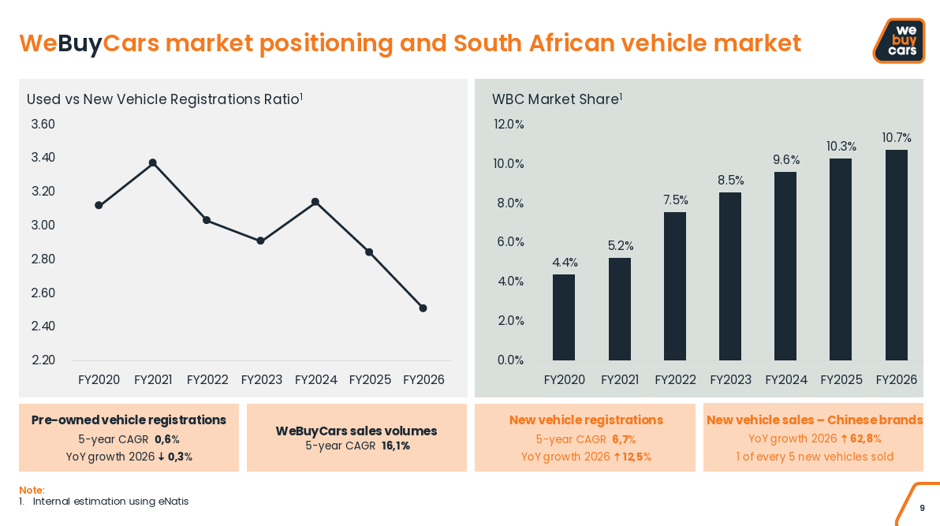
There’s a lot happening on this slide, but note the year-on-year movements here: -0.3% in used car registrations vs. 12.5% in new cars! It’s not enjoyable to be on the wrong side of that trend.
The Chinese brands (up 62.8% year-on-year) are driving a new car replacement cycle that few saw coming. WeBuyCars is one of many victims of this trend, as evidenced by the extraordinary correction in the share price:

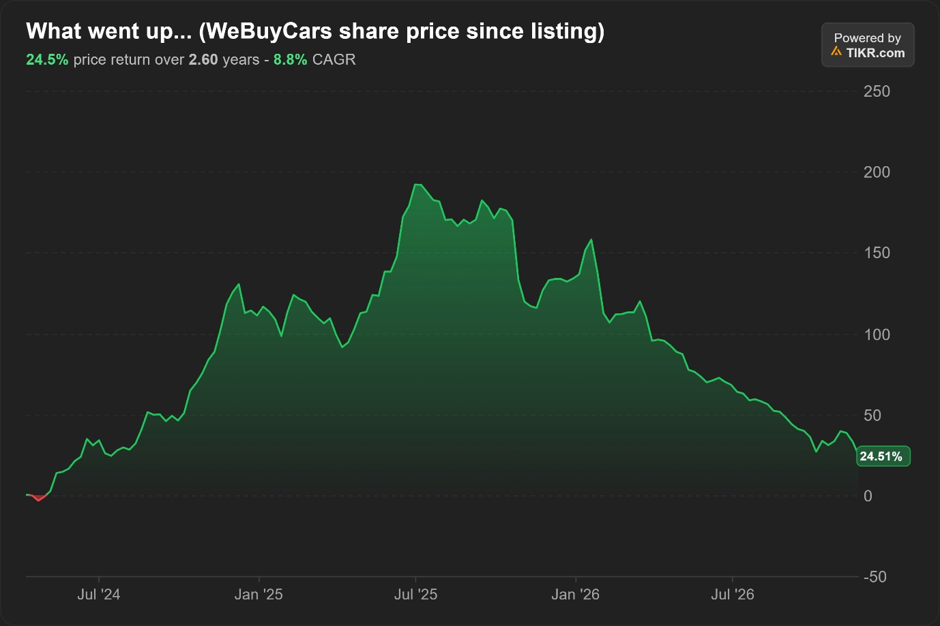
WeBuyCars – but are they selling them as well?
The problematic trend in the broader automotive industry can be directly observed in the key numbers at WeBuyCars.
The top of the income statement gets off to a decent start, with revenue up by 7.2% thanks to a 4.0% increase in unit sales and higher average selling prices. The issue doesn’t lie in getting the cars out the door. The problem also isn’t a lack of value-added services, as finance and insurance commissions grew by 7.2%.
Things go wrong from there, with EBITDA down by 13.1% thanks to the deflationary trading environment. On a related note, the write-down of inventory increased from 3.0% to 4.2%. The company attributes this to the inventory competing with the Chinese and Indian brands in the R300k to R550k price brackets.
Operating profit fell by 17.1%, with operating margin declining from 5.1% to 3.9%.
The net insurance result was up by 2.5%, so the pressure sat squarely in the selling prices for the vehicles relative to the purchase prices.
The 49% stake in GoBid gave the income statement a bit of help, with equity accounted income up from R6 million to R41 million. That’s small in the context of the net insurance result (R135 million) and total operating profit (R1.1 billion).
In fact, just the increase in net finance costs (up from R129 million to R173 million) more than offset the entire GoBid investment! WeBuyCars has been investing heavily in capacity, driving higher debt levels in the first three quarters of the year.
With core HEPS down by 18.6%, the question is whether WeBuyCars should’ve hit the brakes on the expansion while waiting for the market to settle.
Instead, they pumped the accelerator
WeBuyCars now has 22 supermarkets and 108 buying pods, so they are covering most of the significant urban areas in the country. This is a far more demanding base for further growth, an issue that plays out in trends like only a 40 basis points increase in market share over the past year vs. a 70 basis points increase in the prior year.
The company calls it “investing ahead of demand” when the number of parking bays jumped by 25.4% in this period vs. unit sales growth of only 4%. I would call it a land grab strategy in a weak market, which is either completely crazy or an inspired decision.
The trouble is that we will only know for sure in years to come.
In the meantime, this strategy has put pressure on margins and on the balance sheet, evidenced by the increased debt levels and associated funding costs.
But the really interesting analysis sits on the cash flow statement…
A working capital release for all the wrong reasons
Net cash from operating activities jumped by 48.2% in this period. That sounds wonderful until you start to dig into the reasons.
The deflationary market led to WeBuyCars taking a more conservative approach to buying in the second half of the year. The company also shifted aged inventories at depressed prices. Your first loss is your best loss as the saying goes, but it’s still a loss.
The benefit of this approach is that the cash required for inventory was far more modest than in the comparable period. The capacity was available after a period of rapid expansion, but WeBuyCars opted not to fill it.
In other words: they did hit the brakes, but not in terms of overall parking space.
Financial statements are difficult things to read, but here’s where the key info can be found:
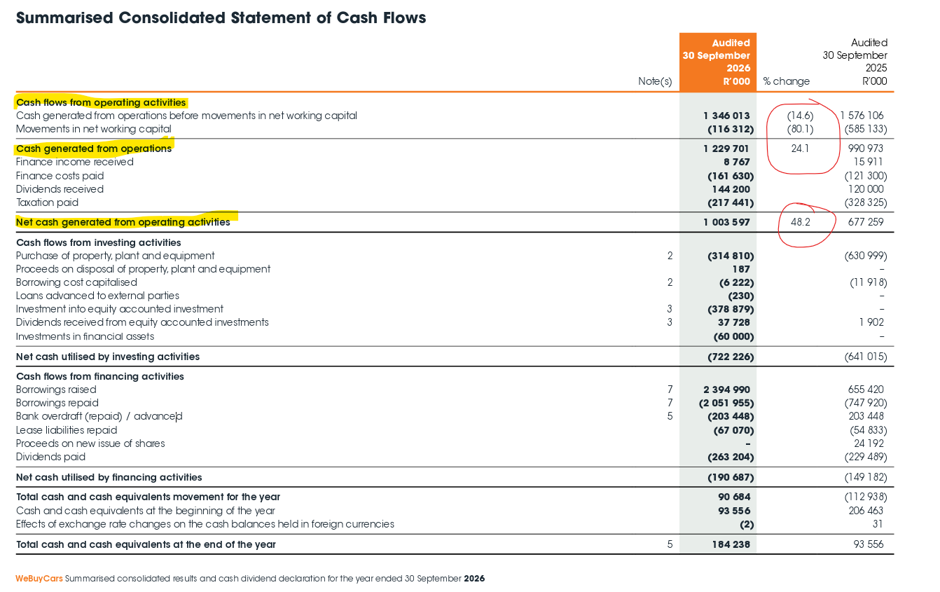
Note that the cash generated from operations before working capital movements was 14.6% lower. That gives us the cleanest view of how the business actually performed.
The movement in net working capital was 80.1% lower than the prior year, but this is an outflow i.e. a lower outflow is flattering for the cash flow statement. They invested just R116 million in net working capital in this period vs. R585 million in the prior period.
The net result? A 24.1% increase in cash generated from operations, painting a far rosier picture of the business than is actually the case. And thanks to a decrease in tax paid and a few other factors, the net cash generated from operating activities was 48.2% higher year-on-year.
Digging into the numbers explains why we’ve seen an incredible deviation between operating cash generation and the final dividend, with the latter down by 43.3%. That’s a nasty change in direction from the 10% growth in the interim dividend. The final dividend payout ratio decreased from 29% to 27%, still comfortably within the group’s dividend policy of paying between 25% and 33% of group headline earnings.
Where is the data narrative?
If you didn’t already know about the AI and data-led strategy at the group, you would be forgiven for missing it in this update.
The only place it really comes through strongly is in the comments made by co-founder Faan van der Walt as part of his retirement notes, as he is now moving into a non-executive role on the board.
Wynand Beukes moves from Deputy CEO to CEO, a succession plan that was beautifully telegraphed to the market over an extended period. Beukes brings plenty of digital experience to the role, as I discussed with him in this podcast earlier this year.
I just don’t understand why they aren’t making far more of a song and dance about the data edge in this update, particularly alongside such a weak trading performance.
Looking ahead
Sanity seems to have prevailed from a capacity utilisation perspective, with the narrative pointing to selected expansion e.g. a capital-light supermarket in Polokwane. That sounds like the right approach to me, as we just don’t know where the Chinese and Indian market share will settle.
WeBuyCars is looking to increase the stake in GoBid from 49% to 51%, which presumably means they would move from equity accounting to consolidating that business. The merger filing is currently sitting with the Competition Commission. I’m not against vertical integration in this space.
Overall, I’m still a shareholder in WeBuyCars. I was waiting for these results to see just how ugly they would be. I haven’t made a decision yet on what I plan to do with the P/E ratio now sitting at 11.7x. For context, both CMH and Motus are trading on 6x. I still like the long-term strategy at WeBuyCars and the level of data they have access to, but the latest results did a poor job of reinforcing that narrative to a market that was already jittery.
Everything you read in Ghost Mail is for informational purposes only and is never financial advice. You should always speak to your financial advisor. Where I disclose a position, this is for transparency purposes and should never be seen as an implied recommendation. This article is not an endorsement of the company.
For further analysis on the sector, you can check out the recent podcast I did with the Motus management team.
Keen to get JSE-listed company insights in your inbox every morning? Sign up to Ghost Mail here: