
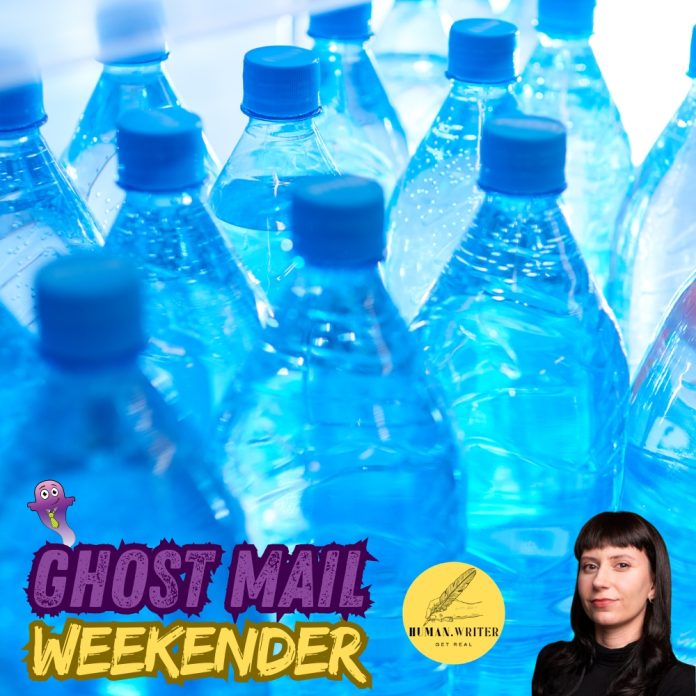
Bottled water has been sold to us as medicine, status symbol and safety net. This is a short history of paying for something that falls from the sky.
In the summer of 1789, as revolution simmered in France, a nobleman called the Marquis de Lessert decided to cool off in a small town on the shore of Lake Geneva.
He was unwell, by most accounts suffering from kidney trouble. During his stay he would take long walks every day, and often stop to drink from a spring in the garden of a local man named Cachat. With time, the Marquis’s health improved. There are many possible reasons for this – the effect of a prolonged period of rest, for example, or perhaps the fresh mountain air. But the Marquis declared with conviction that it was the water he drank from Cachat’s spring that healed him.
Doctors took note and began prescribing the magical “mineral water” to their patients. Cachat fenced off his spring and started charging for the water. And thus, the little town of Évian-les-Bains found its fortune in what would later become known as Évian water.
Whether the water really cured the Marquis hardly matters. There’s even some debate about whether the Marquis ever really existed at all, or whether he was invented by the clever folks over at Évian (I certainly can’t find any evidence of him that isn’t entangled in the Évian origin story).
What matters is what this story inspired: a series of concepts that nearly every bottled water brand has followed since – purity, place of origin, healing – all poured into a container and sold back to us at a premium.

For most of its history, bottled water was considered medicine. Medieval pilgrims carried small flasks of holy water home from shrines to ward off misfortune. The first recorded bottling of spring water took place in 1622 at the Holy Well in England’s Malvern Hills, a spring long credited with healing powers. People travelled to “take the waters” at healing centres at Bath, Vichy and Saratoga, convinced that spring water could fix whatever ailed them.
The water cures may have faded, but the belief they instilled in us hasn’t. Somewhere in the back of our minds, the idea persists that what comes out of the bottle is still cleaner, safer and better than what comes out of the tap. The Marquis’s kidneys (if they ever existed) are long forgotten. But the sales pitch they inspired is still on every label.
The tap fights back
Back in the 19th century, the bottle certainly had a strong case for being the safer option. Cities were growing faster than their plumbing, and the water that reached people’s homes often came from the same rivers that carried their sewage away. Unsurprisingly, cholera and typhoid moved through these supplies with devastating ease.
In 1854, the London physician John Snow (yes, I see you, Game of Thrones fans) famously traced a cholera outbreak in Soho to a single contaminated public pump on Broad Street. Against that backdrop, buying bottled water from a spring wasn’t vanity; it was a reasonable precaution for anyone who could afford it. As for the people who couldn’t afford it… well, they took their chances at the tap.
Then, on 26 September 1908, a chlorination plant at the Boonton Reservoir began disinfecting the water supply of Jersey City in New Jersey. The idea came from Dr John Leal, a public health advisor who was on the frontlines of fighting typhoid. Despite the fierce resistance from his peers, Leal’s idea worked. Waterborne disease fell, the practice spread, and by the 1920s chlorination had become the standard across America.
No doubt this was an anxious moment for Big Spring Water. After all, if the tap was proven to be safe, and could deliver drinkable water right into people’s homes, there was no reason to pay for a bottle. In America, the industry wobbled, but didn’t collapse. It retreated into offices, where the gurgling water cooler became a fixture of working life, while in Europe the bottle never really lost its place at the table.
In 1974, the tap’s saviour turned suspect. Scientists in Rotterdam and New Orleans found that the chlorine used to purify drinking water could react with organic matter to form compounds linked to cancer. The risks were small and the water was still far safer than anyone in the 19th century could imagine, but the seed of doubt had been planted.
Three years later, someone came along to water it.
In 1977, Perrier made its big push into the United States with a campaign voiced by Orson Welles, the man whose (very believable) 1938 radio adaptation of The War of the Worlds had famously sent listeners into a panic about a Martian invasion. Now that same voice promised water that was naturally sparkling – aka not chlorinated – and drawn from the centre of the earth. Perrier priced it with care: cheap enough to buy, just aspirational enough to say something about you.
Bottled water had become a statement.
Pure, until proven otherwise
Purity is a powerful concept to sell. Unfortunately, it also shatters easily.
In 1990, a laboratory in North Carolina found benzene, a known carcinogen, in bottles of Perrier water. The company first blamed a worker who had cleaned equipment with the wrong solvent. It later admitted the real cause was a filter that hadn’t been changed. Around 160 million bottles were recalled worldwide. To add further insult to injury, Perrier was also pushed to drop the words “naturally sparkling” from its labels.
Then came the Dasani debacle. In 2004, Coca-Cola launched its Dasani bottled water in Britain with a multimillion-pound marketing push, promising a highly sophisticated purification process. The press soon discovered that the source wasn’t a mineral spring at all, but rather plain old tap water from a factory in Sidcup, a London suburb.
Weeks after launch, tests found bromate, a suspected carcinogen, at up to twice the legal limit. It hadn’t come from the tap, which inspectors confirmed was clean. It had been created through Coca-Cola’s own purification process. Half a million bottles were recalled, and the brand left the UK with its tail between its legs.
So should we trust what’s marketed to us?
Perhaps not on the strength of words like “pure”, which is marketing language rather than a guarantee.
In much of the world, municipal water is tested constantly, and the results are a matter of public record. In South Africa, for instance, the Department of Water and Sanitation publishes Blue Drop reports grading the water systems of municipalities across the country. South African public bodies have an extremely patchy track record, but the principle is there.
Of course, bottled water is regulated too, but you’re far less likely to see its test results. Most of the time, all we have to go on is the label, and the label is written by the people trying to sell you the bottle.
Who owns a drink of water?
In a 2005 documentary, We Feed the World, Nestlé’s then-CEO Peter Brabeck-Letmathe dismissed as “extreme” the NGO push to declare water a public right. Water, he argued, should instead have a market value like any other foodstuff. The clip still circulates, and Nestlé is still fielding questions about it to this day. In fairness, Brabeck-Letmathe has since clarified that he believes the water people need to survive is a human right. But the remark touched a nerve because it voiced a tension the industry would rather we didn’t notice: if water is a right, why does access to it so often depend on what’s in your wallet?
In 2010, the UN General Assembly formally recognised safe drinking water and sanitation as a human right. No country voted against it, though 41 abstained. South Africa got there earlier: our Constitution guarantees everyone the right to access sufficient water.
Yet we know how quickly that right can start to feel like a product.
During the Day Zero crisis in 2018, Capetonians queued at springs and stripped supermarket shelves of bottled water. In Johannesburg, repeated outages have pushed households towards boreholes and bulk buying. When the public system falters, the bottle fills the gap, but only for those who can afford it.
Back to the spring
Today, in Évian-les-Bains, the Cachat spring where the Marquis drank still flows. Locals and tourists alike turn up with their own bottles and fill them for free.
The water that launched an industry is, at its source, still a public tap. What we buy in the bottle is mostly reassurance. Sometimes that’s worth paying for, but the real luxury, and the one worth protecting, is a tap you can trust.
About the author: Dominique Olivier


Dominique Olivier uses her love of storytelling and ideation to help brands solve problems.
Her first book, Lessons from Loss, has been published by Penguin Random House.
She is a weekly columnist in Ghost Mail and collaborates with The Finance Ghost on Ghost Mail Weekender, a Sunday publication designed to help you be more interesting.
You can learn more about her work at dominiqueolivier.com and she can be reached on LinkedIn here.