

In this edition of Ghost Bites:
- Blu Label Unlimited looks forward to reporting easier numbers in future
- DRDGOLD beat their production guidance for FY26
- Exxaro’s HEPS has dipped significantly
- A much better year at KAP as PG Bison ramps up production
- NEPI Rockcastle wants some of that sweet Spanish action
- Resilient REIT’s performance boosted by more affordable funding
- STADIO achieves mid-teens growth
- A significant number of director dealings and other Nibbles
In addition to these updates, you can read my more detailed work on Truworths and Rainbow Chicken here. There’s also a deep dive on Weaver Fintech available here. The next planned deep dive is on Standard Bank.
Blu Label Unlimited looks forward to reporting easier numbers in future (JSE: BLU)
But for now, it’s still a messy affair
Blu Label Unlimited’s trading statement for the year ended May 2026 will create more questions than answers. As usual, the group’s accounting is complicated and has led to a major move in earnings. The impact of the listing and restructuring of Cell C (JSE: CCD) continues to skew the numbers.
If you completely exclude Cell C, then Blu Label would’ve had revenue of R9.4 billion and core headline earnings of R681 million, equating to 75.33 cents. “If” is a big word, but at least Cell C has now gone through its restructuring process and is a separately listed company with its own balance sheet. Going forwards, the Blu Label results should be much cleaner and easier to understand.
But for now, without taking Cell C out, HEPS has dropped by between 81% and 83%. Core HEPS is much the same, down by between 80% and 82%.
DRDGOLD beat their production guidance for FY26 (JSE: DRD)
That’s not the same thing as achieving growth in production

DRDGOLD’s trading statement for the year ended June 2026 is a great example of how lucrative the gold sector can be when the gold price is doing well. Despite flat production and only a 1% increase in gold sold, HEPS has jumped by between 85% and 95%. The average gold price received increased by 40% in rand terms, while cash operating costs per kilogram were only up by 7% overall.
Notably, capital expenditure jumped by 57%. DRDGOLD is busy with a significant expansion programme at the moment (called Vision 2028). One of the areas where they’ve been focusing is energy supply, with the investment in solar plants and battery storage systems helping to mitigate some of Eskom’s inflationary pressure on operating costs. Although the group is currently free of debt, they have an undrawn R1 billion revolving credit facility in place to support the capex plan over the coming years.
Although production was flat, it’s also worth highlighting that they came in above their production guidance for the financial year. Always keep in mind that beating guidance and growing year-on-year are completely unrelated concepts.
Exxaro’s HEPS has dipped significantly (JSE: EXX)
There’s a mix of external and internal pressures
Exxaro’s trading statement for the six months to June reflects the impact of lower income from Sishen Iron Ore and Black Mountain Mining. The strengthening of the rand against the US dollar has played a role here, as have inflationary pressures on input costs. Black Mountain Mining can’t only blame external factors though, as there was also a delayed ramp-up of the Gamsberg project.
Despite flat EBITDA vs. the prior period, HEPS has fallen by between 18% and 23%. When full results become available, it will be interesting to see what happened between EBITDA and HEPS. Depreciation and interest costs are the usual suspects where you see this kind of mismatch, although taxes can play a role as well. But generally, if there has been heightened capex or the introduction of more debt, then you’ll find the costs with these decisions coming in below the EBITDA line.
A much better year at KAP as PG Bison ramps up production (JSE: KAP)
But I’m really waiting to read the outlook statement, especially for Safripol
KAP’s updated trading statement for the year ended June 2026 gives shareholders a tighter earnings range to work with. The initial trading statement for the period noted an expected increase of more than 50% in HEPS. We now know that the jump is a lot better than that!
HEPS is up by between 82% and 92%, which means an expected range of between 43.8 cents and 46.2 cents. The share price closed 7.5% higher in response to this update. At R2.86 per share, the mid-point of this rage is a Price/Earnings multiple of 6.4x.
FY25 was a soft base for a number of reasons, so investors will be careful of how they extrapolate these numbers. The ramp-up of the new MDF line in PG Bison is making a significant difference here. A reduction of net debt by more than R1 billion is also the happy outcome of a period in which KAP was strongly cash generative. This debt reduction is literally double their target!
The fact that there are impairments in this period at Sleep Group, Safripol and Optix tells you that there are still divisions that are having a tough time. The company will pay a lot of attention when the company releases its outlook statement as part of the full results on 1 September.
NEPI Rockcastle wants some of that sweet Spanish action (JSE: NRP)
The company is branching out of Eastern Europe
NEPI Rockcastle is synonymous with markets like Poland. This fund showed South African institutional investors what can be achieved when you find success in Eastern Europe. Now, they’ve decided to ride the growth train in Spain, where rivals like Vukile Property Fund (JSE: VKE) and Resilient REIT (JSE: RES) have found success.
NEPI is doing this via the acquisition of MegaPark Barakaldo (a mall located in Bilbao) for €254 million. The net initial acquisition yield is 6.8%, serving as a good reminder that Spain offers a healthy mix of yield and underlying macroeconomic strength. Through a combination of growth in tourism and the lowest unemployment rate since 2008, Spain’s economy is highly supportive of retail landlords at the moment.
With a 97.3% occupancy ratio and a strong catchment area in Spain, NEPI is sticking to its knitting by focusing on high-quality properties. It’s a new country for them, but not a major deviation from how they do things in the property space.
Resilient REIT’s performance boosted by more affordable funding (JSE: RES)
Resilient REIT’s dividend per share growth in the six months to June 2026 was 11.7%. They managed this growth despite renovations taking place at six of the 28 retail centres in the portfolio, so I think that’s a great outcome.
Based on the solid positive reversions in leasing activity (i.e. new leases at a premium to outgoing leases), retailers clearly value Resilient’s space. The portfolio is unusual in that it has no Western Cape exposure at all. Instead, you’ll find significant exposure to a wide range of provinces, including malls in lower income areas that have strong growth prospects.
The fund also has a stake of 27.3% in Lighthouse Properties (JSE: LTE), a company that has found success in Western Europe. Markets like Spain supported strong dividend growth at Lighthouse. Together with a solid performance by the properties in which Resilient has a direct co-investment alongside Lighthouse, the offshore exposure was a boost to performance in this period.
The balance sheet also did a lot of heavy lifting, with interest rates down 70 basis points vs. the prior period. When combined with a refinancing of facilities at better pricing and the underlying performance in the portfolio, Resilient shareholders were spoilt with double-digit growth in the dividend.
STADIO achieves mid-teens growth (JSE: SDO)
The tertiary education model remains in good shape
STADIO’s trading statement for the six months ended June 2026 tells an encouraging story, with the company expecting HEPS to be up by between 12.1% and 19.8%. If you use core HEPS instead, the growth rate is between 14.5% and 22.2%.
I look forward to seeing the Durbanville Campus in the coming weeks. I also have a podcast scheduled with management, so keep an eye out for that!
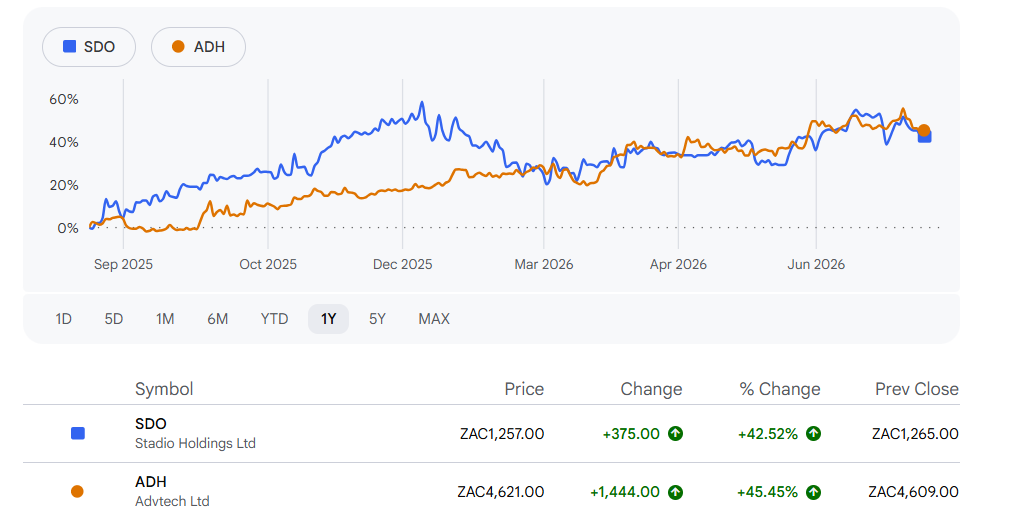
The 12-month performance vs. rival Advtech (JSE: ADH) is about as close a race as you’ll find anywhere:
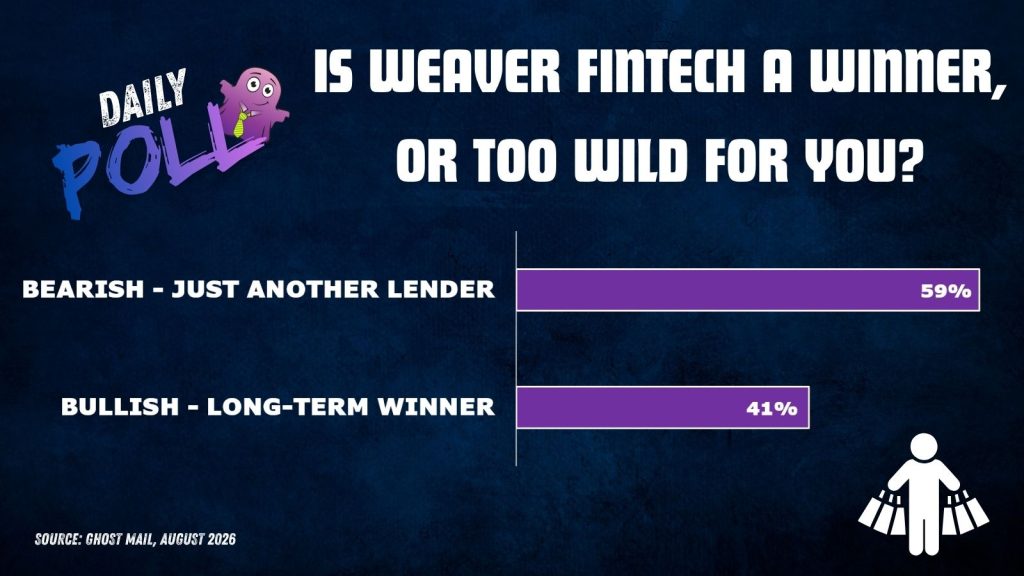
Results of previous poll:
Selected Nibbles:
- Notable director dealings:
- A2 Investment Partners, the vehicle linked to Nampak (JSE: NPK) director André van der Veen, bought shares in that company worth a meaty R63 million. Separately, the CFO of Nampak entered into a collar hedge over shares worth R16 million and also sold around R4 million in shares in an off-market deal. It looks like the recent purchases by A2 included being on the other side of the CFO’s disposal.
- A number of Vunani (JSE: VUN) directors bought shares in the company worth nearly R1.1 million in aggregate.
- A director of a major software subsidiary of Araxi (JSE: AXX) received shares awards and sold the whole lot for an after-tax amount of R588k. Given that this part of Araxi’s group has been a headache for shareholders, I would treat this as bearish.
- A South African entity linked to a director of Canal+ (JSE: CNP) bought shares worth R291k.
- The CEO of Marshall Monteagle (JSE: MMP) bought shares worth R264k.
- A director of Southern Palladium (JSE: SDL) sold shares worth R163k.
- A director of Huge Group (JSE: HUG) bought shares worth R45.6k.
- A director of Stefanutti Stocks (JSE: SSK) bought shares worth R41k.
- The Lead Independent Director of Sirius Real Estate (JSE: SRE) reinvested dividends worth R32.2k in the company. This was part of a broader dividend reinvestment plan offered by the company, in which holders of 0.95% on the UK register and 6.78% on the SA register elected to reinvest their dividends in shares. These are shares purchased in the market, not new shares issued by the company.
- The CEO of Salungano Group (JSE: SLG) bought shares worth R29k.
- Reinet (JSE: RNI) has announced the next instalment of its share buyback programme. Having already repurchased shares worth €500 million, they are now looking to implement buybacks of €250 million between 18 August and 15 December 2026.
- MC Mining (JSE: MCZ) has announced that Kinetic Development Group will provide the company with capital support of up to $16 million. This takes the form of an unsecured bridge loan of $8 million, as well as an eventual subscription for new shares of $16 million. The bridge loan will be set off against the first tranche of the equity subscription. You may recall that Kinetic is already the controlling shareholder of MC Mining, having taken a 51% stake in the company. This stake looks set to increase over time.
- Novus (JSE: NVS) has bought another R43.4 million in shares in Mustek (JSE: MST). This increases the Novus stake from 51.91% to 56.86%. They are up to 77.15% if you include the concert parties.
- Copper 360 (JSE: CPR) released results for the year ended February 2026. The loss after tax worsened by 14.2% to R366.8 million. This is the messy company that Neal Froneman is trying to become involved in as the new Chairman.
- Eastern Platinum (JSE: EPS) released results for the second quarter of 2026. Revenue fell by 25.8% year-on-year. Production was so low that the company reported a negative gross margin of -53%. That’s not something you’ll see every day! This has been going on for a while at the company, with ongoing operating losses and a working capital deficit. Run-of-mine processing at the Crocodile River Mine is running behind targets.
- Dipula Property Fund (JSE: DIB) has renewed its bland cautionary. They’ve been trading under cautionary since May. Shareholders are none the wiser as to what the company is busy negotiating.