

In this edition of Ghost Bites:
- Copper 360 pulls a rabbit out of the hat with Neal Froneman
- Pick n Pay’s grocery business is showing some positive signs
- Quilter’s distribution model shines through once again
- Sappi’s outlook for the fourth quarter gives speculators something to latch onto
Copper 360 pulls a rabbit out of the hat (JSE: CPR)
As announcements of new Chairmans go, this is a big one
Copper 360 has been a less-than-joyous story for investors. In fact, it’s been catastrophic. The share price has shed nearly 90% of its value over three years.
But out of nowhere, like Gandalf arriving at Helm’s Deep at first light on the fifth day, a saviour has emerged. Rupert Smith has retired as Chairman, making space for none other than Neal Froneman (of Sibanye-Stillwater fame) to be appointed as an independent non-executive director and Chairman of the board.
Ghost Bite: Within an hour of this announcement, the share price had shot up 18%. I’m not surprised at all.
Pick n Pay’s grocery business is showing some positive signs (JSE: PIK)
Comparing the like-for-like growth to Boxer is interesting
Pick n Pay has added its name to the list of recent retail updates on the JSE. We know that the apparel retailers have been struggling with weak sales this winter. But how did Pick n Pay do?

This retailer is still deep in turnaround mode, so they are closing or converting underperforming company-owned supermarkets. This means that total group turnover was flat for the 20 weeks to 19 July 2026. Pick n Pay’s like-for-like sales growth was 2.6% overall.
If we focus on the South African business, we find 1.9% like-for-like growth in South Africa vs. a 0.4% decline in total turnover. The impact of store closures is more than offsetting the like-for-like growth. Internal selling price inflation was 1.3%, lower than the 1.9% in FY26. CPI Food inflation was 2.5%, so Pick n Pay is having to implement below-inflation increases to compete.
The odd situation around company-owned vs. franchise stores continues, with company-owned supermarkets growing like-for-like sales by 3.3% (and volumes up by 2.0%). The franchise stores could only manage like-for-like growth of 1.3%. I still scratch my head about how a store with a salaried manager can be outperforming a franchisee who has invested a fortune in their store, but there we have it. This has been going on for a couple of years now.
The online business grew by a solid 37.5%, so Pick n Pay isn’t being completely left for dead by Shoprite (JSE: SHP) and their Sixty60 offering, or Woolworths (JSE: WHL) with Dash.
On the clothing side, clothing sales in standalone stores decreased by 1.3% on a like-for-like basis. That’s a poor performance for a value-focused clothing retailer, even in the context of recent struggles for SA consumers. At least it’s better than the terrible -5.6% they reported in the second half of FY26. Total clothing sales increased by 3.3%, so they are opening more clothing stores while they close underperforming grocery stores.
The company is still busy with the s189 process to try and rectify the labour costs in its stores. As you can imagine, the trade unions are all over this thing. It’s sad that years of poor decision making at head office will lead to job losses in the stores, but that’s unfortunately how these things go. It’s why executives get paid a lot of money, as they have a responsibility that filters all the way down.
To end on a positive note, keep in mind that Pick n Pay still has a controlling stake of 53.1% in Boxer (JSE: BOX). As we know from Boxer’s recent update, that excellent retailer grew sales by 2.2% on a like-for-like basis in the latest period. It’s interesting to note that this was only 30 basis points ahead of Pick n Pay South Africa!
But if you strip out the relative inflation in both businesses, the gap is larger, as Boxer had to navigate deflation of -1.9% vs. Pick n Pay’s 1.3%. Importantly, both still achieved positive volumes.
Ghost Bite: Other than the concerning performance in Pick n Pay Clothing, this looks like one of the better recent updates from the embattled retailer.
Quilter’s distribution model shines through once again (JSE: QLT)
Strong distribution is the real moat in wealth and asset management
Quilter, the UK-based asset and wealth manager with a strong distribution model, has reported results for the six months to June 2026.
By going out and hunting for assets, rather than hoping that airport ads will do the trick, Quilter tends to achieve solid inflows. This period was even better, with record core net flows of £6.0 billion (up 32%). Importantly, this represents 9% of their opening assets under management and administration (AUMA).
Together with positive market movements, AUMA ended the period 11% higher than at the end of December 2025. Remember, this is growth for only six months!
Revenue was up 12%, with management fees on assets driving their growth. Cost growth was 13% though, so this was a period of heightened investment in the platform. Adjusted pre-tax profit grew by 12%.
HEPS is far less exciting than adjusted earnings, dipping from 3.4 pence to 3.3 pence per share. The group would instead like you to consider adjusted diluted earnings per share, with an increase of 13%.
The answer, as usual, is probably somewhere in the model. Cash remains king in this world, with the interim dividend up by 5%.
The company is executing significant share buybacks. It looks like they bought back roughly £60 million in shares in this period based on the timing of the tranches. This is part of a broader £100 million programme to be completed by the end of the year.
For context, interim adjusted profit before tax was £112 million. There’s a lot of cash flowing back to shareholders at the moment.
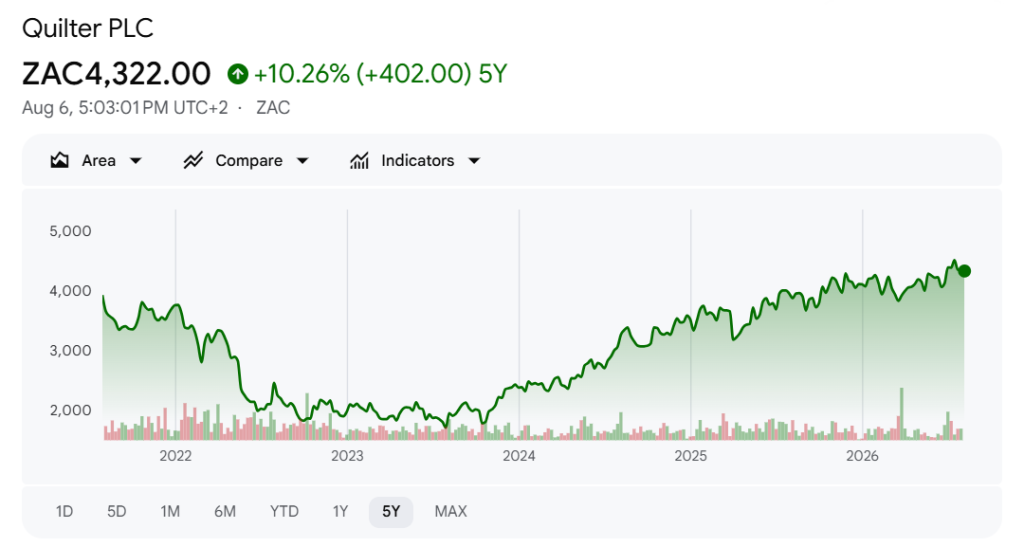
Ghost Bite: In my opinion, asset and wealth management firms should be judged primarily on inflows. On that metric, Quilter tends to be a strong performer. They have various distribution channels that performed really well in this period. That’s why the share price looks like this:
Sappi’s outlook for the fourth quarter gives speculators something to latch onto (JSE: SAP)
But I’m still avoiding this one
Sappi’s share price closed 12.6% higher after the release of results for the third quarter of 2026. Before I go any further, let me zoom out to give you full context:
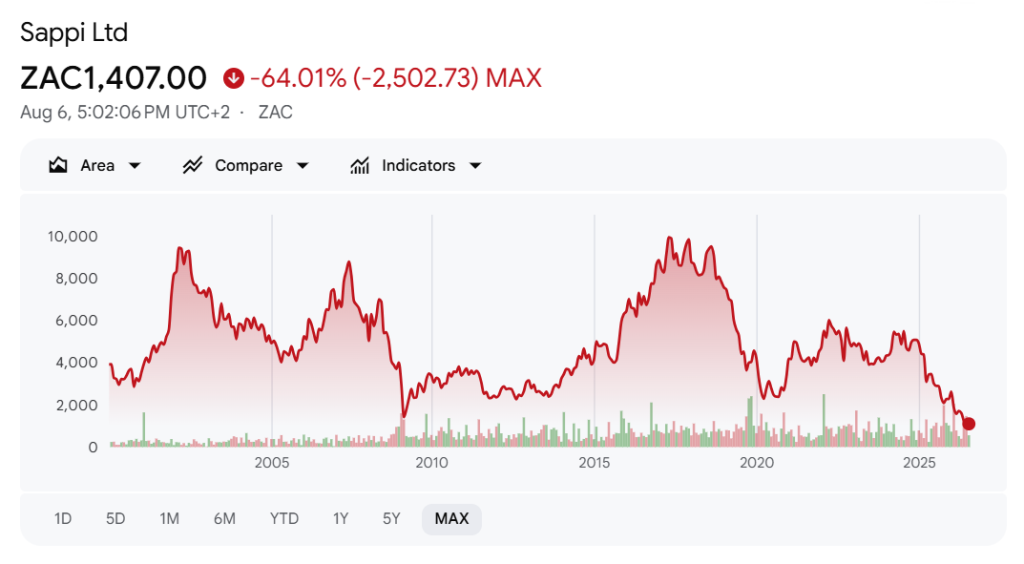
As you can see, the latest move doesn’t even register on a long-term chart. If you ever wondered what a cyclical share price chart looks like, you now have your answer.
It’s not like the numbers were anything to feel good about when viewed in isolation. Revenue was up by just 1%. Adjusted EBITDA fell by a nasty 34%. The headline loss per share worsened from 5 US cents to 27 US cents. On top of all this, net debt was up 3%.
If you can believe it, this is “in line with the improved guidance” given to shareholders. Talk about low expectations!
Escalating fuel costs just added fuel to the fire, with Sappi already dealing with multiple challenges in its business. Selling prices are under pressure across most of Sappi’s product categories. An increasingly digital world is a hostile place for paper and pulp.
The “highlight” was packaging and speciality papers, where volumes were up 14%. But those inverted commas are critical, as profitability actually declined in this sector on a year-on-year basis, not least of all due to a scheduled maintenance shut.
To their credit, profitability in the graphic paper segment was only marginally lower than the prior year. There’s been a lot of focus by management on right-sizing and restructuring this part of the business. Sales volumes fell 6% though, so they appear to be fighting a losing battle.
So, why did the share price go up?
The answer lies right at the bottom of the announcement, with Sappi estimating that adjusted EBITDA for the fourth quarter will be “materially above that of the third quarter”. Given that adjusted EBITDA was just $53 million for Q3 and that Sappi reported a net loss of $181 million, adjusted EBITDA will need to be 4x higher just to get them into the green.
Ghost Bite: Every now and then, I’m tempted to take a speculative position based on the long-term chart. But each time, I stop myself based on the demand trends for Sappi’s products. I fear that this cyclical business has slipped into structural decline.
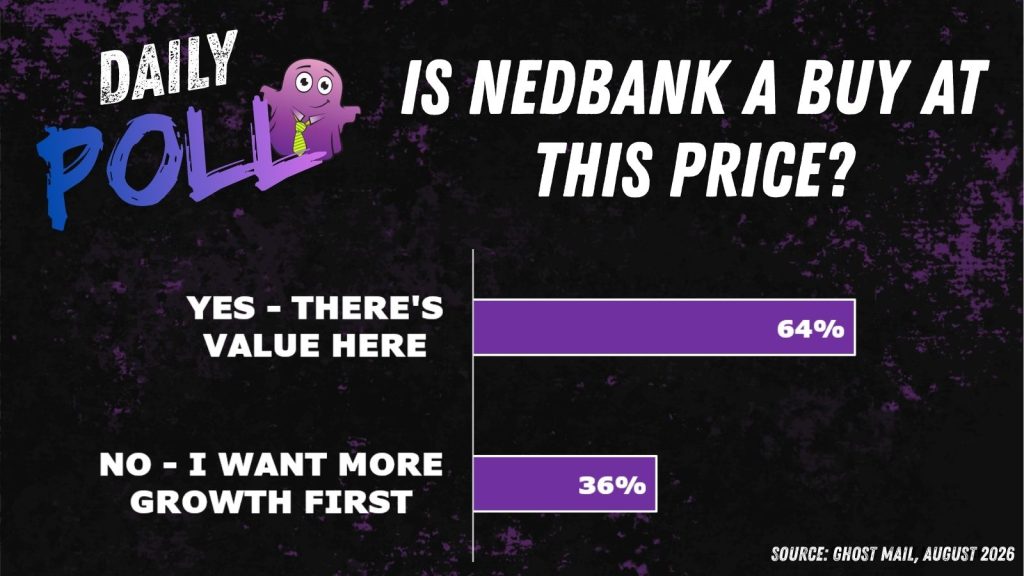
Results of Nedbank poll:
Nibbles:
- Director dealings:
- An executive member of the board of Richemont (JSE: CFR) sold shares worth nearly R35 million. That’s a nice payday for somebody! As the company is Swiss, we have no idea which director actually sold the shares, so it really is “somebody” in this case.
- The CEO of Sirius Real Estate (JSE: SRE) sold shares worth around R11.2 million. That’s a significant trade, although his remaining stake in the company is worth more than R280 million.
- The CEO of Salungano (JSE: SLG) bought shares worth over R3.3 million.
- ASP Isotopes (JSE: ISO) has announced a take-or-pay deal at Renergen. And no, it’s not for helium! This is a liquefied natural gas (LNG) transaction with a domestic food processor. This five-year take-or-pay contract does what it says on the tin, with Renergen now sitting with secured contracts that underpin 75% of the LNG volumes in Phase 1. Of course, the market is waiting nervously for helium production to start, with big promises being made about this happening in the coming months.
- Montauk Renewables (JSE: MKR) published results for the six months to June 2026. This stock is well off the beaten track on the JSE, so I’m just giving them a mention down here. Although revenue was up by 14.5% and EBITDA jumped by 85.4%, this was still only good enough for the company to creep into the green at headline earnings level. They moved from a headline loss of $4 million in the comparable period to headline earnings of $1.1 million in this quarter. That’s just $0.01 per share in HEPS vs. a net asset value per share of $1.85. Not exactly a money spinner, is it? The share price has shed a whopping 83% over 3 years!
- As regular readers know, Brait (JSE: BAT) is busy with a value unlock strategy that has included asking shareholders for more money. Odd, I know. Part of the plan is to make changes to the capital structure, with the relevant transaction steps requiring holders of exchangeable bonds to vote in favour of the transaction. The good news is that bondholders are playing ball, with the terms and conditions successfully amended. Shareholders are watching with scepticism though, evidenced by the resolution at the AGM that deals with the board’s authority to issue ordinary shares. 49.5% of votes at the meeting were cast against this resolution!
- Southern Palladium (JSE: SDL) requested a trading halt on its ASX listing. We’ve finally seen some sense prevail here, as the JSE has also halted trade in the shares. Usually, the halt is only on the ASX and not on the JSE! Under ASX rules, a halt is needed pending the release of an important announcement. We will now wait and see what it is.
- Sable Exploration and Mining (JSE: SXM) has successfully convinced the JSE that the transaction with Daemaneng Minerals re: the management of the Lapon beneficiation plant is in the ordinary course of business. It’s simply the appointment of a contractor. It’s therefore not going to be considered a Category 1 transaction. Sable has avoided an onerous outcome here.