

Ghost Mail is a daily dose of analysis on JSE-listed company news. If you’re craving a proper financial lens on local company performance, view the recent newsletters and sign up here>>>
The Woolworths (JSE: WHL) trading update for the 19 weeks to 8 November 2026 was the catalyst for a negative move of 8.5% in the share price.
Group sales increased by just 0.2% overall, or 0.1% in constant currency.
Disappointing group numbers at Woolworths are as consistent as the rotisserie chickens that we all buy from time to time. This means we have to dig into the underlying performance to learn anything useful.
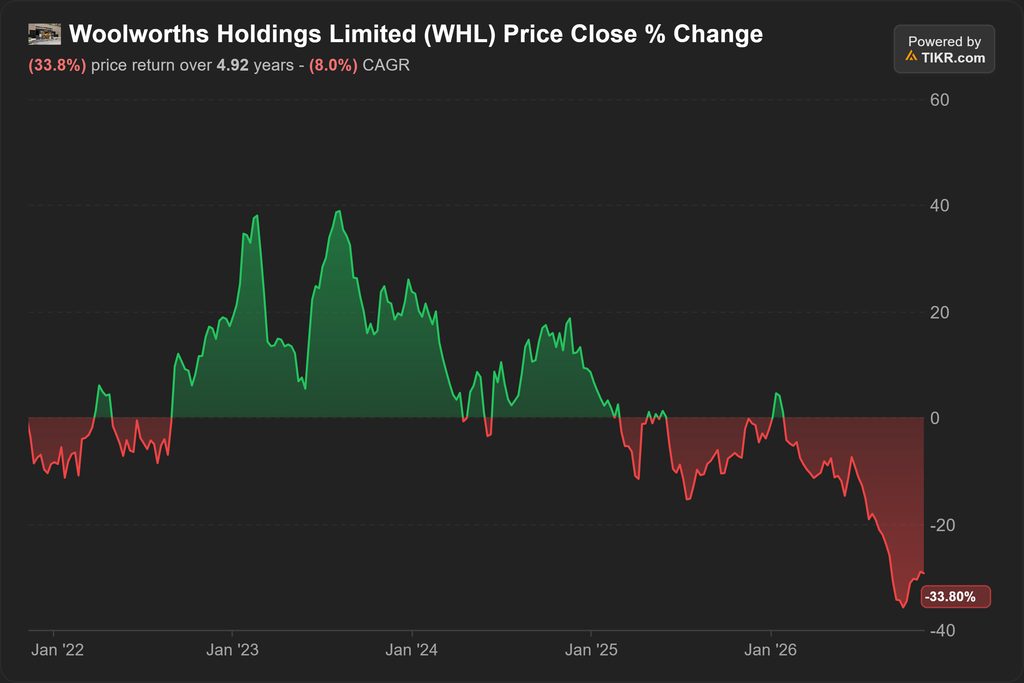
Before we do that, let’s examine the experiences that investors have had in the Woolworths ovens over the past five years:
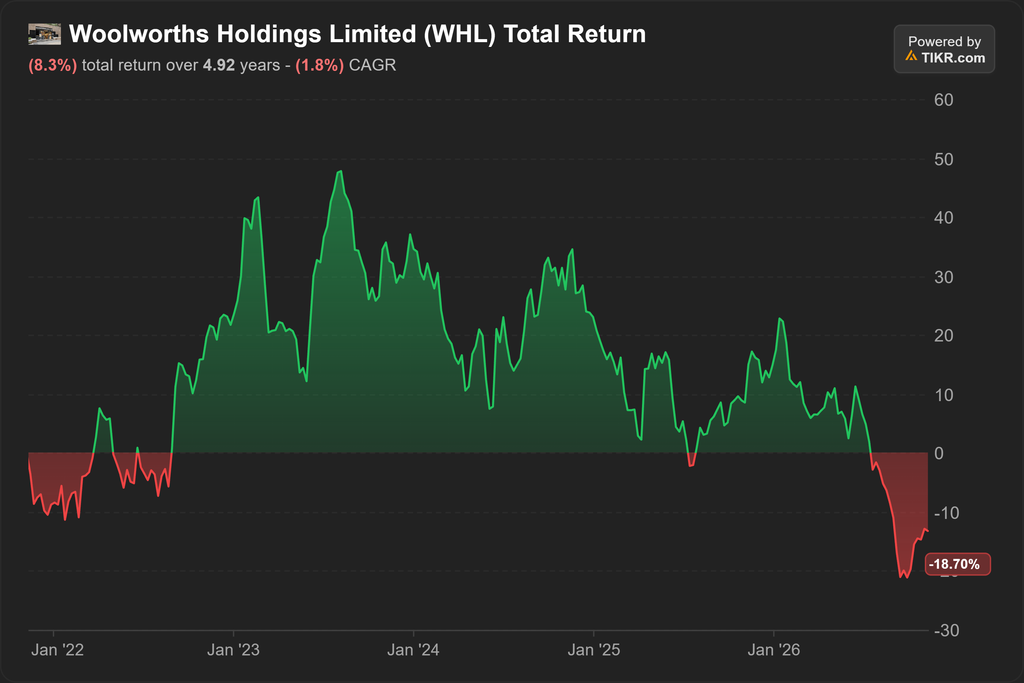
Even with dividends included, investors would still be in the red:

Now for the more interesting chart
Here comes the chart that I think really tells the story, dealing with the Price/Sales multiple going all the way back to the Global Financial Crisis:
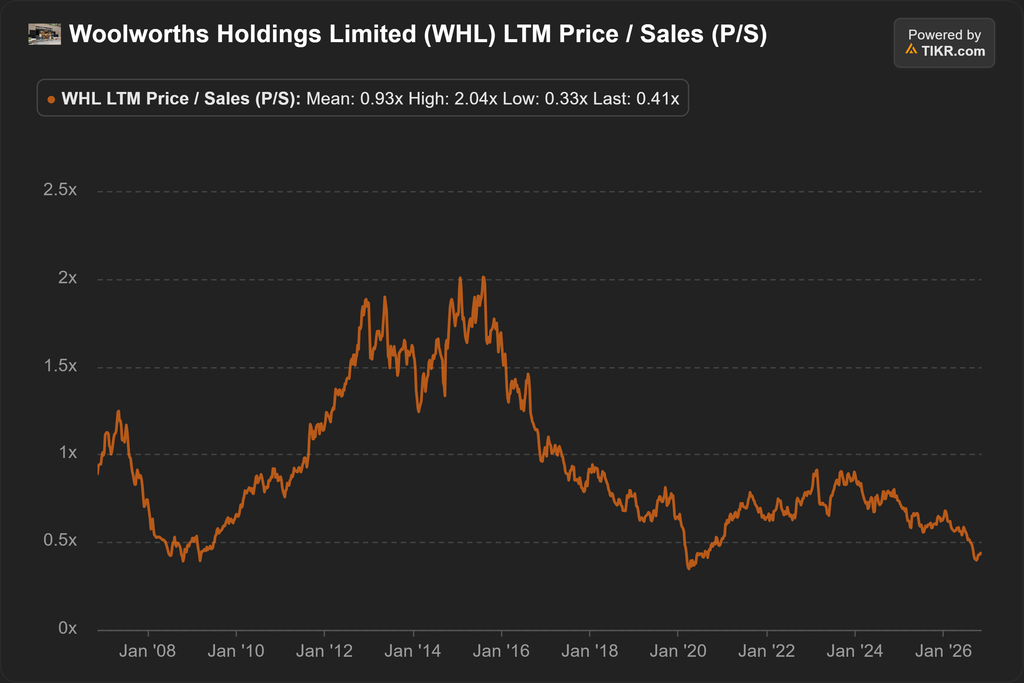
Note the crazy period in the middle of the “Lost Decade” where the market celebrated companies that were going offshore. Woolworths acquired the now-nearly-defunct David Jones in 2014. The Price/Sales multiple subsequently peaked at over 2x in 2015.
Today, Woolworths trades at just 0.4x – not much higher than the low of 0.33x in the worst of the pandemic. What an utterly awful journey over 10 years!
Price/Sales is a very simplistic multiple that doesn’t give you all the answers. But it does tell us something about market sentiment towards a retailer that many South Africans would describe as their favourite place to buy food.
But are enough people shopping at Woolworths Food?
The short answer: no.
The market is used to seeing weak numbers from the apparel business, but nobody was ready to see Woolworths Food delivering turnover growth of just 1.9%.
It’s even worse on a comparable-store basis, with Woolworths Food up by just 0.1%.
If you’ve been following the grocery sector, you might be wondering if deflation is to blame. Alas, price movement was 3.0% for the period, so it seems very likely that Woolworths Food suffered negative volumes here.
The only real highlight was an increase in online sales of 24.1%, now contributing 9.1% to South African food sales. It’s amazing how many retailers are currently running at an online penetration rate of between 9% and 11%.
Is there hope in Fashion Beauty Home (FBH)?
Perhaps some, but not much.
FBH experienced a sales decline of 0.3% (both overall and on a comparable store basis). Net trading space decreased by 0.7% relative to the prior period. This part of the business has been shrinking for a while as Woolworths tries to figure out an effective way to compete in this hugely competitive market.
My wife and I think they should go upmarket and just copy everything that Poetry is doing, but what do we know?
Price movement was 1.2% over the period, which suggests that volumes suffered a decline in this period. Fashion experienced deflation of 0.3%, so there must’ve been significantly higher price movements in Beauty and Home to balance things out.
Beauty has been a huge focus area for Woolworths, yet sales increased by just 3.1%. Homeware was a better story, up by 6.4%.
Online sales were up by 16.1%, contributing 7.0% to SA sales – a penetration rate that sits below some major competitors. If the group is decreasing trading space in these categories, they need to get that online penetration up.
Even Woolies customers are struggling
The Woolworths Financial Services book increased by 4.1%, a rate above the Woolworths South Africa sales of 1.6%. This suggests that credit sales gave the numbers a much-needed boost.
The problem is that the macroeconomic environment has deteriorated, leading to the annualised impairment rate for the four months increasing to 7.3% (vs. 6.7% in the prior period).
And yes, it’s even worse in Australia
Just when you thought that the David Jones nightmare was fully behind Woolworths after they got rid of that “asset”, there’s a sting in the tail. I suppose this is to be expected from a country that is famous for poisonous animals.
Various Country Road Group brands trade as concessions within David Jones, which has now been placed into administration and receivership. It’s not clear at this stage what that means for the trading relationship, but it can’t be good.
It’s not like the rest of the footprint is doing well either, with sales down 9.5% for the period and 8.2% on a comparable store basis. Online sales fell roughly in line with in-store sales. Net trading space fell by 2.2% for the period as they try to shrink into prosperity.
If there’s a small silver lining anywhere, it’s that Country Road Group had reduced markdowns and thus better gross margins.
Sadly, the market needs far more good news than that.
Tough scenes
The awful outcome over the past decade can be at least partially attributed to the disastrous deal in Australia. We know this. It’s in the past, and I don’t see this management team doing anything even remotely like that.
The bigger worry is that the latest pressure has nothing to do with M&A and everything to do with weakness in South African consumers. We are seeing it everywhere in the sector. There isn’t much of a pie to fight over, and Shoprite seems to be grabbing pieces with both hands.
Remember to always do your own research on these companies. Past performance is no indication of future performance. This article is for informational purposes only and should never be seen as financial advice or an endorsement of these companies.


Only some of Woolies’ pain is due to market conditions. Some is self-inflicted. For example, my local Woolies had only one fresh organic chicken in stock on my last visit and none on the previous visit
They also shot themselves in the foot by charging loyal customers a fee to hold the WW store card.
Many customers were incensed to have to pay a monthly fee for a card whether you used it or not. This was not a credit card – just a store card. They also charged you massive interest if you paid a few cents short on a payment.
I held their store card for 30 years and will no longer shop there.
I agree that the changes to the Loyalty Card programme have seriously annoyed loyal customers including myself.
Having had a Woolworths account card since its inception and suddenly finding that my “account” was in arrears, after being charged a monthly fee for having an account card but not using it, incensed me! After phoning and then emailing, to rectify the matter, nothing was done, I was eventually told that I had to phone a specific number!! WW finally credited my account with the 3 months charges and I advised them to close my “account “!
I will never use their card again and I now shop there minimally, preferring the efficient professional Checkers and Sixty60 offering.
I agree that the changes to the Loyalty Card programme have seriously annoyed many loyal customers including myself. And I am getting virtually no loyalty points now although I haven’t yet reduced my spending at Woolworths.