
In this edition of Ghost Bites:
- Will the IDC swoop in and save ArcelorMittal?
- Significant dilution for shareholders in ASP Isotopes
- BHP signs off on a successful year, boosted by copper prices
- Coronation has given an update on its assets under management
- iOCO has announced a small acquisition in the ERP space
- Karooooo’s recent bad press in Cartrack hasn’t taken the shine off the numbers
- Prosus will be paid over R40 billion for the remaining stake in Delivery Hero
- Supermarket Income REIT raised the £100 million they wanted
Will the IDC swoop in and save ArcelorMittal? (JSE: ACL)
And what could the commercial terms be?
ArcelorMittal has released a further cautionary announcement regarding the negotiations with the IDC. This has been going on for a long time, with the share price stuck in a deep, dark hole of despair:
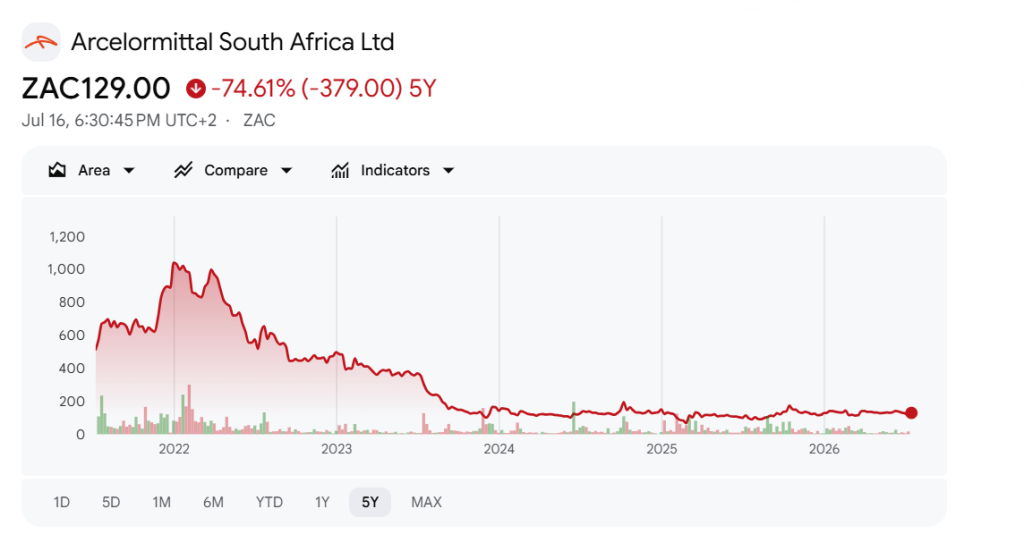
There are a zillion reasons for this, most of which can be traced one way or another to the deindustrialisation of South Africa. It really is a very serious problem that is causing premature grey hairs for executives in any value chain that touches the heavy industrial sector in our country.
Given their name is literally the Industrial Development Corporation, this does seem like something that the IDC would want to address. I shudder to think where the ArcelorMittal share price would be if not for the ongoing negotiations with the IDC…
Ghost Bite: We should find out soon whether it’s South African taxpayers or market speculators (who bought stock recently) who will feel the pain. Someone is going to lose out here.
Significant dilution for shareholders in ASP Isotopes (JSE: ISO)
A complex capital structure can dish up these kinds of surprises

ASP Isotopes is working towards a distinct capital structure for subsidiary Quantum Leap Energy (QLE). The intention is for QLE to separately in the US.
As part of this, a chunk of debt in QLE will be settled through the issuance of new listed shares by ASP Isotopes. To be precise, holders of $109.2 million in QLE notes will exchange those instruments for a whopping 23.2 million shares in ASP Isotopes. This represents 17.8% of ASP’s stock!
This is substantial dilution that the market clearly wasn’t expecting to see, as the share price closed 11% lower on this news. Investors don’t like being diluted. Few market participants are doing the level of research required to spot this potential source of dilution in the capital structure.
Accounting rules try and make allowance for hybrid instruments, but nothing brings the message home quite like the news of your position being diluted by 17.8%. It’s worth pointing out that removing debt from further down in the structure also makes the entire group more valuable in the equity layer, so “dilution” isn’t always an issue. It depends on the terms at which the instruments have been converted.
Even after this, there would still be another $110.7 million in notes in QLE running around. Could there be further dilution down the line? And at what price?
Ghost Bite: A capital structure with many layers, particularly of a mezzanine finance nature (convertible instruments), needs thorough research before being fully understood. This is why the market tends to reward simplicity.
BHP signs off on a successful year, boosted by copper prices (JSE: BHG)
But be careful of the copper guidance for FY27
BHP has released an operational review for the year ended June 2026. As the largest mining group in the world, any update from BHP gets plenty of attention in the market. This is also the first major update delivered by Brandon Craig after he stepped into the CEO role with effect from 1 July 2026.
The share price has been doing very well in the past year, with a return of 46% (or 52% on a total return basis including dividends). This is despite recent challenges, like the delays and cost overruns at the Jansen Stage 2 potash project.
The underpin of this performance is copper, with BHP flagging that prices are up 35% vs. last year. Although BHP flatters its numbers by describing production as being “~2 Mt for the second consecutive year”, the somewhat less glowing reality is that production actually dipped by 3%. The production dips are set to keep dipping, with FY27 production forecast to be between 1.65 Mt and 1.8 Mt (due to an expected grade decline at Escondida).
At least unit costs came in at the bottom of the guided range for copper, so that should lead to solid returns to shareholders alongside the increase in copper prices. Hopefully the various copper projects underway will lead to improved production down the line.
The PR team kept the good times rolling in iron ore as well, describing 1% growth in production as “record” numbers. That’s technically true, but the word record appears over and over again in the announcement. It’s a bit over the top when the underlying growth is just 1%! More records may fall (by the tiniest of margins) in FY27, with iron ore production guidance of 260 to 272 Mt, suggesting a midpoint that is just above FY26 at 265 Mt.
Iron ore prices were up 3% for the year, with BHP reaffirming guidance for their unit costs in iron ore as well.
Steelmaking coal and energy coal don’t get much attention, but production was up 3% and 9% respectively.
Ghost Bite: Overall, it was a decent year for BHP. The market is rewarding them for their copper exposure. I just encourage you to look at the actual numbers, rather than the narrative that is designed to tell the best possible story.
Coronation has given an update on its assets under management (JSE: CML)
This means we have to go digging for comparatives
For reasons I will never understand, Coronation is allergic to providing historical numbers in their updates on assets under management (AUM). They always just give the latest number, without any indication of year-on-year or quarter-on-quarter growth. For a company focused on investing, you would think that they would put more than the bare minimum effort into their SENS announcements.
For what it’s worth, at least they are consistent with this approach regardless of whether they have good news or bad news.
As at 30 June 2026, AUM was R778 billion. That’s 4.3% higher than the AUM at 31 March 2026, which I think is good going against a backdrop of global disruption.
They are 5.5% up on the AUM a year ago (June 2025). This shows you that you cannot just extrapolate the movement over one quarter. In this case, the year-on-year number is far less impressive than the quarter-on-quarter view.
The share price is up just 1% over the past 12 months. Thanks to a fat dividend yield, the total return is 12.2%.
iOCO has announced a small acquisition in the ERP space (JSE: IOC)
Will they build the group through bolt-on deals like these?
iOCO, led by Rhys Summerton, is getting a lot of attention at the moment. Investors are very curious about the different permutations for this group, particularly as Summerton is a dyed-in-the-wool dealmaker who is very unlikely to just sit on his hands.
Will the deals be smaller in nature, or will we see a blockbuster transaction at some point? Could it be both? Perhaps most of all, is there a chance that Aimia (JSE: AII) could be involved? If you haven’t heard of Aimia before, this is a cash-flush entity that Summerton recently listed on the JSE.
For now, all we know is that iOCO is open to acquisitions in the South African market. They’ve announced a deal to acquire 100% of Astraia Technologies. Try say that name out loud without sounding like you have an Aussie accent!
Astraia is a South African enterprise resource planning (ERP) solutions provider. They specialise in cloud ERP implementations, financial software integration and business process optimisation. That sounds like it will be right at home in the iOCO stable. The deal is expected to become effective within six weeks.
We don’t know what the value of this deal is. We just know that there’s a performance-linked element that may become payable based on performance over the next 18 months. The value is undisclosed because this is such a small deal that it falls below the JSE categorisation thresholds.
Ghost Bite: I have a small position in iOCO, as I think the company represents decent value with optionality to the upside. Or, in simple terms, I think that Summerton will do something interesting. I don’t know what it is yet, but a management team that gives forward free cash flow guidance is a team that I’m willing to put some money behind. The guidance for FY26 is free cash flow of at least 60 cents per share. The current share price is R4.00. Yes, that’s a 15% forward free cash flow yield – in theory, at least.
Karooooo’s recent bad press in Cartrack hasn’t taken the shine off the numbers (JSE: KRO)
As is so often the case, the cash flow trend looks very different to earnings growth
Karooooo’s share price closed almost 9% higher after releasing first quarter 2027 results. This is because the numbers look great, despite key subsidiary Cartrack having to deal with a lot of bad press recently (about working conditions in South Africa). We will have to wait and see how that develops.
Total Cartrack subscribers grew by 18% year-on-year, surpassing the 2.8 million mark. Critically, net subscriber additions increased by 70% to 142,472. If you think about it, as the base gets bigger, it becomes harder to achieve strong growth rates. Achieving a consistent percentage growth rate requires more individual subscribers each time.
The important thing to remember is that Karooooo is still growing subscribers very nicely. Subscription revenue has followed suit, up 19% to R1.35 billion.
The Delivery-as-a-Service (DaaS) business achieved growth of 46%, but it remains small at just R177 million in revenue.
Operating profit margin always flaps around at Karooooo based on the timing of investment in capacity (like sales staff) vs. growth in subscriptions. Operating profit was up 16% in this quarter, so there was a contraction in operating profit margin from 30% to 28%. I’ve been invested in Karooooo for long enough to not be bothered by this.
Albeit off a small base, special mention goes to the DaaS business for growing operating profit by 50% to R15 million. The margin is still only 8% in that business, so I’m hoping that they can achieve margin expansion as the business scales.
Adjusted earnings per share increased by 11%. There’s no shame in double-digit growth!
Other important metrics relate to the cash generated by the group. As Karooooo invests in telematics devices to be put in customer vehicles, cash doesn’t always align with earnings.
In this period, net cash from operations before working capital changes increased by 21%. But once you reach free cash flow, having taken off the extensive investment in devices, you’ll find a sharp decline from R338 million to just R60 million. This volatility is pretty normal on a quarterly basis, so I wouldn’t read much into it. Karooooo has been executing this business model for a long time.
Guidance for FY27 is unchanged at this stage, although the underlying management commentary is bullish to say the least. They expect growth in expenses to moderate, unlocking space for margin to increase. Investors will also expect to see a positive swing in free cash flow as devices are deployed.
Ghost Bite: This is a strong start to FY27. With a total return of 161% over 3 years, Karooooo has been a great performer in my portfolio.
Prosus will be paid over R40 billion for the remaining stake in Delivery Hero (JSE: PRX)
The acquirer is Uber, giving us a sign that food delivery competition in Europe is heating up
Prosus has given an irrevocable undertaking to Uber to sell the remaining 16.8% in Delivery Hero. This is directly related to the terms of the European Commission’s approval of the acquisition of Just Eat Takeaway.com by Prosus.
The requirements of the regulatory were vague to say the least, with Prosus needing to “significantly reduce” its stake of 26.5% at the time. There’s a point at which it simply doesn’t make sense to have shares anymore, hence the decision to sell the entire remaining stake to Uber.
This is part of a broader play by Uber for Delivery Hero, with a recently announced offer of €41.50 per share. Uber’s offer represents a 151% premium to the 30-day VWAP before Prosus first announced the disposal of 4.5% to Uber back in April this year.
Uber’s offer values Delivery Hero at nearly $15 billion. Prosus has 16.8% of that pie, so the expected proceeds will be over R40 billion before costs. That’s a proper payday that I hope will primarily be put towards share repurchases.
As an aside, I can only imagine how irritating it is for the European Commission that Uber is their saviour in terms of achieving competition in this space!
Ghost Bite: The success of Prosus CEO Fabricio Bloisi’s tenure will largely depend on the successful implementation of the Just Eat Takeaway.com opportunity. They made a big decision to step into that space and walk away from Delivery Hero.
Supermarket Income REIT raised the £100 million they wanted (JSE: SRI)
But the raise wasn’t upsized, which suggests that demand didn’t blow them away
Earlier in the week, Supermarket Income REIT announced that they were looking to raise £100 million in fresh equity to support an acquisition pipeline of nine assets. They also announced the details of three of the assets, with only a vague indication given of the remaining six.
The fund has a very tight strategy, with a focus on properties with leading grocery chains as the anchor tenant. This means that they can get away with being vague, as the market knows that the company will largely stick to its knitting.
The £100 million was raised without any issue. The investors were a combination of UK and South African institutions, as well as UK-based retail investors. South African retail investors weren’t given an opportunity to participate.
The shares were issued at 83 pence per share – quite a discount to the 89 pence per share price on the London Stock Exchange at the start of the week.
Ghost Bite: Supermarket Income REIT initially noted that the raise might be upsized, but that didn’t happen. It seems that the UK property market is still a tough sell to investors, as this raise was harder to get away than some of the other recent activity we’ve seen (like Hyprop’s (JSE: HYP) capital raise).
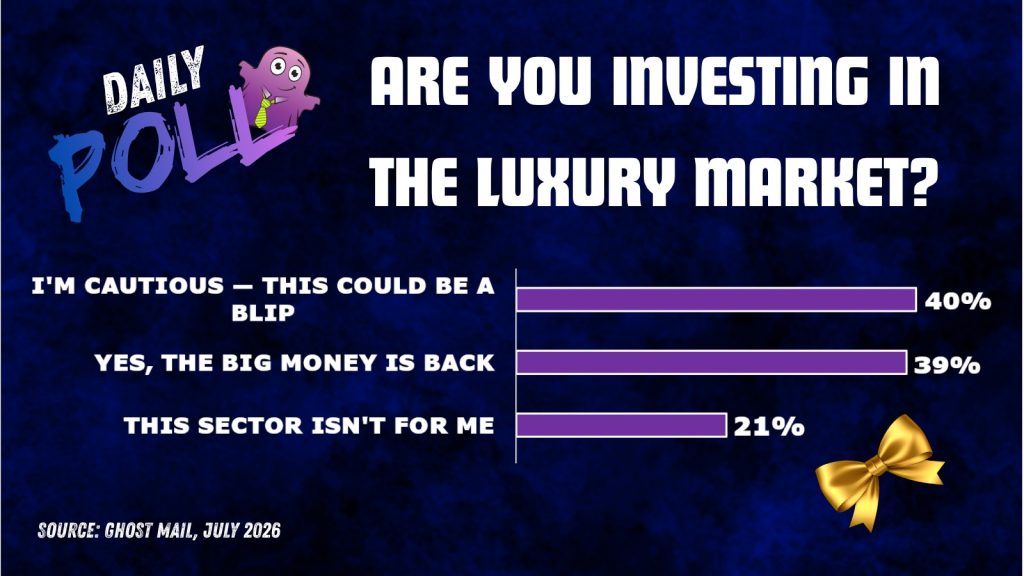
Results of previous poll:
Nibbles:
- Brait (JSE: BAT) has confirmed that all conditions precedent for the rights offer have been met. This means they can proceed with their plan to raise R2.5 billion from participating shareholders at a price of R1.51 per share. The shares will represent 30% of the company’s post-rights offer share capital. As I’ve pointed out several times, this is the strangest “value unlock” strategy around.
- Efora Energy (JSE: EEL), suspended from trading and looking to put itself into provisional liquidation, announced that Vuyo Ngonyama has resigned as chairman of the board and as an independent non-executive director.


EFORA , another great investment by the PIC , bought at huge cost , now worth nothing. probably owns in excess of 90% of company