
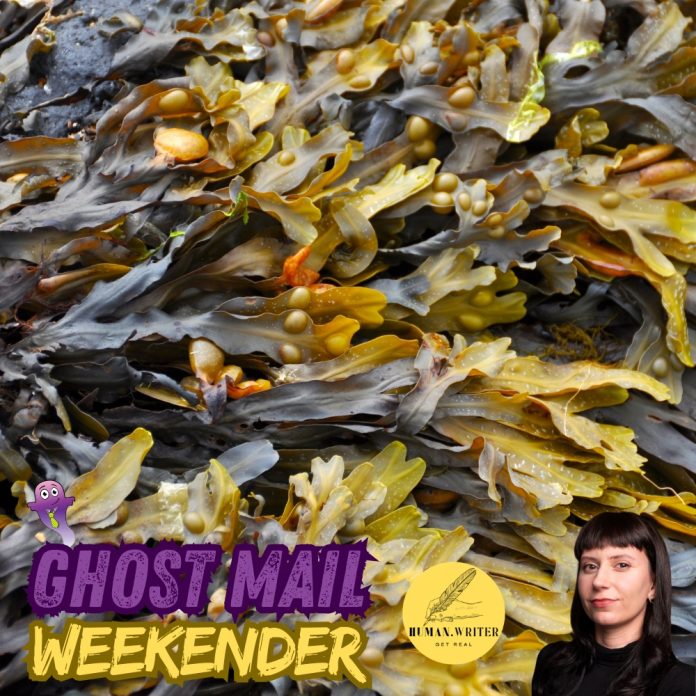
It’s in your yoghurt, your toothpaste and possibly your next pair of boots. Here’s how a slimy beach nuisance became one of the planet’s most valuable – and greenest – economies.
Quick question: did you eat any seaweed this morning?
For most of us (those who don’t eat sushi for breakfast), the obvious answer would be no. But there’s a good chance that we would be wrong. Because these days, seaweed doesn’t just mean slimy lengths of ocean vegetation or crumbly dried sheets. It means the carrageenan stopping your almond milk from separating, or the alginate thickening your yoghurt, or the agar responsible for making those bubbles in your bubble tea so squishy.
Open your bathroom cabinet, and you may find a bit of seaweed in here too, hidden in your toothpaste, your face cream or perhaps even your shampoo. Unassuming, unglamorous seaweed – the same stuff that we step over on the beach – has become one of the great invisible workhorses of both the grocery aisle and the pharmacy shelf. Today, it’s the star of a global economy worth almost $20 billion a year, and by most forecasts it’s set to roughly double that number by the mid-2030s.
High time, then, to give the weed its moment in the sun.
The Mother of the Sea
Eating seaweed is not exactly a new idea. In fact, people have been doing it for about as long as they’ve lived beside the sea. But for almost all of that history it was gathered, not grown, foraged from rocks and shallows, at the mercy of tides and storms. Nobody really understood how to cultivate it. Early Japanese farmers nicknamed nori “gambler’s grass”, because you never really knew whether the next crop would show up at all.

This all changed thanks to the determination of one British woman, armed with a microscope and a collection of old jam jars.
Kathleen Drew-Baker was a phycologist (a scientist who specialises in the study of algae) who lectured at the University of Manchester. She was dismissed from her position after marrying a fellow academic in 1928, since the university had a policy against employing married women.
We may have our share of challenges in 2026, but at least we’re not dealing with this type of nonsense anymore.
Undeterred, Kathleen continued her research. Working as an unpaid research fellow, she cracked the missing piece of the nori farming puzzle and published it in a paper in 1949.
Kathleen discovered that during one microscopic phase of its life cycle, the elusive seaweed shelters inside shells. On the other side of the world, a Japanese scientist named Sokichi Segawa read her findings and applied them. By the 1950s, Japanese farmers could reliably seed nori onto nets, and as a result production surged into the industry that supplies the majority of the world’s sushi wrapping today.
Kathleen Drew-Baker never set foot in Japan, yet she is revered there as the “Mother of the Sea”. The Japanese were so grateful for the contribution of her knowledge that they built a monument to her at a shrine, and even host a festival in her honour on the 14th of April every year.
So the next time you’re out for sushi, make sure to raise a glass of sake to Kathleen Drew-Baker, without whom your maki wouldn’t be the same. Her breakthrough marked the moment that seaweed stopped being foraged and started being farmed at scale. Global seaweed farming has since grown around a thousandfold since 1950, to more than 35 million tonnes a year, cultivated across more than 56 countries.
Sea star
Food is the obvious use for seaweed – nori, kombu, wakame and the rest of the Asian pantry, now joined by a Western market chasing a wider selection of plant protein and “sea vegetables”. But the lucrative, lesser-known business is the hydrocolloids I mentioned earlier: agar, carrageenan and alginate. These are the gelling and thickening agents extracted from seaweed that turn up in ice cream, beer, processed meats, pharmaceutical capsules and the petri dishes of every microbiology lab on Earth. It helps that these hydrocolloids are essentially vegan and kosher alternatives to animal-based gelatin, which broadens the consumer base for these products.
It’s on the newer frontiers, though, where exciting things are happening.
Agriculture is a major growth driver, as seaweed-based biostimulants and fertilisers feed into regenerative farming. Cosmetics lean on its antioxidant-rich extracts. Also, an unexpected barnyard surprise: a red seaweed called Asparagopsis, fed to cattle at a ratio of just 1-2% of their diet, has been shown to cut the harmful methane they emit by anywhere from 30% to as much as 70%. Given how much of global warming rides on livestock methane, that is not a minor party trick.
And then there’s the material element. For decades now, the fashion industry has wrestled with the problem of leather. The genuine item (a product of livestock farming) puts strain on the environment, since cattle need so much space and water (and of course there’s the previously mentioned methane problem). The alternative, polyurethane (also known as pleather or vegan leather), is hardly any better, since it is made from fossil fuels and degrades into microplastics.
Fortunately, there’s hope.
Off the coast of Zanzibar, the Tanzanian biomaterials company KelTex is blending locally grown seaweed with sisal and banana fibre to make a biodegradable leather alternative for the fashion industry. This leather alternative needs no arable land, no fresh water and no fertiliser, and is ready to harvest in about 60 days. It’s no science-fair novelty, either – the material apparently matches real leather for feel and strength, has won H&M’s Global Change Award, and is already being commercialised for global brands.
The stuff we wrap around sushi, it turns out, may soon be wrapped around us.

A blue ocean of opportunity
Asia grows about 97% of the world’s seaweed, with China responsible for roughly 60% and Indonesia around a quarter. Layered on top of that base is a market forecast to climb toward $40 billion or more within the decade.
But the more compelling growth story is who it lifts. Seaweed farming is light on both land and capital, which makes it a rare economic lifeline for coastal communities in lower-income countries.
Tanzania alone produces about 92% of Africa’s seaweed. Zanzibar is home to roughly 23,000 farmers, more than 80% of them women, and the seaweed they grow has become the archipelago’s third-largest export after tourism and spices. Now layer fresh demand in the form of bioleather, biostimulants, cattle feed, and add new technology onto that foundation.
KelTex, for instance, uses AI to help its farmers predict weather, temperature and water pH so they can increase both yield and quality. The result is a genuine multiplier on incomes that have historically been very slim.
The wealthy world is stirring, too. Alaska, Maine, France and Norway have all more than doubled their output of farmed seaweed in recent years, and both the EU’s Algae Strategy and US climate-smart farming programmes are now channelling money and research toward the sector.
For a plant with no roots, no flowers and a longstanding reputation as beach litter, seaweed has assembled a remarkable CV. It feeds us, sets our desserts, softens our skin, calms our cattle, fertilises our fields and may soon clothe us. We spent centuries treating it as the sea’s afterthought. But now it seems as if the tide is turning.
About the author: Dominique Olivier

Dominique Olivier uses her love of storytelling and ideation to help brands solve problems.
Her first book, Lessons from Loss, has been published by Penguin Random House.
She is a weekly columnist in Ghost Mail and collaborates with The Finance Ghost on Ghost Mail Weekender, a Sunday publication designed to help you be more interesting.
You can learn more about her work at dominiqueolivier.com and she can be reached on LinkedIn here.


Very interesting.
I live in Gansbaai, Western Cape. Here the seaweed is harvested from the sea as a food for the abelone that is farmed here.
There also a strong move to use the high protein content in seaweed as source of nutrition.
Christi Thompson