

Once upon a time, getting lost was how you found the good stuff. Then the internet learned to predict exactly where you were going – and how to redirect you. Are we in the twilight era of the digital flâneur?
When I was 14 years old, I travelled to Germany as part of my high school exchange programme. It wasn’t the brightest idea, in retrospect: I had only been studying German for a year and some change, which meant I could barely speak or understand the language. But I was young, naive and convinced that I could navigate both the foreign language and the foreign country all at once. With my parents’ blessing, I boarded the plane and took my first steps into a big, unknown world.
All in all, the trip was a success. I spent three weeks with a family in Köln, where I learned about Germans (always happy to correct your grammar), myself (surprisingly susceptible to homesickness) and the world beyond the familiar confines of my home town (more confusing, exciting, frightening and inspiring than I ever imagined).
I also learned that my German host family was way more relaxed about my general whereabouts than my parents were. On my second day in their home, they pointed me in the direction of the nearest bus stop and told me to go explore. Confused but happy to oblige, I boarded the bus alone and made my way into the centre of town, where I spent about two hours getting myself thoroughly lost.
I was too shy to ask anyone for directions (and fairly sure that I didn’t have the vocabulary or pronunciation skills anyway). So I wandered around without any particular aim, popping in and out of shops as the mood took me, until I started to get hungry. I found a restaurant on the corner of a street and went inside. There, I was given a menu covered in German that I could barely read, but I did recognise two words – “spaghetti” and “eis”, the German word for ice-cream.
Unsure whether or not this was some sort of strange meal combo (but again too shy to ask), I ordered it. What arrived in front of me looked exactly like a plate of spaghetti covered in Neapolitan sauce, crowned with a handful of perfectly round meatballs. But the clever trick revealed itself when I tried to twirl the noodles onto my fork: it was ice-cream. The “spaghetti” was vanilla ice-cream, fed through some contraption that shaped it into realistic noodles. The red sauce was made of strawberries. And the meatballs? Chocolate truffles, of course. Spaghetti ice-cream – exactly as named.

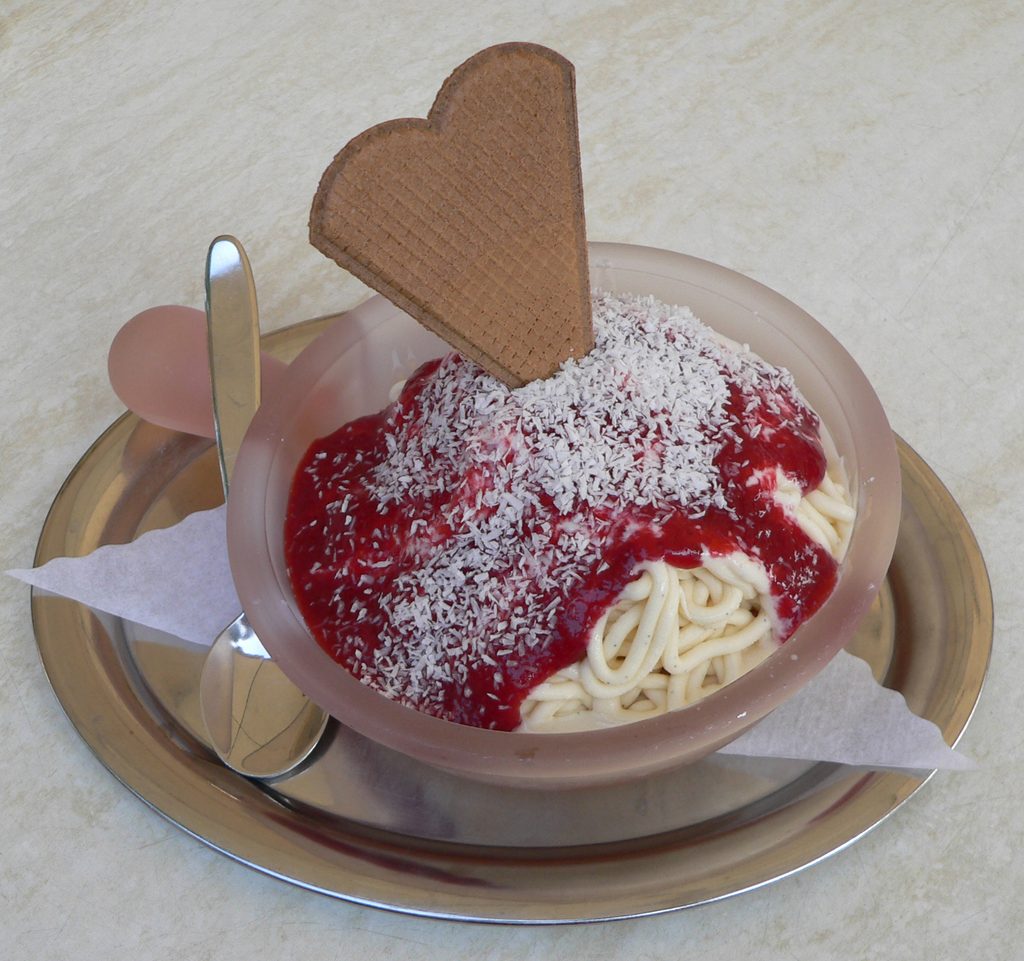
Photograph: Frank C. Müller, Baden-Baden – Own work, CC BY-SA 2.5, Link
Why am I telling you this story? Because this moment of delighted surprise, of encountering something completely novel and wonderful without really seeking it out, is something that I am finding harder and harder to achieve as the years go by. I don’t think I am alone in this experience – nor do I think that this is because of some fault or mistake on my part, or yours, if you feel the same way.
The world doesn’t have fewer new things in it. But something has made it much harder to stumble across them.
The wonder in wandering
There’s a word for what I was doing on the streets of Köln, though I didn’t learn it until I was at uni years later: I was being a flâneur. The term is French, and it belongs to the 19th century and the wide boulevards of Paris that Baron Haussmann had carved through the medieval tangle of the old city. A flâneur was a stroller, a saunterer; a person who walked the city with no destination and no purpose beyond the walking itself. Drifting and observing, the idea was to let the street deliver its surprises.
The poet Charles Baudelaire made the flâneur into something close to an artist. To stroll aimlessly, he suggested, was a way of seeing – a discipline of openness, of being available to whatever the crowd and the shopfronts and the passing faces might offer. Later, the critic Walter Benjamin spent years on an unfinished study of these Parisian arcades, the glass-roofed passages where the flâneur could wander among goods and strangers, half-shopping, half-dreaming. The point was never to arrive anywhere. The point was to remain porous to the world, to let it act on you.
It’s easy to romanticise this, and plenty of people have. But strip away the top hats and arcades and what you’re left with is something quite ordinary and quite precious: the human capacity to go looking for nothing in particular, and to be rewarded for it.
The boulevard of links
For a while, the internet was one of the great flâneur’s playgrounds. If you are old enough, you might remember what it felt like to really browse the internet, in the full, literal sense of the word. You followed a link because it looked interesting, and it took you somewhere unexpected, and that place had three more links, and an hour later you were reading about deep-sea fish or medieval siege weapons with no memory of how you’d gotten there.
Web pages were made by people, one at a time, often badly, and their badness was part of the charm. Every site was like a room someone had decorated by hand.
Sometimes I get a bit nostalgic for the internet that I grew up on, and when I do, I look up the Space Jam website. This is the original promotional page that Warner Bros. built for the 1996 film and then simply forgot to take down. It’s still live, decades later, exactly as it was: the corny starfield background, the planet-shaped navigation, the chunky pixelated buttons floating haphazardly in space. No banners, no ads, not a pop-up in sight.
And because we know you’re allergic to clicking anything these days, here’s a screenshot of the home page:
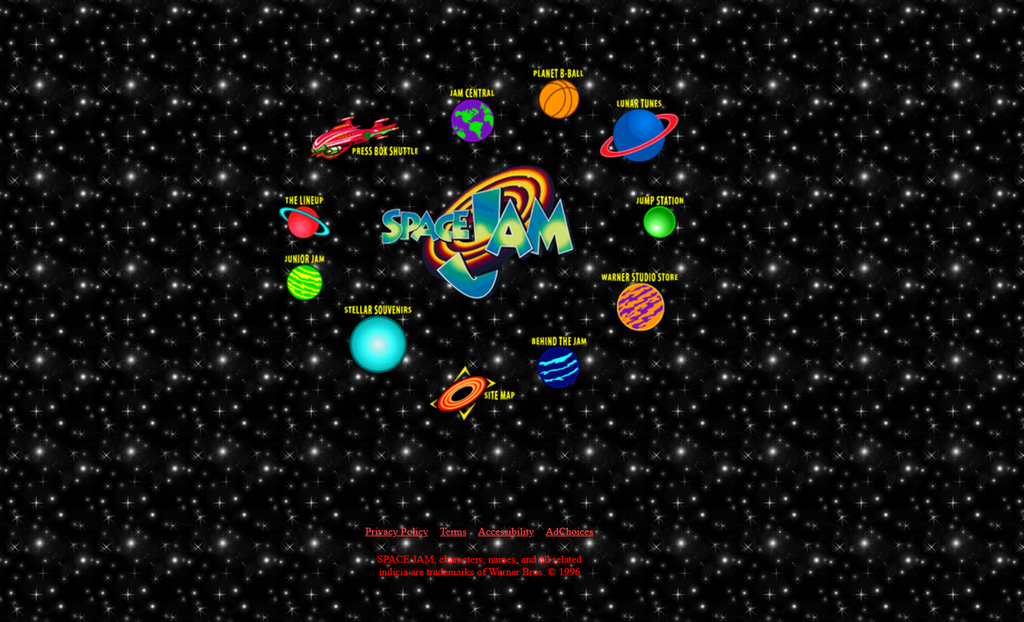
It is gloriously useless by modern standards. It sells you nothing efficiently. But it is a place, unmistakably, with its own weird kind of weather, and you can still wander into it and feel the particular texture of an internet that hadn’t yet decided what it was for.
That’s the internet as boulevard. What we have now is the internet as shopfront.
Today’s web is built around the destination. You arrive with a goal – a product, an answer, a booking – and the entire architecture exists to move you from intent to completion as smoothly as possible. Friction is the enemy. Every stray path has been paved over or fenced off, because a wanderer is, from a commercial point of view, a customer who hasn’t converted yet. The modern site doesn’t want you to drift. It wants you to buy, and then leave, and then come back and buy again.
The algorithm doesn’t do surprises
We rarely wander the internet anymore because we live in a world of platforms and everything apps. The feed decides. The recommendation engine decides. The algorithm watches what you linger on and hands you more of it, and more, and more, in a loop tuned with extraordinary precision to your existing tastes.
And it works. It is genuinely good at giving you what you already like. Which is exactly why it can never give you spaghetti ice-cream.
Serendipity, by definition, is the thing you weren’t looking for. It requires a gap – a moment of not-knowing, of aimlessness, of being loose in a space large enough to contain surprises. Algorithms, on the other hand, are built to close those gaps. They remove the wandering, and with the wandering they remove the possibility of the genuinely, delightfully unexpected.
I feel this most strongly when I’m on social media, where even the painters that I follow all start to look the same after a few months; I am unable to tell the work of one from another. A few weeks ago I liked a painting of a floral still-life, now every time I open my window to the world I am choked by flowers.
On Spotify, every “Recommended For You” playlist reschuffles the same five albums I have loved since varsity. I haven’t listened to a new song in months.
So what do we do about it? Beats me, honestly. Move to the platteland, delete everything, become unreachable? I’m too fond of my playlists for that (even the stale ones). International travel is the best playground for any committed flâneur, but it also costs a fortune.
But maybe I can leave a little more room for accidents – click the link that has nothing to do with anything, follow the account the algorithm would never have picked for me, take the wrong turn on purpose now and then, order the thing I can’t pronounce. Online or off, the move is the same: stop letting something else decide where I’m going before I’ve even left.
About the author: Dominique Olivier
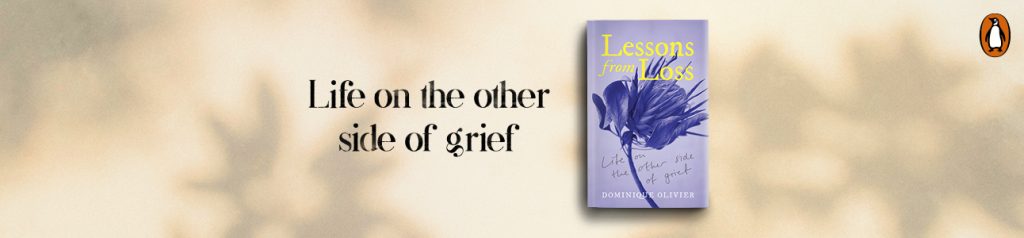

Dominique Olivier uses her love of storytelling and ideation to help brands solve problems.
Her first book, Lessons from Loss, has been published by Penguin Random House.
She is a weekly columnist in Ghost Mail and collaborates with The Finance Ghost on Ghost Mail Weekender, a Sunday publication designed to help you be more interesting.
You can learn more about her work at dominiqueolivier.com and she can be reached on LinkedIn here.


I dote on your weekly letter and this week your message gave a very real message.
The internet not only feeds you the same stuff you were looking for yesterday, but makes you less likely to click a link than before at the risk of linking to something that you only vaguely wanted to explore. At 66, I am way older than you are but I have been there from the days of before computers and social media. Now we have AI which not only analyses what you request but uses it to to train itself. No more Just Jeves providing answers which were often wrong anyway (although at this stage AI is managing that too).
Thank for your weekly message – it helps to take one away from junk and back to reality (and stuff you didn’t even know you were interested in!). Incidentally your ‘I am not a robot’ is really intrusive 🙂
Hi Paul! Ghost here, just replying re: I am not a robot – it’s a pain, right? And you would be amazed how many spam comments just make it through that. Without it, I would spend an hour a day just throwing comments out that try and send you to gambling sites (or much worse).
Brilliant – as always – but definitely one of the best!
Thank you.
Every Saturday my biggest treat is reading your column, because your articles are so interesting and varied. Your articles are like getting lost and finding the exciting random bits of information I wouldn’t ever have imagined. Thank you Dominique.
An excellent point and a great article! I live for my random walks along the backwaters of the internet. I tend to stick to Wikipedia vortices, which at least has a hard-coded global algorithm…