
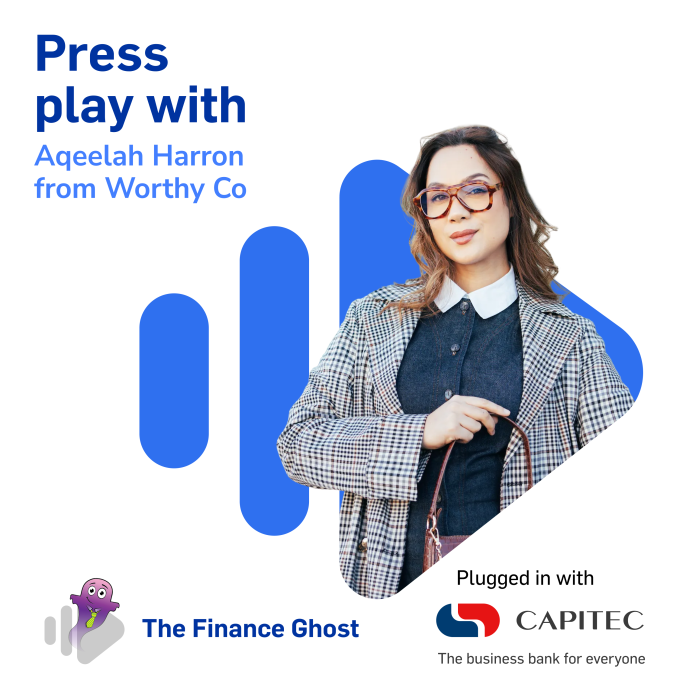
In Season 2 of this podcast, The Finance Ghost talks to South African entrepreneurs about the ideas, choices and turning points behind building a business from scratch.
Listen to the podcast:
In this episode of The Finance Ghost Plugged in with Capitec, The Finance Ghost sits down with entrepreneur, content creator and wellness advocate Aqeelah Harron, better known as @fashionbreed on Instagram.
Aqeelah shares the deeply personal experiences that shaped her entrepreneurial journey, from navigating serious health challenges and pregnancy loss to building an online community through honesty and vulnerability. Along the way, she discovered a growing passion for wellness and a desire to create products that could genuinely help others facing similar struggles.
She also unpacks the realities of launching and scaling a business, including an early product that didn’t go as planned, the challenges of importing goods into South Africa and the lessons learned from pivoting into supplements.
From earning a coveted Faithful to Nature listing to winning a major industry award, Aqeelah reflects on what it takes to build a purpose-driven business while balancing entrepreneurship, motherhood and family life.
This is a story about resilience, authenticity and turning life’s toughest moments into opportunities to help others.

Episode 7 covers:
- Building a community before starting a business
- Turning personal health challenges into entrepreneurial opportunities
- Managing the risks of importing products and working with suppliers
- Why passion alone isn’t enough to build a successful business
- Securing a listing with Faithful to Nature
- Working with your spouse as a business partner
- Balancing business and family life
- Building customer trust through word of mouth
- Why purpose remains the ultimate motivator for entrepreneurs
The Finance Ghost plugged in with Capitec is made possible by the support of Capitec Business. All the entrepreneurs featured on this podcast are clients of Capitec. Capitec is an authorised Financial Services Provider, FSP number 46669.
Read the transcript:
The Finance Ghost: Welcome to this episode of The Finance Ghost, Plugged in with Capitec. I really do enjoy this podcast series because I get to speak to some seriously cool local entrepreneurs, and this episode is no different.
Aqeelah Harron, who I think the world may know as @fashionbreed on Instagram, is my guest today. Aqeelah, I must be honest, I’m not someone who follows too many fashion and beauty influencers on Instagram (my apologies for being that stereotype), but I have checked out your Instagram. It looks amazing.
And what’s very cool is that that is by no means all that you do, because you’ve actually launched a really interesting business in the wellness space. Thank you for joining me on this podcast, and I look forward to digging into your story.
Aqeelah Harron: Thank you so much for having me. It’s definitely been a journey, and I’m excited to tell you guys more about it.
The Finance Ghost: Yeah, me too. It’s actually heartbreaking that this is an audio-only podcast because you would have such a cool opportunity to show off that fashion sense of yours…
Aqeelah Harron: [laughing]
The Finance Ghost: You really do have an impressive Instagram page…
Aqeelah Harron: Thank you.
The Finance Ghost: …But it’s interesting, because life threw some pretty serious medical conditions your way along that journey, which is actually not an easy thing to have to deal with when you’re doing this whole Instagram-influencer vibe (which, by the way, people think is very nice and easy, and it’s not).
Instead of shying away from those medical conditions, you bravely, and quite correctly, decided, “No, this is real-life stuff we need to talk about this. It doesn’t make women any less beautiful.” Well done!
And you’ve then used that to go and build a business, which I think is amazing. So double, triple, quadruple congratulations.
Tell us about the last few years. I mean, it’s been an incredible journey for you – motherhood, all kinds of things – in the build-up to launching the business you have today, which is called Worthy Co.
Aqeelah Harron: So over 10 years ago, I was diagnosed with PCOS (polycystic ovary syndrome), which has now changed to PMOS (polyendocrine metabolic ovarian syndrome).
This condition affects every area of your life (your mental health, your reproductive health, your energy levels, brain fog, your cycles every month) and it really can be debilitating for some women.
I definitely went through periods of my life where that was the case, and it was absolutely awful.
So, that was one part of my medical history, from a day-to-day basis. I kind of started learning different things that helped support the condition, and that was all good and well until October 2020, when I had a very hectic miscarriage.
It was a ruptured ectopic. I never knew I was pregnant. And I was all the way out in Swellendam on a birthday weekend away when I had to suddenly be rushed to hospital.
That really deepened my sense of, “Oh my gosh, this is really what people who go through anything medical endure, and it’s quite hectic.” That came with its own complications which later caused me to have a small bowel obstruction because of scar tissue that had grown around my intestines. So, I was in hospital for a few weeks with that.
On a completely separate note, I’ve had a number of cases of pneumonia as well. At one stage, they were even going to remove part of my lung. But then I made this really miraculous recovery.
The last six years have been very intense on that front, but I’m now the healthiest that I’ve ever been.
What that’s really done for me is it’s allowed me to deepen my empathy on another level. In the wellness space particularly, it’s a bit frustrating for me to see wellness look like something really elite, or to see it look like this “aesthetic” and this “vibe”.
Of course, health is wealth. It is a flex to care for your body. It is one of the biggest things and the best things that you can do. But wellness is also for everybody.
Wellness is also something that can be really expensive, traumatic and disappointing when your healthcare providers let you down. I’ve been through all of that. I’ve experienced financial difficulty from dealing with the financial implications of having this difficult medical history.
I think that what that has given me is the ability to really treat my business with respect and put the customer first. It is absolutely a business – it is profitable – but it comes from a very deep passion, for lack of a better word, for giving people something that’s really just going to improve their lives. And it’s really built from a place of deep respect, because I have absolutely been there.
And somewhere in those six years I also managed to pull off having a baby, so there was that too!
So, now I’m juggling everything with a four-year-old. But at the same time, as crazy as it sounds, I wouldn’t change anything. It’s been a journey, and I really like who I’m becoming because of it.
The Finance Ghost: Yeah, listen, it’s amazing. I sometimes think that I’ve had a wild journey since the onset of COVID, but then I hear stories like that. It’s always good to just get this perspective of how much people actually go through.
And it’s a huge deal that you did manage to conceive, given all of those medical challenges along the way. It really is a wonderful part of the story.
When we were prepping for the show, we were swapping war stories on what it’s like to be a business owner with preschoolers, because it is nuts [laughing], but it’s also wonderful.
It really is an incredible story. I think it speaks directly to launching a business into a passion, or maybe from the place of a passion, which I think is a really important thing to do, actually.
It works (or at least it can work) if you’ve got the discipline to make sure that you’re actually launching a business and not a glorified hobby or just a side gig. If you actually see it as a business, but you also address something that you understand really well, then I think that tends to improve your chances of success, right?
Aqeelah Harron: 100%. I also always feel like… I don’t know, for my personality type, I need to find myself in an area of work that I would do for free or paid. Do you know what I mean? In the sense that, when things require you to make the sacrifice, you are already all in.
So, even with businesses, you are not immediately profitable. It requires an enormous amount of sacrifice. For a long time, you’re going to be doing a lot of unglamorous things. You’re going to be doing a lot of things for free. You’re going to be doing a lot of late nights, and you’re going to sit there and you’re going to wonder, “Why am I doing this?”
And you need to know your Why. That Why is your absolute anchor through the storm. Because there will be a storm [laughing], if not multiple, so 100%, you need that passion.
I don’t know if I could do… I mean, I shouldn’t say “never”, but right now this makes the most sense to me. Because I am really so passionate about what we do and being able to help lots of people. Especially when you get that feedback, it is a feeling like no other. You really just get reminded, “Okay, this is why we do what we do.”
The Finance Ghost: I actually wanted to ask you this later, but I’m going to ask you now. I just want to bank the whole point around being an Instagram influencer and then this leading into a business, before we actually talk in detail about what the business is doing, because I think it’s interesting.
You’ve had such a crazy story over the past few years, but obviously, in and amongst all of this, you’ve also managed to build this fantastic Instagram page around fashion and beauty and all the rest.
And for reference, it’s got 77,300 followers, which is a lot. That is a lot of people. That fills a stadium…
Aqeelah Harron: [laughing]
The Finance Ghost: …of people who are following you on Instagram, which is sensational.
People who haven’t tried to build something online think that being an influencer is easy. You just wake up one morning and bang! Land of milk and honey. It is nothing like that. It is extremely difficult, and I think there’s a very small number of people who actually make it work.
What was your experience with having that along the way and then actually launching a business into that community? Did you find that it gave you this big head start?
Aqeelah Harron: It definitely gave me a head start, knowing that I had already built this community where we were discussing reproductive health and just health and wellness in general.
I have had the habit in the past of being a bit of a chronic oversharer. It isn’t always a bad thing, because sometimes it makes people feel seen. Especially when I’m just going on my stories and I will just tell the most hectic story about my period that month, and I think, “Oh my gosh, did I just go overboard?” And then I get countless women going, “Oh my gosh, I feel so seen. Thank you for speaking about this. Nobody speaks about this.”
And it was the same with my ectopic, you know? Not that I’m minimising any other miscarriage, but it really was this massive, dramatic event from start to finish.
When I shared that, I had so many women reaching out saying, “Thank you for speaking about your miscarriage. Nobody speaks about this. We’re always just seeing the perfect pregnant influencer who just goes on to motherhood and the Pinterest nursery and all of that, and I really just feel so seen.”
So, we really built that trust in advance. And at first, there was no plan to monetise that trust or that audience in this way. It really came later, as a result of me looking for more answers for myself and not being satisfied with what I found.
I was trying other hormone balancing supplements and other energy supplements, and it just wasn’t doing it for me, or I was having negative reactions, or I was looking at some of the ingredients and going, “Why is this marketed for this thing when this isn’t something that I should be having?”
So, for example, there was this one supplement that had ashwagandha in it, and everyone at the stage was just putting ashwagandha in everything. Then I looked it up, and ashwagandha boosts your testosterone, but a lot of women with PMOS already have high androgen testosterone levels.
So, I looked at this and I was going, “Why is this in here? This doesn’t belong in here. This is maybe why I’m gaining weight even on the supplement. It’s just not agreeing with me.”
So, we decided to do our own formula with a formulator who has been in the natural health space for over 30 years. I wanted to work with a woman as well. She really held our hand through the process. We unpacked and took apart every single ingredient and scrutinised it to see how it could support multiple conditions without the adverse effects.
And that’s how we came up with our own formula, which I’m so proud to share with women whose trust I have gained. It’s a big responsibility, and it’s not something that I take lightly.
So unintentionally, it really was that case of “build the community first and launch the product later” that everyone is saying you should do now.
It wasn’t my intention for that long, as far back as when I started speaking about it, but it’s definitely what it turned into.
The Finance Ghost: It’s a fantastic story, and I’m going to just mention that your Instagram page does include your cat, which I think must be at least, what, 12% responsible for the success here? What would you reckon?
Aqeelah Harron: [laughing] Of course. I’ve got two, actually. There’s a five-year-old one and a 12-year-old, and they are my babies. They are the best.
The Finance Ghost: Can’t go wrong with cats on the internet, right? They are the ultimate cheat code.
Aqeelah, just back to the business. You’ve already mentioned, there, some of how you’ve got into marketing and building these supplements and everything that you’ve got in Worthy Co. (which we’ll discuss in a bit more detail just now, including getting into Faithful to Nature, which I know is a big deal for you).
But before you got to those products, you actually started with something else and it didn’t work. So, on top of all of these other challenges that you had to deal with along the way, the first product that you launched in Worthy Co. as I understand it, ended up being something that you needed to pivot away from.
Tell us that story. Tell us about the cotton pads and what you learned about the absolute joys (I say, dripping with sarcasm) of global manufacturing and importing into South Africa.
Aqeelah Harron: Worthy Co. was always a two-part plan. Phase one was always going to be organic-cotton, 100% biodegradable sanitary pads. The second part was always going to be supplements and wellness.
We had always planned on launching that much later. We thought the pads seemed like the best idea in the beginning. We manufactured abroad in China, which came with its own huge series of challenges.
It was pretty hard to actually get a pad that met all of our criteria. Nonetheless, we purchased our first batch of stock. It came down, and it took about three months to actually arrive here.
When it did and we went live, I had a four-month-old at the time, and that was pretty intense (just to even get it off the ground while being postpartum).
But nonetheless, we did it. And on the first day we sold 70% of our stock. So that was quite a lot.
I remember going into my room and having a bit of a panic attack because I went, “Oh my gosh, we’re going to have this huge business now. It’s going to be so hectic. How am I going to manage this? I didn’t expect people to love this product already so much. Are we going to get new stock in time?”
We scrambled because we knew how long it takes for the stock to get here. We didn’t anticipate it to sell so well on the first day.
We needed to scramble together funds to get more stock shipped in time before the balance of the other stock ran out. We literally scraped together every last cent that we had and managed to do it.
Second batch of stock arrives: defective.
Not only that, the dollar had soared in comparison to the price we had paid for it before.
So now you’re looking at what you paid in dollars the first time around versus the second time around, and you’re going, “Do I do a price increase? Do I keep the prices the same and now absorb the cost of having a lower profit margin? What do I do here?”
And then you’re also looking at it and you’re going, “Oh my gosh, I didn’t think this through because there’s such a small profit margin on a pack of pads.”
We did sell them in bundles to make it more feasible for people buying online (so they were buying three to six packs at a time), but still, there was a lot to consider.
And then of course we’re sitting with these defective pads.
So, imagine with the first batch, we’re getting rave reviews. Everyone is extremely happy. They’re saying, “This is so comfortable. My cramps are less.” Because normal pads, in South Africa and the world, the plasticky ones, they have endocrine disruptors, right? So those are really bad for your body. It can exacerbate symptoms in reproductive issues.
We wanted to bring in something that’s going to make that easier and just healthier for everyone and for the planet. The whole slogan was “better for you, better for the planet”.
We have rave reviews. We have an amazing launch. Second batch of stock comes, and it is just not working out. I’m having countless customers sending me emails going, “My pads are breaking and I’m leaking and it’s a mess.”
And they were annoyed, but thankfully also so compassionate and understanding. We’ve always prioritised good customer service and a lot of empathy. I didn’t deny anyone’s experience, and we were just offering people refunds left, right and centre.
It wasn’t happening with all of the stock, so we did have some happy customers, but it was an absolute gamble.
It got to a point where we had to just be transparent with our audience and say, “Listen, we don’t know what’s defective and what is not.” We sold the balance of the pads. We said to people, “Okay, we’re going to sell these to you guys at cost price.”
Because now we’re trying to recover spend, and we’re trying to sort it out internationally with the manufacturer, who for a long time was denying that they had anything to do with it.
Basically, our community thankfully (and I think this is because of the relationships we had built) was extremely understanding. People were still buying the defective product because I think they said they were going to layer it and they couldn’t do without the comfort. They’d really just grown to love the product.
So, we managed to recover some of our capital that way. Eventually we settled, and then we had to go through this whole investigation case with the manufacturer, who eventually settled on paying us 60% of the money back.
Our funds were all over the place and it was a big mess. We decided to close up shop for a bit after just six months and lick our wounds and regroup, and then we were going back and forth trying to find a new manufacturer.
But I kept telling my husband, who’s also my business partner, “Listen, I don’t want to deal with fluctuating dollars anymore. I don’t want to deal with language barriers. I don’t want to deal with different time zones. I don’t want to deal with months of shipping time. If I have a product and there’s something wrong with it, I want to be able to, at most, fly to Joburg, or Durban or wherever it is and go and sort it out myself in person if I have to. I can’t deal with very long distances to sort this thing out. I’m not doing that again.”
We eventually agreed, but also, pads have an insane minimum order quantity, and it really is a big risk to put up that amount of money.
My husband was actually the one who didn’t want to let go of the pads. I said, “Dude, I am done. I am ready to move on to phase two. I think we should start looking into our supplements. That was always the plan. We’ve always known more or less what we want to do. Let’s get into that.”
Eventually he gives in. He says, “Okay, cool, let’s do it.” We still had some capital that we managed to gather up again, and we started the formulation process with vetting different formulators and manufacturers until we found one that aligned with our values and pivoted into supplements.
But like I said, it was always meant to be phase two.
The Finance Ghost: It’s a wild story, and I think a lot of entrepreneurs can relate to just how quickly things can go wrong and how you can almost get that false positive, right? You launch, you get lots of sales, and you think, “Okay, fantastic. This is going to fly.” And then the reality sets in of just how difficult it is.
I think as a small entrepreneur, when you’re doing this order by order, you don’t have the forex hedges in place. You don’t have experience doing this. It’s extremely difficult, and it’s very easy for this stuff to go wrong.
I have a little bit of experience with a side gig I started once upon a time that included some importing. I promise you, it’s an incredibly similar story.
I think the other lesson which I learned (and it sounds like you learned), when you’re launching something new, just be careful extrapolating that initial hype-phase demand, Someone at some point mentioned to me the Tupperware party or the Tupperware business – your aunt will buy one and the people in your family will buy one, and you’ll think, “Great, I can sell Tupperware to everyone.”
But actually, once you’ve gone through the people who are your initial big supporters, it is much harder to lock in that second layer of sales and repeat business and everything else.
So, it can give you this very skewed view on what the long-term success of that thing can actually be.
It’s just something to be aware of and a lesson that it sounds like we’ve both learned.
Aqeelah Harron: Definitely. We are now, I would say, entering that second layer. We’ve kind of been in there for the last few months since going into retail, but 100%, I know exactly what you mean. Having to first go with your initial layer of people you know are going to support you and then to convince more people.
What’s been really great for us – is it’s one of my favourite stories where I’ve had this now a few times, popping into a stockist of ours or dropping off stock if it’s a smaller stockist. And then while I’m there, I actually bump into people buying our product and I kind of lurk. I hang around and I make awkward eye contact and I smile and I think to myself, “Are you here because you follow me on Instagram and you like my outfits? Is that what you’re buying?” And they just look at me like, “Who is this weird girl smiling at me?”
Then I wait until they buy it and I go, “Okay, so you bought that product. Just letting you know, I’m actually the founder. What do you think of it? Is it your first or second time?”
And, you know, they’ll tell me, actually, this is word of mouth. My cousin recommended it, my friend, my colleague. I’ve had that happen quite a few times.
And that, for me, is a good thing because that means we’re entering that second layer. And if you have no idea who I am on Instagram, that is my dream. That’s the best scenario that I could possibly hope for, because that means you really are buying the product for what it is.
The Finance Ghost: It’s funny you say that, because something I also get a kick from is when I meet someone who’s never heard of The Finance Ghost. I love it. I’m like, “Yes, there are lots of people out there who can become part of the ecosystem and might be interested in it.”
So, it is funny how there’s a lot of congruence in thinking here.
Let’s maybe move on then from what was obviously a very tough initial journey into this. And now you’ve achieved quite the milestone, which is getting vetted by Faithful to Nature.
Aqeelah Harron: Yes.
The Finance Ghost: It’s a big deal because they don’t just stock anything. You actually have to go through quite a process, right? And it obviously gives a lot of credibility to what you’re doing.
So maybe just give us a sense of what that’s been like, just briefly, and how you convinced them that your product belongs on the shelf when they already have a lot of other products that do all kinds of interesting things.
Aqeelah Harron: So, what was quite funny was they were always my number one dream first stockist because I had, in the past, gone to some of the brand events.
I knew I’d also met the owner. I’d also met the founder at one of the events and just kind of spoken to them about the brand ethos and the strict criteria that they have when accepting brands.
They really are fussy in a good way. They are really pedantic about vetting the ingredients and brands that they put on their shelves.
I had literally written down in a book of mine because, remember, I said I had this miraculous recovery after needing an op? This was last year in June. And as soon as I came home, I said, “Okay, I’m going to lock in and I’m going to set my goals because I’m having a second chance at life and my health right now.
And the first thing I wrote down was, “Get Worthy Co. into Faithful to Nature.”
And we were waiting for some professional product shots to be sent back to us, the final edits. And I was going to put all of that in a deck and send it to them.
And then someone from their team actually reached out to us two days later, which was so weird. And when they did, they said, “One of our colleagues has actually been using your product, loves it, and has suggested that we vet you guys to see if you are eligible to be stocked with us.”
And of course, we said, “Absolutely!”
So they said, “Okay, great. So, here’s all the documentation. Here’s all the criteria you have to meet. And they sent out this Excel that had 206 line items that you have to answer and meet all these criteria to even be considered.
And they tell you, even if you pass all 206 of these things (and that’s per product), you are not guaranteed a listing with us. We’ll give it a think. Even so, it may take three to six months before we even onboard you.
So, we did the vetting process. It took maybe two or three months, but eventually we were onboarded, which was such a huge deal.
I just remember being so giddy. My husband and I took the stock to the warehouse ourselves. Our first batch of stock. We don’t do that anymore, but it was really cool at the time.
And yeah, we were just so, so proud. We’re still so proud because it really is a testament to how we didn’t compromise on quality, how we didn’t compromise on doing things the right way.
And to have that nod from Faithful to Nature and their seal of approval, that’s a pretty big deal.
The Finance Ghost: Yeah, congratulations. Hilariously, Capitec would go down as one of mine. I guess the fact that I get to do this entire podcast series with the support of Capitec is very cool because they are obviously an amazing brand.
You do these things and you spend the years doing the hard yards, and then finally things start to really come through for you, which is amazing.
Something that you’ve referenced a few times on the show, actually, is that you work with your husband in this business. You’re not our first husband-and-wife team on the show. And generally speaking, the advice from guests has been that if you each just stay in your lane and have specific responsibilities, then the whole thing works.
And when you start to actually fall over each other in terms of what you’re each trying to bring to the business, then that’s where it can start to get a little bit trickier.
So has that been your experience on this journey? And also added to that, how do you then juggle the responsibility (shared responsibility, obviously) of having a preschooler actually running around the house while you’re doing all this stuff?
Aqeelah Harron: It’s exactly what everyone else has said. We do stay in our own lane, and we have our assigned roles. Especially as an entrepreneur, there’s always something new in your way that you’ve never done before. So those things, we usually come together and go, “Uhhm hi! So… what is this?” And, you know, we’re sitting there figuring that out.
But other than that, absolutely.
So, I tend to focus more on marketing and dealing with customers. And he is the systems guy. He is so good at systems. Whereas the things that he deals with from the business side, if I look at that, my brain just turns into mush. It all becomes a blur.
I leave that up to him, and he’s really good at it.
And it’s the same, actually, with my content creation. He shoots all the videos, all of the photography. So I leave that up to him. I don’t even know anymore how the camera works, which is funny because I started out as a photographer, and I genuinely don’t even remember how to use it.
So, it does help.
And it works exactly the same way in our home. Of course, a preschooler’s needs change every single day, and no two days when you’re working for yourself are the same, so we kind of play that by ear. We really try to focus on keeping her routine consistent because she really is a routine girl. She thrives in an environment that is predictable.
We prioritise that because she didn’t choose for us to be entrepreneurs. We chose that. We kind of look at what we have to do for that day, play it by ear, work around her schedule and tag-team as best as we can.
And that’s how we get things done. Hoping for the best every day, but we’re getting it done.
The Finance Ghost: It’s one foot in front of the other, right? And you just have to keep going, even when it’s tough and even when it feels insane (and it does often feel completely insane).
I don’t know about you, but you often also feel like you’re doing everything badly. Bad parent, bad business owner, bad friend, bad family member, bad everything all the time. You must have dealt with that as well.
Aqeelah Harron: I’ve had those phases for sure, where I feel like, “Hey, maybe I’m dropping the ball a bit.” But I’ve also learned to approach my life with grace because I feel like you can’t be everything for everyone all of the time.
There are certain times where you’re going to be the best mommy, and then maybe the business or something is going to get a little bit less attention, and that’s when you bring somebody else in or you just kind of have to accept that on that day, you just weren’t giving it, and vice versa.
Just yesterday, I had to get some help getting my daughter home from school because I had to be somewhere and her dad had to be somewhere. It is what it is. You try your best every single day.
And I also think that as a mother, for me, it’s important for my daughter to see me follow my dreams, my goals, and helping other people.
And I also do have that flexibility, thankfully, to also be a really present mom. I can be that mom that can do really cool, fun things with her. If I spontaneously say, “After school today, Mom’s had a bit of a quiet workday. Let’s go do something fun. Let me go and take you shopping. Let’s go have ice cream.” Because why not? You’re only four once in your life!
So, I am that mom and I really try to step into her world. I’m a quality-over-quantity person as well, so when I do spend time with her, I try to make it really fun and I try to get down on her level and immerse myself in that.
I think we’re all just trying our best. And when you are hard on yourself, I have found it actually usually means you’re really good at that thing. You’re really good at parenting, you’re really good at your job. It’s just that it means so much to you. It doesn’t mean that the quality of what you’re doing isn’t good.
The Finance Ghost: Yeah, it’s funny, I was about to say that. So, my wife always says to me, “If you’re worried all the time about being a bad parent, it’s probably because you’re a really good parent.”
Which I think is actually an important thing to just keep in mind. You care enough and you’re aware enough that you are doing all the things you actually should be doing. You’re just beating yourself up along the way.
I’m definitely not as good as you are at approaching it with grace, unfortunately, towards myself. But that’s something I can maybe work on from this.
Aqeelah, literally last thing and then I’ll let you go and do all the amazing things you’re doing. You have recently won an award, which is great.
Does it feel like a validation of everything you’ve done so far, or do you find the validation just comes in the day-to-day stuff? Seeing someone buy the product, giving you feedback about it. Where does that validation come from? And maybe just give us one minute quickly on this award you’ve won.
Aqeelah Harron: So, it’s for our product called Adrenal Thrive, and it’s a Woman & Home Holy Grail Beauty Award, which is a really well-known award in the beauty and wellness space. It’s quite coveted every year.
That’s a really big deal that we got it for a product that we actually felt was a bit of a risk. I wasn’t sure if people would get it. But in terms of validation, of course it feels great. It’s literally the first award that I’ve ever won for any job that I’ve ever done. So, it definitely feels amazing.
But I remember when we got the email, my husband and I were actually in the middle of dealing with a customer query.
I had this moment where I went, “Okay, so we won this award. Oh my gosh, that’s very cool.” And I went right back into discussing with him, how are we going to make this experience amazing for the customer? Because it was really important to me that she still had a good impression of us, and that was what I was valuing in that moment.
So, to answer your question, as amazing and as validating as it certainly felt, it’s more of a professional recognition for me. Because the ultimate validation, the ultimate reminder of our Why, will always be when I get that email from a mom who’s been having a hard time and our products helped her, or this other person who’s been dealing with insomnia for years and our sleep tincture helped her.
Because I know what it’s like when you are dealing with your health. It is so debilitating that you can’t get back to your life. And when you finally find that thing that works, or, like, things just fall into place and it clicks and you just feel like you can enjoy your life again, that is absolutely priceless.
It’s the best feeling ever after having a hard time, knowing that we get to play a part in so many people’s lives, to give them back their own power, their energy, their health. You can’t match that. I genuinely don’t know if I will ever get a feeling as good as how I feel when people give us that feedback.
So that’s essentially the main validation for me.
The Finance Ghost: Amazing. Aqeelah, thank you so much. It’s been really good to have you on the show. Appreciate your time, especially when you’ve got so much going on.
I look forward to seeing how your journey continues because it’s actually early days for you and you’ve already achieved so much. Thank you for this. Congratulations, and all the best for the future.
Aqeelah Harron: Thank you so much. I have loved being on the show.